
Recordings › The Story of Safiyya: the Prophet's Jewish wife -Mufti Abu Layth al-Maliki · 21 Feb 2018 › Segment 7 of 11
Why did Safiyya ride with the Prophet on the way back from Khaybar?
hadeeth ahadith ahaadeeth hadis hadees ahaadith muftis madinah madina al-madinah madeenah yathrib nikah nikkah nikaah nikah nama nikahnama taqwaa muttaqi god-consciousness pietyMufti Abu Layth freed her and did not marry her: the ride on the camel, the knee, the fall and the cloak
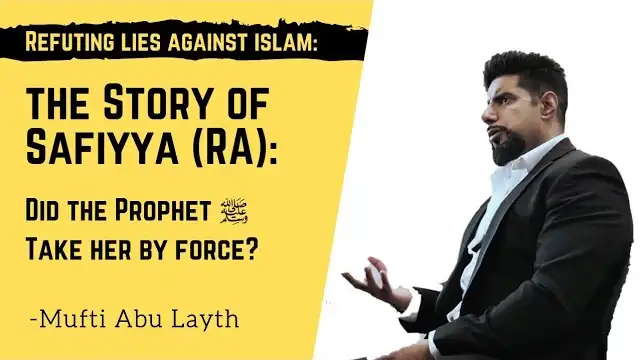 Play from 27:21
The video loads from YouTube only when you press play. Click a time in the transcript to seek.
Watch this part
Open on YouTube at 27:21The player starts at 27:21, the beginning of this part.
This segment27:21 to 29:57 · 2 min 36 sGeneral teaching
What this part covers
machinesummary, machine-writtenBecause others were abusing her, the Prophet freed her and had her ride with him, laying out a cloth and offering his knee for her to mount, and covering her with his cloak when the camel fell. Mufti Abu Layth says this was kindness, not a marriage.
In more detail
Mufti Abu Layth says the Prophet rebuked those who abused Safiyya and, when some wanted to hold her as a captive, freed her; he did not marry her. Because of the animosity shown to her he told her to ride with him, which Mufti says was common in that society, citing the hadith in which the Prophet, passing Asma bint Abi Bakr walking with a load, offered to take her on his camel and she declined. The hadith records that he laid out a cloth on the camel for her and bowed his knee so that she could step on it and climb up, which Mufti presents as the Prophet's akhlaq towards a Jewish woman being mocked after a battle. On the way back the camel stumbled and both fell, the Prophet hurting himself slightly, and he took his cloak and covered her with it. He repeats that none of this was marriage.
Position stated
Mufti Abu Layth holds that at Khaybar the Prophet freed Safiyya rather than marrying her, and that his having her ride with him, laying a cloth and offering his knee, and covering her with his cloak when the camel fell were acts of kindness to a woman being abused, not a marriage.
“some people held her as a captive they'd wanted to hold her as a captive the Prophet freed her he did not marry her he freed her”
Category: historical claim
Kind: general teachingTranscript
machine27:21 to 29:57 · click a time to seek · dotted terms open the glossary
says because I had this dream now obviously a lot is going on because there's a whole battle everything has settled things like this people make disparaging comments about her people say oh yeah who the yahoodi a jewish woman this that and the Prophet tells them off he tells them off this is in a sardine he tells them off some people held her as a captive they'd wanted to hold her as a captive the Prophet freed her he did not marry her he freed her now
because people were showing animosity towards her the Prophet said to her right with me now this is I noted today some Muslims go kind of like you know they talk what they have like a taqwa attack and stuff like this but there's several other hadith where the Prophet has gone on his camel and he's gone past Asma the daughter of a worker seen her walking carrying any said listen why didn't you get on the camel with me come with me and she says no I don't want these kind of things were common that societies were about us man so the Prophet says to her that listen you ride
with me and it mentions in the hadith that you have wheeler the bar after he got a cloth and laid it out on the camel for her to sit and he mentions he kind of bowed his knee the Prophet this is in Asahi Adid the Prophet bowed his knee and she stepped on his knee and climbed onto this camel when people are being so rude to her this was the alakh of the Prophet towards he did not marry her he did not he freed
her told them off from abusing her said to her listen why don't you ride with me because they were abusing her because she was obviously a Jew Jewish person she and they obviously just had this huge battle and himself lowest for her to step on his on his knee and climb onto this camel when in the southeast when they're coming back they have an incident where the camel falls over and the prophet hurts himself as well and so well documented in I mean not severely but he hurts and she falls off and what
does the Prophet do and remember this is her in this kind of devastated State the Prophet gets his cloak and puts it round her and covers her this is in the hadith it did not marry her now they come back to Medina look at the way the alakh that the Prophet had demonstrated towards her she would have been naturally somebody in her head that the prophet has not approached anis is assuming because she's riding with the of the Prophet and
Paragraphs overlapping 27:21 to 29:57. Full text on the recording page.
Cite this segment
Stable id, transcript version and tier are part of the citation. Every change to a transcript is logged.Mufti Abu Layth Archive, segment 2018-02-21b-S07, auto-transcribed, may contain errors. https://muftiabulayth.org/r/dper6y4mgwa/s/7/ (accessed 1 November 2026)
- APA 7
Mufti Abu Layth. (2018, February 21). Why did Safiyya ride with the Prophet on the way back from Khaybar? [Video, segment 2018-02-21b-S07, auto-transcribed, may contain errors]. Mufti Abu Layth Archive. Retrieved November 1, 2026, from https://muftiabulayth.org/r/dper6y4mgwa/s/7/
- Chicago author-date
Mufti Abu Layth. 2018. "Why did Safiyya ride with the Prophet on the way back from Khaybar?" Video, segment 2018-02-21b-S07, auto-transcribed, may contain errors. Mufti Abu Layth Archive. Recorded February 21, 2018. Accessed November 1, 2026. https://muftiabulayth.org/r/dper6y4mgwa/s/7/
- BibTeX
@misc{abulayth-2018-02-21b-S07,
  author = {Mufti Abu Layth},
  title = {{Why did Safiyya ride with the Prophet on the way back from Khaybar?}},
  year = {2018},
  month = {2},
  date = {2018-02-21},
  howpublished = {\url{https://muftiabulayth.org/r/dper6y4mgwa/s/7/}},
  url = {https://muftiabulayth.org/r/dper6y4mgwa/s/7/},
  organization = {Mufti Abu Layth Archive},
  urldate = {2026-11-01},
  note = {Segment 2018-02-21b-S07, auto-transcribed, may contain errors}
}
Something wrong here?
Tell us what is wrong and it will be checked against the recording. Nothing changes until a person has reviewed it.
Sending a note needs JavaScript, which is off or unavailable in this browser. Nothing has been sent.
No name, email address or account is asked for or stored, and the inbox does not store your IP address. For rate limiting it keeps an unreadable fingerprint of your connection for 48 hours, and our database provider's own logs record connections as every website's do. Only your note, its kind, the page and the moment in the recording are kept, for review.