
Recordings › The Story of Safiyya: the Prophet's Jewish wife -Mufti Abu Layth al-Maliki · 21 Feb 2018 › Segment 2 of 11
Who was Safiyya and why did the Muslims march on Khaybar?
muftis mecca makka mekka madina al-madinah madeenah yathrib ummah umma ummat in sha allah insha'allah in shaa allah insha allah inshaa allah salam as-salamu alaykum assalamu alaikum assalamualaikum salaam salaams salam alaykum wa alaykum as-salam greetingBackground to Khaybar: Banu Nadir, Huyayy ibn Akhtab, the coalition against Madinah and the fortresses
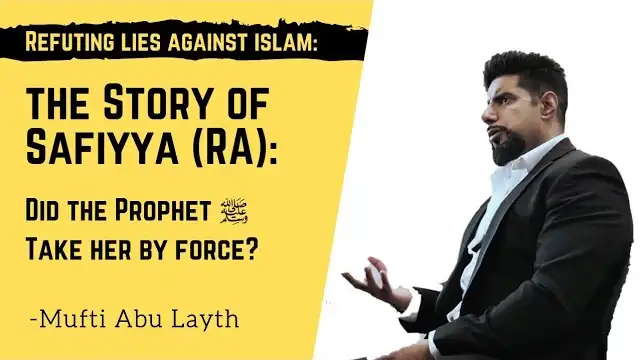 Play from 5:12
The video loads from YouTube only when you press play. Click a time in the transcript to seek.
Watch this part
Open on YouTube at 5:12The player starts at 5:12, the beginning of this part.
This segment5:12 to 9:06 · 3 min 54 sGeneral teaching
What this part covers
machinesummary, machine-writtenSafiyya was the daughter of Huyayy ibn Akhtab, a chief of Banu Nadir at Khaybar who had organised the coalition against Madinah, while her uncle was a Muslim. After Hudaybiyya the Prophet marched on Khaybar's fortresses, which fell after weeks of fighting in which about eighty Muslims died.
In more detail
Mufti Abu Layth gives the background: Safiyya was a Jewish woman of Banu Nadir living in Khaybar, whose father Huyayy ibn Akhtab was a chief and one of the most hostile men to the Prophet, while her uncle Abu Yasir [?] had embraced Islam early, lived among them and pleaded with them about Islam. He says nothing in Islamic history is concrete and there is disagreement on everything, including the date of Khaybar: the popular view is 7 AH, Malik said 6 AH. It came after Hudaybiyya, because the Jews of Khaybar, with Quraysh, had been behind the coalition at the Trench that meant to wipe out Madinah and had drawn Banu Qurayza into it, so the Muslim community had been under constant threat from Khaybar. Once the treaty with Makkah gave some security, the Prophet marched on Khaybar with some 1,400 to 1,600 men, by one view only those who had been at Hudaybiyya. The Arabs were not used to fighting fortresses, and Khaybar had eight, taken one at a time over several weeks; the Muslims won, with around eighty killed, among them Mahmud, the brother of the companion Muhammad ibn Maslama, killed by Safiyya's father or husband, with Muhammad ibn Maslama arguably the one who retaliated.
- Some terms in this segment are uncertain
Position stated
Mufti Abu Layth says that nothing in Islamic history is concrete and that there is disagreement on everything, including whether Khaybar took place in 6 or 7 AH.
“let's get one point clear nothing is concrete in Islamic history this this difference is on everything”
Category: method
Kind: general teachingTranscript
machine5:12 to 9:06 · click a time to seek · dotted terms open the glossary
you some background she she was a Jewish woman from a tribe of from bunny na Beebe that lived in a place called Faber and her father was one of the chief people right so his name is her gay even after her yeah even after and he had met the Prophet before on a few occasions he was one of the most kind of vile people against the Prophet what's interesting is his brother Abu Yasser embraced Islam very early on and still lived with them
in Kleber and Abu Yasser embraced Islam and he actually would often plead with them and about Islam you know stop misrepresenting Islam and stuff like this now the battle of Kleber takes place there's some disagreement like as they always is this nothing listen to one point let's get one point clear nothing is concrete in Islamic history this this difference is on everything so this some days this disagreement on when the Battle of Labor took place let's go with a mainstream a popular view of it
was in 73 the seventh a jury some say in my Malik said it was in sixth a jury but either way seven hit early now it happens after hudaibiya because these were the huge fronts that were threatening the realization in Medina so when you had the Battle of Azov and stuff like this people who got all these tribes the coalition against to kind of demolish and wipe out everybody you know man woman and child in Medina but they failed the key people behind this were like the croatian makkah and they were these people from hey ba ba nee na b if
na ba nee na beard had also family in Banu Qurayza and and so they had got Bonnie her either onto it so bonnie Caray they were to attack when the trenches and that's a whole different topic you can listen to that another time or do your research on it so the whole Muslim civilization had been under threat by these keep hours now in the Battle of hood they are not the battle but in the treaty of hudaibiya the Prophet had a treaty with the people in Makkah that they would have a peace treaty so once he had a bit of security from them because of the constant threat from Haber he did go to Haber and they
very some people say it was only the people popularly they say it was only the people of hudaibiya that went to Haber they go to this place to for battle now there was something like 1,400 people some Muslims some say there were 1500 1600 there around that kind of amount now hey bird was in fortresses now the Arabs never normally had fortresses so they weren't used to how to battle with fortresses so these people had fortresses and they had eight key fortresses five spaced out then three separate behind and these were I'm just giving you a little picture and
this is where the battle kind of takes place it's one full press at a time now anyway moving fast forwarding on to this point the battle the Muslims eventually win the battle it's it's a very typically difficult kind of thing it lasts several weeks eventually the Muslims do win it several Muslims are killed I think all over 80 Muslims get killed during this battle amongst them there's a famous companion Mohammed didn't Muslim and his brother motive Muslim eyes killed by Sophia's father or by Sophia's husband and
there's a difference of opinion and arguably he is the person who retaliates but at the end of this amongst the peeps a fear leaves with the Muslims and girls now I want us to pause here okay right I want to now tell you what the the narrative that is being pushed around is and then what the truth is okay so let's I gave you the background and inshallah in the future maybe I will do a detailed video on this but right now for us to have an understanding so this is now the narrative that is being
Paragraphs overlapping 5:12 to 9:06. Full text on the recording page.
Cite this segment
Stable id, transcript version and tier are part of the citation. Every change to a transcript is logged.Mufti Abu Layth Archive, segment 2018-02-21b-S02, auto-transcribed, may contain errors. https://muftiabulayth.org/r/dper6y4mgwa/s/2/ (accessed 1 November 2026)
- APA 7
Mufti Abu Layth. (2018, February 21). Who was Safiyya and why did the Muslims march on Khaybar? [Video, segment 2018-02-21b-S02, auto-transcribed, may contain errors]. Mufti Abu Layth Archive. Retrieved November 1, 2026, from https://muftiabulayth.org/r/dper6y4mgwa/s/2/
- Chicago author-date
Mufti Abu Layth. 2018. "Who was Safiyya and why did the Muslims march on Khaybar?" Video, segment 2018-02-21b-S02, auto-transcribed, may contain errors. Mufti Abu Layth Archive. Recorded February 21, 2018. Accessed November 1, 2026. https://muftiabulayth.org/r/dper6y4mgwa/s/2/
- BibTeX
@misc{abulayth-2018-02-21b-S02,
  author = {Mufti Abu Layth},
  title = {{Who was Safiyya and why did the Muslims march on Khaybar?}},
  year = {2018},
  month = {2},
  date = {2018-02-21},
  howpublished = {\url{https://muftiabulayth.org/r/dper6y4mgwa/s/2/}},
  url = {https://muftiabulayth.org/r/dper6y4mgwa/s/2/},
  organization = {Mufti Abu Layth Archive},
  urldate = {2026-11-01},
  note = {Segment 2018-02-21b-S02, auto-transcribed, may contain errors}
}
Something wrong here?
Tell us what is wrong and it will be checked against the recording. Nothing changes until a person has reviewed it.
Sending a note needs JavaScript, which is off or unavailable in this browser. Nothing has been sent.
No name, email address or account is asked for or stored, and the inbox does not store your IP address. For rate limiting it keeps an unreadable fingerprint of your connection for 48 hours, and our database provider's own logs record connections as every website's do. Only your note, its kind, the page and the moment in the recording are kept, for review.