
Recordings › A Reply to Sheikh Yasir Qadhi - Mufti Abu Layth · 20 Oct 2018 › Segment 8 of 15
Why does the Quran call Jesus the Word of God and speak of the Holy Spirit?
muftis koran quraan al-quran sura soorah suwar soora chapter ayah aya ayat ayaat aayah aayat wahy wahi wahee ummah umma ummat as-salamu alaykum assalamu alaikum assalamualaikum salaam salaams salam alaykum wa alaykum as-salam peace greetingThe rhetoric about Jesus in the Quran: the Word of God and the Holy Spirit
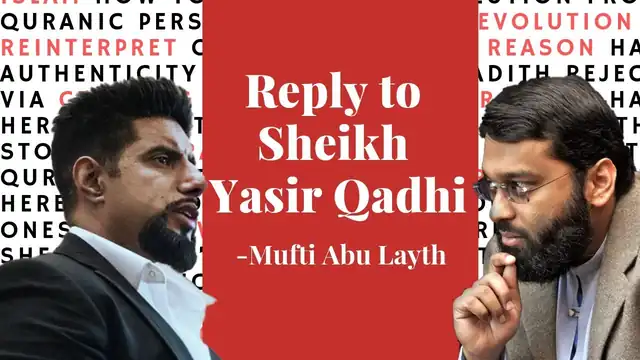 Play from 43:11
The video loads from YouTube only when you press play. Click a time in the transcript to seek.
Watch this part
Open on YouTube at 43:11The player starts at 43:11, the beginning of this part.
This segment43:11 to 49:47 · 6 min 36 sGeneral teaching
What this part covers
machinesummary, machine-writtenThe Quran applies to Jesus terms it uses of no other prophet, the Word of God and the Holy Spirit, which Muslims do not read literally. Mufti Abu Layth suggests this Christian rhetoric may have been meant to build bridges with Christians.
In more detail
Turning to the birth of Jesus, Mufti Abu Layth says the Quran's language about Jesus is styled in ways no Muslim believes literally. Jesus is called the Word of God, in the glad tidings to Mary in Al Imran and in al-Nisa where the Messiah is called the messenger of Allah and his word cast to Mary and a spirit from him, language he compares to the opening of the Gospel of John; he says that if the word of God is uncreated this would make Jesus uncreated, and that the reply that Jesus is so called because he had no father fails because Adam had no father and is not called the word of God. He lists the three places where Jesus is helped with the Holy Spirit, in 2:87, 2:253 and in al-Ma'idah, and says the term is used of no other prophet except once of revelation. He suggests this Christian rhetoric may have been used to build bridges with the Christian community and bring them closer to Islam. Checking a reference suggested to him, 58:22, he says it speaks of a spirit from Him, not the Holy Spirit, which people identify with Jibril. He concludes that the rhetoric around Jesus is different from that around other prophets and begins to turn to the virgin birth.
- Some terms in this segment are uncertain
Position stated
Mufti Abu Layth says the Quran applies to Jesus terms such as the Word of God and the Holy Spirit that it uses for no other prophet and that Muslims do not take literally, and suggests this Christian rhetoric may have been meant to build bridges with the Christian community.
“Christian rhetoric that is used in the Quran perhaps in a sense of building bridges between the Muslim and Christian communities”
Category: teaching
Kind: general teachingTranscript
machine43:11 to 49:47 · click a time to seek · dotted terms open the glossary
were saying that that the table didn't actually get sent down now you can believe that the table got sent down that's up to you people can believe that it didn't get sent down that's up to them but no way in the Quran does he actually say that it got sent so what I'm trying to say is to force your interpretation onto something and then to call other people deviance is unacceptable he then went on to say about the birth of Jesus and this is something that people are deviants for
challenging now regarding Jesus ali ali salam in the quran we know the language surrounding Jesus in the Quran is quite interesting ok because it's styled in ways that no Muslim beliefs about Jesus so for example Jesus is referred to on more than one occasion in the Quran as the Word of God now that doesn't resonate with Muslims we don't believe in Jesus to be the Word of God
that's a Christian thing get in the Quran so for example in Ali Imran verse 43 Allah says when giving glad tidings to Mary that they hear that she received glad tidings we kill him at a min who but of the word coming from God is smoo al maseeh hi Sapna Maryam the Messiah Jesus the Son of Mary that will be his name this the word this is the word of God in another verse in Surat Annisa 170 in the Messiah I said no Maryam rasool allah wa kelly that jesus is the messenger of god and
his word which he sent down or threw down on to Mary and the Spirit of God what I mean once again what are these these words no Muslim really believes this about Jesus if you want to accept literal nobody believes that another see this is very like like in the Gospel of John that in the beginning there was you know in the beginning there was the word and the word was with god and the word was god and as muslims if you believe that the word of god is uncreated then by
that you ought to it follows almost ties into Jesus being uncreated because he is the word of God now Muslims will say oh but by the Word of God here we just mean he was a miracle no but that word of God isn't used for any other prophet and you could say yeah because he didn't have a dad yeah but then you argue that Adam didn't have a dad and you don't refer to either as the Kalamata law is the Word of God so what is going on why and then the word the holy spirit is used with no other prophet I mean it's used once as
revelation coming down with the Holy Spirit but otherwise it's used on three occasions just with Jesus and so you have for example Allah says in Surat al-baqarah verse 87 ye Adnan Bey help others and we assisted we gave him a help with the holy spirit this was to Jesus in surah bakra verse 253 while our teen is a memory man bayonetta we gave him the clear signs what a Vietnam be Rohilkhand us and we as helped him with the holy spirit in surah maidah verse 1 1 5 Allah says if call Allah yeah i said
'no maryam and when god said oh jesus the son of mary booth corneum a ti-liger remember my blessings upon you and your mother what is the take it yet took a bear or help others when I helped you with the Holy Spirit once again what is this holy spirit this isn't mentioned with any other prophet generally you don't get any of this so there's a lot of rhetoric being used when it comes to Jesus that was generally the kind of Christian rhetoric that is used in the Quran perhaps in a sense of building bridges between the Muslim and Christian
communities and to maybe a find an ally in them and be maybe for many of them to convert and come closer find themselves in greater proximity to Islam and they by embrace the message right right generally a they say is 58:22 what is
that let's see let's see 58 sort of ok oh right no I've passed it sorry one moment I wish they would number in this myself I haven't got it numbered you see
right okay what verse did you say 58 22 21 22 that's I didn't know it doesn't say it doesn't say see this is my point it doesn't say in any verse of the Quran right I I mean see it says we help them with a spirit from him not with the Holy Spirit we're raw hello cutters row hello cutters is the Holy Spirit not Roy Roy
just means spirit holy spirit which people will say is gibreel now that only comes generally comes wants to do with revelation that we sent them revelation with the Holy Spirit other than that with the only prophet that it is mentioned it is just ASA now my point of mentioning this is that the rhetoric with Jesus is is different so now when it comes to the virgin birth first of all it's a different topic that even in the Bible right now with the exception of the Gospel of Luke and
Paragraphs overlapping 43:11 to 49:47. Full text on the recording page.
Cite this segment
Stable id, transcript version and tier are part of the citation. Every change to a transcript is logged.Mufti Abu Layth Archive, segment 2018-10-20-S08, auto-transcribed, may contain errors. https://muftiabulayth.org/r/7cylt19gx5k/s/8/ (accessed 1 November 2026)
- APA 7
Mufti Abu Layth. (2018, October 20). Why does the Quran call Jesus the Word of God and speak of the Holy Spirit? [Video, segment 2018-10-20-S08, auto-transcribed, may contain errors]. Mufti Abu Layth Archive. Retrieved November 1, 2026, from https://muftiabulayth.org/r/7cylt19gx5k/s/8/
- Chicago author-date
Mufti Abu Layth. 2018. "Why does the Quran call Jesus the Word of God and speak of the Holy Spirit?" Video, segment 2018-10-20-S08, auto-transcribed, may contain errors. Mufti Abu Layth Archive. Recorded October 20, 2018. Accessed November 1, 2026. https://muftiabulayth.org/r/7cylt19gx5k/s/8/
- BibTeX
@misc{abulayth-2018-10-20-S08,
  author = {Mufti Abu Layth},
  title = {{Why does the Quran call Jesus the Word of God and speak of the Holy Spirit?}},
  year = {2018},
  month = {10},
  date = {2018-10-20},
  howpublished = {\url{https://muftiabulayth.org/r/7cylt19gx5k/s/8/}},
  url = {https://muftiabulayth.org/r/7cylt19gx5k/s/8/},
  organization = {Mufti Abu Layth Archive},
  urldate = {2026-11-01},
  note = {Segment 2018-10-20-S08, auto-transcribed, may contain errors}
}
Something wrong here?
Tell us what is wrong and it will be checked against the recording. Nothing changes until a person has reviewed it.
Sending a note needs JavaScript, which is off or unavailable in this browser. Nothing has been sent.
No name, email address or account is asked for or stored, and the inbox does not store your IP address. For rate limiting it keeps an unreadable fingerprint of your connection for 48 hours, and our database provider's own logs record connections as every website's do. Only your note, its kind, the page and the moment in the recording are kept, for review.