
Recordings › Intoxicants: Imam Abu Hanifa vs the rest | Mufti Abu Layth · 5 Mar 2021 › Segment 1 of 2
What counts as khamr, and is a drink with very little alcohol haram?
madhab mazhab school of law madhahib mazahib madhaahib malik ibn anas malik bin anas imam maalik imam malik ibn anas imaam prayer leader maaliki malikite malikiyyah maliki school hanafite hanafiyyah hanafi school fatwah fatawa fatwaa fataawa legal opinion muftis hukm ahkam hukum hukam ahkaam haraam forbidden koran quraan al-quran ulama ulema ulamaaWhat counts as khamr: Abu Hanifa's ruling on weak drinks and the embarrassment of later Hanafis
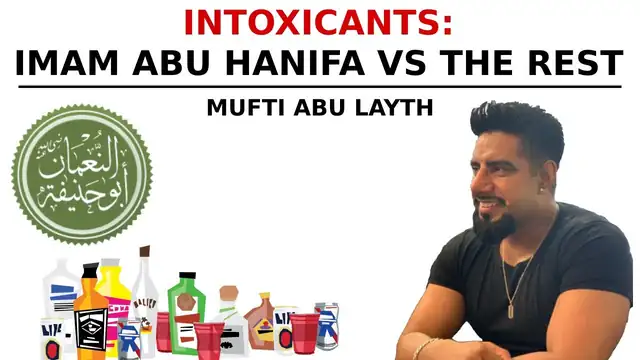 Play from 0:00
The video loads from YouTube only when you press play. Click a time in the transcript to seek.
Watch the answer
Open on YouTube at 0:00The player starts at 0:00, where the answer begins.
This segment0:00 to 3:59 · 3 min 59 sGeneral teaching
The answer in brief
machinesummary, machine-writtenIn the Quran khamr is wine; other drinks are haram if they intoxicate similarly, but a drink so weak that normal consumption does not intoxicate is not haram. This was Abu Hanifa's ruling, for which the Hanafi school was attacked for centuries until later Hanafis grew embarrassed by it.
In more detail
Mufti Abu Layth repeats a question about what an intoxicant is and how far it must cloud the intellect to be khamr. He says that in the Quran khamr is wine, and that one may call other things khamr metaphorically, but in Quranic terminology the word meant wine, just as wine has its own name alongside whiskies and beers. Other drinks made from honey or fruit were also haram if they were clearly of a similar intoxicating nature, but drinks with so weak an alcohol content, one or two percent, that an average consumption would not intoxicate were not haram. He says this was the Hanafi method that Abu Hanifa defended, that scholars for two or three centuries afterwards attacked the Hanafi madhhab over it, and that the Hanafis eventually became so embarrassed that they distanced themselves from the ruling and discussed it less. He adds that scholars often become embarrassed by rulings the imams stood up for, but that the imams were not standing up for alcohol or deviant practices; they were standing for the principle of truth even when it was bitter and blurred the line between black and white, and Abu Hanifa put his neck on the line for that.
Question as read aloud · questioner not identifiedWhat is an intoxicant, and how much does it have to cover the intellect to be khamr?
- The question was reconstructed from Mufti Abu Layth's restatement; the questioner's own words are not in the recording
Position stated
Mufti Abu Layth says that in Quranic usage khamr is wine, that other drinks are haram when they intoxicate in a similar way, and that drinks with alcohol so weak that an average consumption does not intoxicate are not haram, which is the ruling Abu Hanifa defended.
“of that drink would not intoxicate you then in that case they were not haram so if it was a small percentage um you know one two percent”
Category: ruling
Kind: general teachingTranscript
machine0:00 to 3:59 · click a time to seek · dotted terms open the glossary
you said what is an intoxicant and how much does it have to cover the intellect to be hammer well you see in the quran hammer is wine now the question is is other than wine also hammer now so what i would say is if you're metaphorically speaking then fine but in essence hammer was just wine a lot the way you have the name wine and you'll have other things whether they'll be scotches or you know whiskeys or beers and things
like that now you will they have their own names now in in the quranic terminology hammer was just wine other drinks that came about other kind of beers that were around so they were being made out of honey being made out of fruits being made out of things like this they would also be haram if they were clearly of a similar nature in intoxication if they were certainly had some forms of the chemical alcohol in there that were very weak
that an average consumption of that drink would not intoxicate you then in that case they were not haram so if it was a small percentage um you know one two percent these kind of things they wouldn't actually be intoxicating with an average consumption so that's the um that's the kind of uh ruling behind it and that's what the hanafi method uh imam abu hanifah he stuck up for initially and then his mother after him was crucified
for defending so they were heavily heavily the scholars for perhaps two or three centuries after him just slated and rinsed and attacked the hanafi matheb on this topic and it went to the extent that the hanafia eventually became so embarrassed of this ruling that they distanced themselves from me so they kind of uh started to um pretend that it's not really what they stick by or or they start to discuss it less so and and you and they become embarrassed
and this happens in in on many occasions in fear you'll find scholars will get embarrassed of certain rulings that the imams may have stood up for and it doesn't mean you see you have to understand something here when these imams stood up for these rulings it's not that they were standing up for alcohol or deviant practices they were standing up for the principle of truth even if it was embittering and that was their point that was imam abu hanifa's point that
i absolutely understand this is gonna upset you i absolutely get the fact that this is gonna destroy the borders and margins between black and white but such is the truth he felt so he stood for it and you know he put his neck out on the line uh defending that principle so it's not about don't think oh why do these imams you know oh were they into this themselves it doesn't mean that sometimes you stand up for something out of principle that look it's not as easy to declare this haram
okay it's like when imam malik spoke out about uh you know his fatwa on sexual matters that nothing sexual is haram obviously between a couple so and with the issue of anal sex at hand so later maliki became embarrassed it's like
Paragraphs overlapping 0:00 to 3:59. Full text on the recording page.
Cite this segment
Stable id, transcript version and tier are part of the citation. Every change to a transcript is logged.Mufti Abu Layth Archive, segment 2021-03-05-S01, auto-transcribed, may contain errors. https://muftiabulayth.org/r/3rpugpmwep0/s/1/ (accessed 1 November 2026)
- APA 7
Mufti Abu Layth. (2021, March 5). What counts as khamr, and is a drink with very little alcohol haram? [Video, segment 2021-03-05-S01, auto-transcribed, may contain errors]. Mufti Abu Layth Archive. Retrieved November 1, 2026, from https://muftiabulayth.org/r/3rpugpmwep0/s/1/
- Chicago author-date
Mufti Abu Layth. 2021. "What counts as khamr, and is a drink with very little alcohol haram?" Video, segment 2021-03-05-S01, auto-transcribed, may contain errors. Mufti Abu Layth Archive. Recorded March 5, 2021. Accessed November 1, 2026. https://muftiabulayth.org/r/3rpugpmwep0/s/1/
- BibTeX
@misc{abulayth-2021-03-05-S01,
  author = {Mufti Abu Layth},
  title = {{What counts as khamr, and is a drink with very little alcohol haram?}},
  year = {2021},
  month = {3},
  date = {2021-03-05},
  howpublished = {\url{https://muftiabulayth.org/r/3rpugpmwep0/s/1/}},
  url = {https://muftiabulayth.org/r/3rpugpmwep0/s/1/},
  organization = {Mufti Abu Layth Archive},
  urldate = {2026-11-01},
  note = {Segment 2021-03-05-S01, auto-transcribed, may contain errors}
}
Something wrong here?
Tell us what is wrong and it will be checked against the recording. Nothing changes until a person has reviewed it.
Sending a note needs JavaScript, which is off or unavailable in this browser. Nothing has been sent.
No name, email address or account is asked for or stored, and the inbox does not store your IP address. For rate limiting it keeps an unreadable fingerprint of your connection for 48 hours, and our database provider's own logs record connections as every website's do. Only your note, its kind, the page and the moment in the recording are kept, for review.