
Recordings › Age of Aisha (ra)- Mufti Abu Layth · 11 Jan 2017 › Segment 13 of 18
If ethics change over time, how can today's ethics judge the Prophet's marriage?
salat salaah namaz prayer salaat namaaz as-salah al-salah salawat shafi'i shafei shafiite shafi'i school muftis nikah nikkah nikaah nikah nama nikahnamaEthics change with time, so how can today's ethics be the yardstick
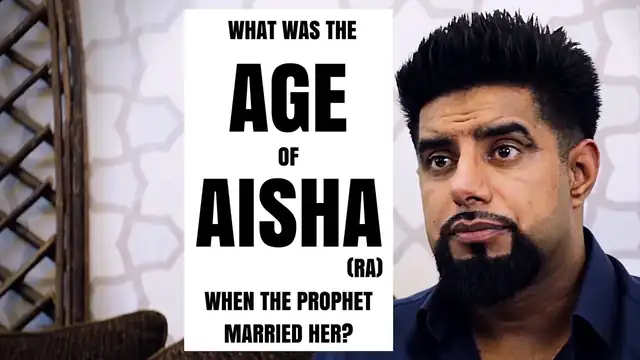 Play from 1:35:34
The video loads from YouTube only when you press play. Click a time in the transcript to seek.
Watch the answer
Open on YouTube at 1:35:34The player starts at 1:35:34, where the answer begins.
This segment1:35:34 to 1:38:13 · 2 min 39 sGeneral teaching
The answer in brief
machinesummary, machine-writtenBase ethics such as the wrongness of harm do not change, and the issue is consent, which a minor cannot give. Mufti Abu Layth does not believe people will ever come to accept otherwise.
In more detail
Mufti Abu Layth agrees that ethics develop and that twenty-first-century ethics differ from those of earlier centuries, but says he does not believe people will ever come to accept this marriage, because humans work towards benefit and the prevention of harm and universally accept that harm is bad, differing only on the details. He says the issue rests on consent: a minor cannot reason and so cannot consent, which makes the act harm and assault. He says today's society, in this part of the world, gives men, women, the elderly, the disabled, children, animals and the environment more rights than at any time in history, and that if humanity ever moved towards eliminating consent he would not advocate it and would hold them wrong.
Question as read aloud · questioner not identifiedEthics change with time, so how can today's ethics be a yardstick; what if in fifty years people come to accept this?
Position stated
Mufti Abu Layth holds that the question turns on consent, which a minor cannot give, and says he does not believe people will ever come to accept such a marriage, since the prevention of harm is a universal ethical base.
“this issue rests upon the concept of consent and how can there be consent from a girl who is a minor and since she can't reason”
Category: teaching
Kind: general teachingTranscript
machine1:35:34 to 1:38:13 · click a time to seek · dotted terms open the glossary
with the sanctification of certain books like bukari and then some people start to exaggerate in this sanctification especially of that movement people like the absolutist uh the Shafi School in general and Other M Salah and other people start to say well this is absolutely certain anything that is in this in this book it is conclusive and then to the extent that other people become influenced that they they almost forget that there was a time that this was not the mainstream kind of view and so on so I I think you are right that this has become common but
that is as a byproduct of certain phenomena phenomena that had occurred I don't believe that this was always the view you are right that the ethics of a society of a civilization do continue to develop and we definitely 21st century ethics seems very different um from even 20th century ethics let alone 19th 18th century ethics so that is true um the question if we're understanding this well look you're you're saying this today because it doesn't sound right and
it doesn't fit in but what if 50 years from today people change and they start saying this is okay firstly I do not believe that that will happen in that sense ever because human beings are working towards the betterment and the preservation of uh of benefits to humans and the prevention of harm so I feel at an as an underlay we all universally do accept certain uh kind of like like base ethics
like we accept that harm is bad and we accept that the prevention of harm is good now yes societies dis disagree on the permutations that these things have and the details but we accept this Universal base as human beings so this issue rests upon the concept of consent and how can there be consent from a girl who is a minor and since she can't reason so the opposite of that is then
harm and assault so you're saying well sexual assault so I do not agree that human Societies or generally especially human civilization as we see it today because we are in an age today whether people accept wholeheartedly or don't but we especially in this part of the world we are in a society where human beings men women uh the elderly disabled children animals the environment all have more rights than they have ever had preserved throughout human
history so we are in an that is undeniable I'm not saying it's perfect I'm not saying it's it's wholesome I'm saying but it is more uh positive and more preserved the rights for all of these things for people for the sick for the disabled for uh you know for all sorts for minorities for animals for pets for the environment for plants for trees then has ever occurred on a societal level throughout human history so if you're telling me well okay human beings seem to be working towards a trajectory now this trajectory will work towards okay eliminating
Paragraphs overlapping 1:35:34 to 1:38:13. Full text on the recording page.
Cite this segment
Stable id, transcript version and tier are part of the citation. Every change to a transcript is logged.Mufti Abu Layth Archive, segment 2017-01-11-S13, auto-transcribed, may contain errors. https://muftiabulayth.org/r/0ovisexs4ca/s/13/ (accessed 1 November 2026)
- APA 7
Mufti Abu Layth. (2017, January 11). If ethics change over time, how can today's ethics judge the Prophet's marriage? [Video, segment 2017-01-11-S13, auto-transcribed, may contain errors]. Mufti Abu Layth Archive. Retrieved November 1, 2026, from https://muftiabulayth.org/r/0ovisexs4ca/s/13/
- Chicago author-date
Mufti Abu Layth. 2017. "If ethics change over time, how can today's ethics judge the Prophet's marriage?" Video, segment 2017-01-11-S13, auto-transcribed, may contain errors. Mufti Abu Layth Archive. Recorded January 11, 2017. Accessed November 1, 2026. https://muftiabulayth.org/r/0ovisexs4ca/s/13/
- BibTeX
@misc{abulayth-2017-01-11-S13,
  author = {Mufti Abu Layth},
  title = {{If ethics change over time, how can today's ethics judge the Prophet's marriage?}},
  year = {2017},
  month = {1},
  date = {2017-01-11},
  howpublished = {\url{https://muftiabulayth.org/r/0ovisexs4ca/s/13/}},
  url = {https://muftiabulayth.org/r/0ovisexs4ca/s/13/},
  organization = {Mufti Abu Layth Archive},
  urldate = {2026-11-01},
  note = {Segment 2017-01-11-S13, auto-transcribed, may contain errors}
}
Something wrong here?
Tell us what is wrong and it will be checked against the recording. Nothing changes until a person has reviewed it.
Sending a note needs JavaScript, which is off or unavailable in this browser. Nothing has been sent.
No name, email address or account is asked for or stored, and the inbox does not store your IP address. For rate limiting it keeps an unreadable fingerprint of your connection for 48 hours, and our database provider's own logs record connections as every website's do. Only your note, its kind, the page and the moment in the recording are kept, for review.