
Recordings › In Depth: Sulaiman (a.s.), the Throne of Sheba, and Miracles in the Quran -Mufti Abu Layth · 8 Jan 2019 › Segment 5 of 9
What does the Quran say about kings in the story of Sheba?
muftis jahannam jahanam jahannum koran quraan al-quran ayah aya ayat ayaat aayah aayat'Kings ruin a town when they enter it': the verse and political philosophy
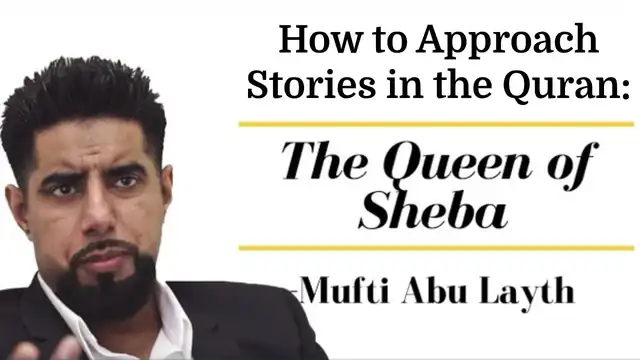 Play from 24:54
The video loads from YouTube only when you press play. Click a time in the transcript to seek.
Watch this part
Open on YouTube at 24:54The player starts at 24:54, the beginning of this part.
This segment24:54 to 27:28 · 2 min 34 sGeneral teaching
What this part covers
machinesummary, machine-writtenThe Queen's saying that kings ruin the towns they enter raises the question of what gives anyone the right to rule others.
In more detail
Mufti Abu Layth says Sulayman wrote to the Queen of Sheba, who consulted her people, and that they offered to fight. He says he always found her reply fascinating, that kings who enter a town ruin it and humble its people, because it opens a discussion of political philosophy: what gives one human being the right to rule another and where kingship came from. He says God, king and money have been the three things that set humanity on its journey of unification, and that one day some person assumed the right to subjugate others and it became a human legacy. He then turns to the Queen setting out with a delegation.
Position stated
Mufti Abu Layth says kingship began when some person one day assumed the right to subjugate others, and it became a human legacy.
“right to sub subjugate and you guys on my subjects some person just assumed that one day and it became a human legacy”
Category: historical claim
Kind: general teachingTranscript
machine24:54 to 27:28 · click a time to seek · dotted terms open the glossary
or you are telling ale you are from though the people who lie people who lie birds are not from people and then is a bird once again a bird knows how to lie he understands human concept as theory of mind it recognizes I'm deceiving somebody it recognizes these things right so it's problematic saying this is a bird nevertheless Solomon ELISA Lam writes to the Queen of Sheba he writes to her censor and then she kind of consults with her people saying what do you think and they say that you know we can fight
him or whatever you whatever you wish and it's interesting she mentioned scarlet Annelle maluca dada hello' kharitonov Sidhu ha Raja Allu eyes Italia as illa voca delicate value I always found this verse incredibly interesting that she says that look Kings whenever they come to a because she asks them what do you think we should do and they say Natalie Batson you know we are people of power and strength like bring it on let him come and she says that whenever it came she says whenever Kings enter a town all
they do is ruin it and spread corruption it's really fascinating because from this verse we can D like opens a separate tangential on a tangent a discussion on political philosophy that what gives human beings the right to rule over another human being we did this concept of kingship even come from who said that one person has the right to be a king who why how do we become where did that come from
why do we have to accept it that you know he's a human we're a human how does the inner maluca is that the hollow Coria tan off sir do you know Kings if they enter it town they only spread facade what could their liquor your final but yet this has been you know the three things that have set man on this journey of ultimate unification has been God king and money and you know and then the thing is that we did this even come from that one human one day felt I have the
right to sub subjugate and you guys on my subjects some person just assumed that one day and it became a human legacy I find that so fascinating the way this verse kind of touched sup on this notion and then it goes on about she kind of liaises with Solomon ELISA Lam and then she eventually she decides to kind of come to him bring a delegation and come to Suleiman Alesana now the interesting thing is then comes the verse Carla this is Solomon aleihsalaam yeah a you hell Mela hey you
come here teeny bit are she her cobbler Enya Tunis Muslim II that who will bring her throne to me before they reach us so they've set off from where they are they it's gonna take a good while before they come obviously back then so who can bring me the throne because hood hood had praised he said oath yet mean cool Alisha she's been given everything and after saying everything he said well haha he said god damn that throne that
Paragraphs overlapping 24:54 to 27:28. Full text on the recording page.
Cite this segment
Stable id, transcript version and tier are part of the citation. Every change to a transcript is logged.Mufti Abu Layth Archive, segment 2019-01-08-S05, auto-transcribed, may contain errors. https://muftiabulayth.org/r/zotvtgdumv8/s/5/ (accessed 1 November 2026)
- APA 7
Mufti Abu Layth. (2019, January 8). What does the Quran say about kings in the story of Sheba? [Video, segment 2019-01-08-S05, auto-transcribed, may contain errors]. Mufti Abu Layth Archive. Retrieved November 1, 2026, from https://muftiabulayth.org/r/zotvtgdumv8/s/5/
- Chicago author-date
Mufti Abu Layth. 2019. "What does the Quran say about kings in the story of Sheba?" Video, segment 2019-01-08-S05, auto-transcribed, may contain errors. Mufti Abu Layth Archive. Recorded January 8, 2019. Accessed November 1, 2026. https://muftiabulayth.org/r/zotvtgdumv8/s/5/
- BibTeX
@misc{abulayth-2019-01-08-S05,
  author = {Mufti Abu Layth},
  title = {{What does the Quran say about kings in the story of Sheba?}},
  year = {2019},
  month = {1},
  date = {2019-01-08},
  howpublished = {\url{https://muftiabulayth.org/r/zotvtgdumv8/s/5/}},
  url = {https://muftiabulayth.org/r/zotvtgdumv8/s/5/},
  organization = {Mufti Abu Layth Archive},
  urldate = {2026-11-01},
  note = {Segment 2019-01-08-S05, auto-transcribed, may contain errors}
}
Something wrong here?
Tell us what is wrong and it will be checked against the recording. Nothing changes until a person has reviewed it.
Sending a note needs JavaScript, which is off or unavailable in this browser. Nothing has been sent.
No name, email address or account is asked for or stored, and the inbox does not store your IP address. For rate limiting it keeps an unreadable fingerprint of your connection for 48 hours, and our database provider's own logs record connections as every website's do. Only your note, its kind, the page and the moment in the recording are kept, for review.