
Recordings › "God did NOT ask Abraham to sacrifice his son" | Mufti Abu Layth · 28 Oct 2020 › Segment 6 of 9
Why does the biblical tradition say God commanded Abraham to sacrifice his son?
udhiyah qurbani qurbaani udhiya udhiyya kurbani muftis koran quraan al-quran ulama ulema ulamaa ibadah ibada ibaadah ibadatWhy the Jewish tradition accepted it: Yahweh the war god and the baggage a name carries
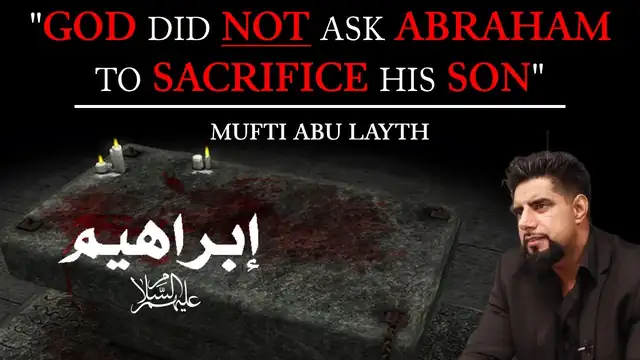 Play from 17:12
The video loads from YouTube only when you press play. Click a time in the transcript to seek.
Watch this part
Open on YouTube at 17:12The player starts at 17:12, the beginning of this part.
This segment17:12 to 21:09 · 3 min 57 sGeneral teaching
What this part covers
machinesummary, machine-writtenMufti Abu Layth says the Israelites adopted the name Yahweh, a Near Eastern war god from the household of El, and that god's brutal character carried over into their picture of God, making such a command plausible to them. For Muslims, he says, that is not the true image of Allah.
In more detail
After repeating that such a command does not fit a God of majesty, Mufti Abu Layth asks why the Jewish people went this way. He says that when the Israelites came to worship one God the name they chose was Yahweh, which he says was already the name of a god in the Middle East: El was another name, and Yahweh belonged to El's household of gods as the god of war, with a consort. He says he does not object to borrowing a name as such, since words evolve, but that it carries baggage, and illustrates with the Vikings: had they become monotheists and called God Odin, part of Odin's warlike character would have spilled into the new narrative. So the brutal, vengeful, exterminating character of the war god carried over into Israelite monotheism, and for them it made sense that Yahweh could ask this of Abraham. For Muslims, he says, Yahweh is not Allah and this is not the true image of God, and to say God wanted a man to slit his son's throat for his pleasure is never acceptable, though he understands that many Muslims believe it because they were raised on Judaeo-Christian stories.
Position stated
Mufti Abu Layth holds that the Israelite picture of God inherited the brutal character of the war god Yahweh, which made a command to sacrifice a son plausible to them, and that this is not the true image of Allah.
“so yahweh is not allah he's not god and allah keeps reminding us he is so this is not the true image of god”
Category: teaching
Kind: general teachingTranscript
machine17:12 to 21:09 · click a time to seek · dotted terms open the glossary
gets a kick out of saying to a father who just about had a son like you know what go kill your son for me slit his throat because why because it's gonna make me happy that you do it and then don't do it kill that sheep instead that is utterly absurd that does not sound like a god of you know of this great majesty of the the wonder of the creator of the cosmos that doesn't sound like that that kind
of a god now the jewish people why did they go now you've got to understand something people jewish people the israelites when they came to worshipping one god the name they chose for god was yahweh you have to understand that yahweh was already a god that existed in the middle east yahweh is not the name of god by the way people don't many people may not know this yahweh is from the house of el el is also another name that jewish people call god now l was another god that existed and he had a household of
gods he had like his children and so on now in his household was yahweh yahweh was the god of war now he has a consult by the way yahweh does but what happens is the israelites choose this term for god and they refer to yahweh now the ultimate god as yahweh now i'm not saying that's necessarily um i'm not saying that is a problem per se i feel that people can do that it's not you know words are developed like that they do kind of evolve over time the issue is
when you do that you will carry over some baggage like let me give you an example imagine the vikings who have this god of war odin now imagine they become monotheists and they start to refer to god the ultimate god as odin now what would happen is naturally the the character of odin that they previously knew as odin will spill over in some aspects in this new narrative it will have to because when they speak of
odin odin even if they block out the bulk of it five percent will see pover at least this war element now yahweh is this treacherous not treacherous but this brutal character of uh that existed in the middle east of this god of war that is vengeful that is he's about killing he's about exterminating he's about making sure you know those that oppose him destroying them he's this comes over into their monotheism so when they speak of abraham to them it makes sense that yahweh could have said this
you see but to us it isn't that isn't the case right so yahweh is not allah he's not god and allah keeps reminding us he is so this is not the true image of god and to say that god wanted god wanted a man to kill his son his own son slices you know to slit his throat in front of him just because it will give god a kick like he will get happy out of it uh it's it's this is you know subhanahu wa
yo as allah says in the quran now this is it's never acceptable honestly and i understand that many muslims do believe that because they've just been brought up with the judeo-christian stories and they're just going with it and they're not really thinking about it you know it's like many of those believe it's like when i grew up with it i didn't really think about it i just accepted it and it's only upon introspective kind of analysis that a person thinks that wait a minute this doesn't actually make sense uh and what's interesting the scholars of the past too i have scholars you know sometimes you got
Paragraphs overlapping 17:12 to 21:09. Full text on the recording page.
Cite this segment
Stable id, transcript version and tier are part of the citation. Every change to a transcript is logged.Mufti Abu Layth Archive, segment 2020-10-28-S06, auto-transcribed, may contain errors. https://muftiabulayth.org/r/yruc09ajkeq/s/6/ (accessed 1 November 2026)
- APA 7
Mufti Abu Layth. (2020, October 28). Why does the biblical tradition say God commanded Abraham to sacrifice his son? [Video, segment 2020-10-28-S06, auto-transcribed, may contain errors]. Mufti Abu Layth Archive. Retrieved November 1, 2026, from https://muftiabulayth.org/r/yruc09ajkeq/s/6/
- Chicago author-date
Mufti Abu Layth. 2020. "Why does the biblical tradition say God commanded Abraham to sacrifice his son?" Video, segment 2020-10-28-S06, auto-transcribed, may contain errors. Mufti Abu Layth Archive. Recorded October 28, 2020. Accessed November 1, 2026. https://muftiabulayth.org/r/yruc09ajkeq/s/6/
- BibTeX
@misc{abulayth-2020-10-28-S06,
  author = {Mufti Abu Layth},
  title = {{Why does the biblical tradition say God commanded Abraham to sacrifice his son?}},
  year = {2020},
  month = {10},
  date = {2020-10-28},
  howpublished = {\url{https://muftiabulayth.org/r/yruc09ajkeq/s/6/}},
  url = {https://muftiabulayth.org/r/yruc09ajkeq/s/6/},
  organization = {Mufti Abu Layth Archive},
  urldate = {2026-11-01},
  note = {Segment 2020-10-28-S06, auto-transcribed, may contain errors}
}
Something wrong here?
Tell us what is wrong and it will be checked against the recording. Nothing changes until a person has reviewed it.
Sending a note needs JavaScript, which is off or unavailable in this browser. Nothing has been sent.
No name, email address or account is asked for or stored, and the inbox does not store your IP address. For rate limiting it keeps an unreadable fingerprint of your connection for 48 hours, and our database provider's own logs record connections as every website's do. Only your note, its kind, the page and the moment in the recording are kept, for review.