
Recordings › "God did NOT ask Abraham to sacrifice his son" | Mufti Abu Layth · 28 Oct 2020 › Segment 2 of 9
Where did the idea of sacrificing a son come from in Ibrahim's time?
udhiyah qurbani qurbaani udhiya udhiyya kurbani muftis ayah aya ayat ayaat aayah aayatHuman sacrifice as a widespread practice of the ancient Near East: Moloch, Baal and Jephthah
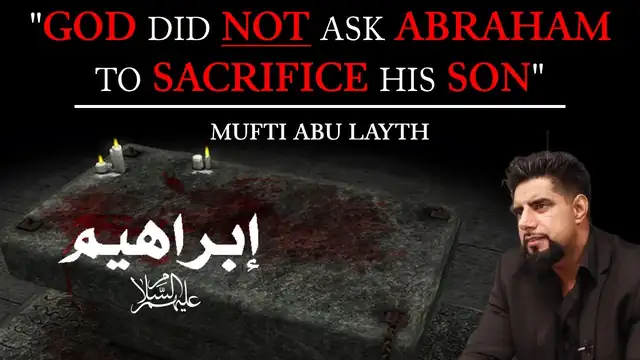 Play from 3:58
The video loads from YouTube only when you press play. Click a time in the transcript to seek.
Watch this part
Open on YouTube at 3:58The player starts at 3:58, the beginning of this part.
This segment3:58 to 7:55 · 3 min 57 sGeneral teaching
What this part covers
machinesummary, machine-writtenHuman sacrifice to gods such as Moloch and Baal was a widespread practice of the ancient Near East, and the Bible's story of Jephthah sacrificing his daughter shows it. Mufti Abu Layth says this surrounding culture explains how such a dream could come to Ibrahim.
In more detail
Mufti Abu Layth shows a paper and an essay on human sacrifice to make the point that it was a widespread practice across Canaan and ancient Mesopotamia and carried on for centuries, with offerings made to particular gods. He mentions Moloch, whose name he says shares a root with the Arabic malik, and Baal as gods to whom sacrifices were ritually made. He turns to the Bible, which he says records other such incidents, and retells the story of Jephthah, who vows that if granted victory he will sacrifice the first person he sees on his return, and then sacrifices his own daughter when she runs out to meet him; he thinks the account is in Judges and says Jeremiah also mentions sacrifice. He concludes that these practices, including the sacrifice of the firstborn, give the context of Ibrahim's time: living within such a culture, even one not his own, can play on the subconscious and manifest in dreams, which is how he explains Ibrahim's dream.
- Some terms in this segment are uncertain
Position stated
Mufti Abu Layth holds that Ibrahim's dream of sacrificing his son is explained by the surrounding Near Eastern culture of human sacrifice working on the subconscious, not by a command from God.
“it's like if you're part of a culture you even if it's not your original culture but you see that this is what people do and sometimes it can play on your mind”
Category: teaching
Kind: general teachingTranscript
machine3:58 to 7:55 · click a time to seek · dotted terms open the glossary
unique like all of a sudden it's just ibrahim one day has this understanding you will see that the near east uh the middle east the whole that region of canaan that region of what would have been ancient mesopotamia all of these places would have had as a widespread practice they would have had human sacrifices so now you will see and this was just a paper as an example i've uh and you've got a another one
here this was an uh an essay done on the whole thing now the reason i'd just like to share with you some of these things is for you to understand that this was a a widespread practice and it carried right on right throughout the centuries that people would make offerings to particular gods i mean this is uh moloch which is actually similar shares the similar roots with the arabic
malek or milk king as well molk which comes from there as well now you would have sacrifices were ritually made to certain gods including molok including baal who is one of the gods that you will see sacrifices were made traditionally to these gods and i'm sharing this just so you get an idea and you can see even in the bible it speaks of uh other incidents as well you've got jephthah you've got orgepta who sacrifices his
daughter that's just like one of the absolute uh craziest seriously craziest notions so those of you that are not familiar with it what you had was uh you have this incident where jeff has gone out on a military campaign and he prays that if god grants him victory he will sacrifice the first person that he sees on his return [Laughter]
don't ask that person just you make all the executive decisions so jephthah says i will sacrifice the first person i see and lo and behold as he's victorious and returning home in the bible i uh it mentions i believe it's is it in um right uh right i think that might actually be in judges but uh but there it's also another sacrifice is mentioned jeremiah as well but along comes his daughter running to see her father because the father is victorious he's returned from war so lo and behold people what does the father do
he sacrifices the daughter ah your intelligence intelligence huh so these things that you can see were were practices that used to happen now it's important to know this because this will give you the kind of context to what is going on in that day and age so the in that whole surrounding that the in that region of canaan in ancient mesopotamia prior to that they had these sacrifices where people would often sacrifice
the firstborn so it's when ibrahim alaihissalam is there he's aware of this in the culture it's like if you're part of a culture you even if it's not your original culture but you see that this is what people do and sometimes it can play on your mind on the subconscious and therefore manifest in your dreams so ibrahim al-islam has this dream now in the dream he sees that he is sacrificing his son so so let's now go back to the verse
Paragraphs overlapping 3:58 to 7:55. Full text on the recording page.
Cite this segment
Stable id, transcript version and tier are part of the citation. Every change to a transcript is logged.Mufti Abu Layth Archive, segment 2020-10-28-S02, auto-transcribed, may contain errors. https://muftiabulayth.org/r/yruc09ajkeq/s/2/ (accessed 1 November 2026)
- APA 7
Mufti Abu Layth. (2020, October 28). Where did the idea of sacrificing a son come from in Ibrahim's time? [Video, segment 2020-10-28-S02, auto-transcribed, may contain errors]. Mufti Abu Layth Archive. Retrieved November 1, 2026, from https://muftiabulayth.org/r/yruc09ajkeq/s/2/
- Chicago author-date
Mufti Abu Layth. 2020. "Where did the idea of sacrificing a son come from in Ibrahim's time?" Video, segment 2020-10-28-S02, auto-transcribed, may contain errors. Mufti Abu Layth Archive. Recorded October 28, 2020. Accessed November 1, 2026. https://muftiabulayth.org/r/yruc09ajkeq/s/2/
- BibTeX
@misc{abulayth-2020-10-28-S02,
  author = {Mufti Abu Layth},
  title = {{Where did the idea of sacrificing a son come from in Ibrahim's time?}},
  year = {2020},
  month = {10},
  date = {2020-10-28},
  howpublished = {\url{https://muftiabulayth.org/r/yruc09ajkeq/s/2/}},
  url = {https://muftiabulayth.org/r/yruc09ajkeq/s/2/},
  organization = {Mufti Abu Layth Archive},
  urldate = {2026-11-01},
  note = {Segment 2020-10-28-S02, auto-transcribed, may contain errors}
}
Something wrong here?
Tell us what is wrong and it will be checked against the recording. Nothing changes until a person has reviewed it.
Sending a note needs JavaScript, which is off or unavailable in this browser. Nothing has been sent.
No name, email address or account is asked for or stored, and the inbox does not store your IP address. For rate limiting it keeps an unreadable fingerprint of your connection for 48 hours, and our database provider's own logs record connections as every website's do. Only your note, its kind, the page and the moment in the recording are kept, for review.