
Recordings › Ponderings on the Holy Quran
The Prophet Noah (a.s.) Did Not Live for 950 Years -Mufti Abu Layth
muftis sunna sunnat sunan prophetic practice koran quraan al-quran sura soorah surat suwar soora chapter ayah aya ayat ayaat aayah aayat as-salamu alaykum assalamu alaikum assalamualaikum salaams salam alaykum wa alaykum as-salam peace greetingvideo · 12:16 · 47,000 views · 11 Aug 2018 · 3 segments · Open on YouTube
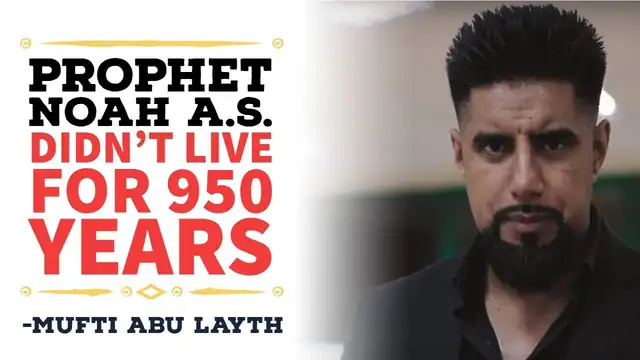 Press play to load from YouTube. Nothing loads until you do.
3 segments
machine3Each block is a segment in time order. Click to open it.All segments · in time order
Transcript
machineauto-transcribed, may contain errors · source: youtube auto · click a time to seek · dotted terms open the glossarytip Nora ELISA Lam live for nine hundred and fifty years no he did not huh you going against the Quran you Cathy hold your horses people hold your horses brace yourselves brace yourself brace yourselves no Ali Salaam did not live for a thousand years like what people think but if you look at this verse of the Quran okay you're gonna have two people
brace yourselves for this okay now Allah mentions about no Holly Salaam philosophy o me he that he stayed like he was amongst his people that he was what is it it mentioned what is the Alpha 17 unless I'm seen Hartmann isn't it so yeah so he stayed in he amongst his people a thousand years except 50
years now what's interesting interesting here is why did Allah use different words to refer to the word year so those of you that speak Arabic and I'm sure this some here that why did Allah say so why did Allah say yes so that's that's that's correct you Marcelino hand Aleppo me he so let me just bring this
up don't wanna miss read it right so we've got this here yeah well Akkad R Selna no honey laughs told me he that we sent no ELISA Lam to his people fella Peterffy him al fascinating Allah from cinnamon ha ha - wahoo Molly moon right now this for example in surah ANCA boots now you've got here that Allah says we sent North to his people and you remained amongst them for Lobby 13 alpha Senate in right so 1000
Sena Allah from Cena Armin except 50 armed now Sunnah means here and Armenia in our week why did Allah use two different words to refer to ya why did he use two different words right why not say Senna Senna um so one obvious one kind of thing you have is where people say people say that well oh this is just for language rhetoric to
make it sound good so it has a flow so you know Allah doesn't want to repeat the same word point point point that's that point you gotta be fair it's a point but then tell me people could not a larger say 950 years what's so difficult about Allah saying you know that this army is in our home see that there is you know that they was all if you want to use um um you know so now just want to say 950 years why say a
thousand years al fascinated alarm see now except 50 years right now this is so some people have argued that there is a linguistic difference between sauna and okay what I'm going to now I want to highlight that difference and say that look this was not just mentioned as a coincidence it was much greater than what people took it to be so people thought oh this is just a las just using a style like he doesn't want to say you know alpha Sena in LA from Cena sauna so he just changed
the word that's low-level thought I'm gonna take us to high-level thinking okay recently okay we have and this is recently there's been great discoveries archaeological findings people of the great kingdoms that existed that were the antediluvian kingdoms the kingdoms which existed pre-flood time especially around what would be modern-day let's say the Middle East Iraq like the kingdom of Sumar kingdom of are like
these kind of on what later on went on to become places like Mesopotamia and all these but much before all of that before Babylon before these you had the Sumerian the kingdom of Sumer so we're dating back thousands of years and then after them they will split different kind of civilizations so they're the kind of people who came up with things like discovered the wheel and discovered or created the wheel and even split of time into 60 like let's say 60 60 minutes within an hour and all this kind of stuff now a lot of the archaeological findings have been recently found and they've
actually one thing that the Sumerian civilization and other civilizations did was they documented certain things extensively and they had this thing called like cuneiform where they would write they had their kind of very early way of writing which was a bit like hieroglyphics a bit like that and they would put that into like into this kind of clay and then hardening as stone so it will just turn into kind of stone so this is why these kind of tablets have been well preserved and what what they wrote these things on
these cuneiform kind of legacy that we find so in there they've got a lot of the rules of the kings so and you can find this on google you can go to like for example the Sumerian Kings and their rule how long did they rule so it's really interesting when you start reading the rule they will say well such-and-such these three kings ruled for 300 and whatever sixty thousand years and you think what and they'll say and this King ruled for twenty thousand
years and this King ruled for and they and they seem to count like ridiculous figures now at first yes so this is before Gilgamesh by the way this is before Gilgamesh Gilgamesh comes a bit later on now the interesting thing is that these people first at first people thought this was exaggeration then they realized actually they're going by a particular system they're not actually just randomly making things up they had a particular system some people felt that they they they've kind of done their own calculations you can google it
but they felt that maybe they timed everything by 60 and hence they had this kind of obsession ain't the right word but this kind of miss strong affinity with 60 hence they divided the hour into 60 minutes and things like this a lot of these things were divided into 64 a four degrees and stuff like this now some sometimes may be in the hundreds they times multiplied numbers when they counted so they would say well such-and-such a king ruled for this time and this King came and this King came and they had excessive numbers and then
you see the numbers start to change these are antediluvian which means before the flood and then post diluvian you start to see the numbers are still huge but they become massively shorter in the hundreds so you start to see that world mmm the system seems to have changed and this is what I believe that people in the old testament some of the Jews had inherited in their time when they were in Babylon and these other kingdoms maybe they never fully understood them but they kind of locked them in the Old Testament as such and such person being around for 800 years or 600 years this
is what it may have been so when Allah is referring to nor alaysalam he's used is referring to something that of his time the Alpha sonatine is going by the time that they were using except - of 50 years which would be our time 50 years so there is great divine wisdom in Allah mentioning the distinction between the two words and this is not new so you would see when Allah refers to so for example when Elijah referring to Yusuf
Ali Salam and the King calls him Allah does not refer to the king as a farrell because in their time the federal thing hadn't been set up yet even though later there was the great especially in that part of Egypt and there was a great pharaoh dynasty and people knew the Egyptian kings as pharaohs but in Yusuf Ali salams time he was not they were not pharaohs yet they were just Kings so Allah addresses them by the reality although when Allah speaks of Moses he addresses him as Pharaoh another interesting thing when you look
at a Brahimi Ali Salam Ibrahim Ali Salam even according to biblical sources changes at a certain point in his life he goes back and you know between his travels of Quran and I'm traveling at a certain point he actually changes his name and this is part of his transformation of ibrahim al islam but you know t but you notice that in like for example surah Baqarah all the way when Ibrahim the word has been written it is omitted it's not actually written as with the yah Ibrahim although people still pronounce
it read it like that but it's not written like that it actually has no yeah whereas in all the other places in the Quran when Ibrahim is written it has the yeah now that's an interesting discussion that well why is it regime being written differently is this something to do with when he changed his name because even according to biblical narrations he changes a variation of his name during his life as part of his transformation what I'm trying to say is that when allah addresses certain narratives in the quran at times he reflects the reality which they were
upon and that may not make sense to you at this point and hence with time you see like these discoveries of the Sumerian civilization are not so so long ago they weren't discovered in the time of the early arabs for example and many civilization did not know these are quite quite relatively recent so and with time the quran unfolds its majesty with new meanings you see like this is what i mean like this is an amazing kind of feature really for people and and some people you know they may not welcome this kind of a look towards the
quran but to me this is much more grounded okay so
Something wrong here?
Tell us what is wrong and it will be checked against the recording. Nothing changes until a person has reviewed it.
Sending a note needs JavaScript, which is off or unavailable in this browser. Nothing has been sent.
No name, email address or account is asked for or stored, and the inbox does not store your IP address. For rate limiting it keeps an unreadable fingerprint of your connection for 48 hours, and our database provider's own logs record connections as every website's do. Only your note, its kind, the page and the moment in the recording are kept, for review.
Cite this recording
Stable id, transcript version and tier are part of the citation. Every change to a transcript is logged.Mufti Abu Layth Archive, auto-transcribed, may contain errors. https://muftiabulayth.org/r/wpqa8rxai-u/ (accessed 1 November 2026)
- APA 7
Mufti Abu Layth. (2018, August 11). The Prophet Noah (a.s.) Did Not Live for 950 Years -Mufti Abu Layth [Video, auto-transcribed, may contain errors]. Mufti Abu Layth Archive. Retrieved November 1, 2026, from https://muftiabulayth.org/r/wpqa8rxai-u/
- Chicago author-date
Mufti Abu Layth. 2018. "The Prophet Noah (a.s.) Did Not Live for 950 Years -Mufti Abu Layth." Video, auto-transcribed, may contain errors. Mufti Abu Layth Archive. Recorded August 11, 2018. Accessed November 1, 2026. https://muftiabulayth.org/r/wpqa8rxai-u/
- BibTeX
@misc{abulayth-Wpqa8rxaI-U,
  author = {Mufti Abu Layth},
  title = {{The Prophet Noah (a.s.)  Did Not Live for 950 Years -Mufti Abu Layth}},
  year = {2018},
  month = {8},
  date = {2018-08-11},
  howpublished = {\url{https://muftiabulayth.org/r/wpqa8rxai-u/}},
  url = {https://muftiabulayth.org/r/wpqa8rxai-u/},
  organization = {Mufti Abu Layth Archive},
  urldate = {2026-11-01},
  note = {Auto-transcribed, may contain errors}
}