
Recordings › Ponderings on the Holy Quran
Verse in Surah Al-Nur about the Hijab | Mufti Abu Layth
hadeeth ahadith ahaadeeth hadis hadees ahaadith malik ibn anas malik bin anas imam maalik imam malik ibn anas imaam imams prayer leader qiyas qiyaas muftis haraam forbidden fard farz faraid fard ayn fard kifayah fardh sunna sunnat sunan prophetic practice iman imaan eemaan eeman jahannam jahanam jahannum koran quraan al-quran sura soorah surat suwar soora chapter ayah aya ayat ayaat aayah aayat sahabah sahaba sahabi sahabiyyah sahabiyat salaf as-salaf salaf al-salih salaf us-salih al-salaf madinah medina madina al-madinah madeenah 'alim aalim ulama ulema ulamaa hijaab hejab hijabi barakah barakat barkat baraqah blessing al-din ad-deen ad-dinvideo · 18:43 · 44,000 views · 3 Nov 2019 · 4 segments · Open on YouTube
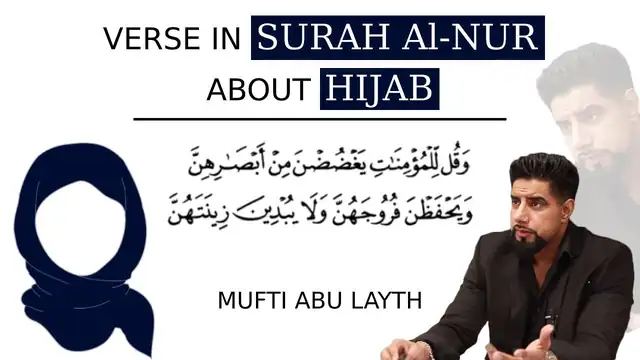 Press play to load from YouTube. Nothing loads until you do.
4 segments
machine4Each block is a segment in time order. Click to open it.All segments · in time order
Transcript
machineauto-transcribed, may contain errors · source: youtube auto · click a time to seek · dotted terms open the glossarysauron verse in surah 2 more on the subject of hijab speak more about covering the jape then covering the head see I have covered this previously ah pun intended huh covered hijab you see that not going into too much detail but I have done this in the past I've covered it in much detail and I will again to some extent in the future but hijab if you're going to just look at the Quran and this one now you will not
find anything on resi because this first of all the term head hey job in and of itself is a modern term okay hey job meant a barrier so in the Quran when the term hijab is used it doesn't mean the head covering which we today are calling hijab people for most of Islamic history never would have known that that you meant hey jab by that so if you could time travel a few hundred years in the past and you said to some scholar about the hijab I mean unless they could just gather by the context what you're saying
that word does not mean the head covering the head covering is called the hem are in Arabic this is a recent modern term so the twentieth century probably so it's very recent call referring to the head covering as the HR that said is there anything in the Quran and Sunnah that clearly speaks about the head covering the truth is there isn't there's nothing explicit in the or are nor in the Sun neither speaks about the
head covering so you have got right so there is nothing explicit in the Quran asana you've got the verse in or in surah noor which speaks about covering the j the bosoms the kind of chest area for women because the jab meant a kind of the slit so it was because that's we which is then also used for pocket because a was in
essence a kind of slit you slit and then you create a pocket so similarly so the dress was kind of created with a large cutout here so you could kind of and then that would you could see a considerable amount of cleavage so the Orang speaks about covering the bosom the covering the chest area and it mentions the term use your the homer muhammara hina so the women a lot of the arab women did used to where he marked
so the way they would presumably is a towel from to use this towel i've got a towel here today so presumably women would cover it like this so they would do that kind of like wrap it like that so this was about bringing this over and covering the the kind of chest area with it so just ruin
my head right so this so the point was about bringing this round what was just kind of just hanging at the back there now the question is that was because allah says you know fully that for Yathrib nabi home arena now let them kind of use their Hummer and cover the bosoms does this mean that having a Hummer or having the Hummer or the Samar is singular Hummer is plural not to be confused with comma which
means alcohol otherwise that would be a totally different if you say huh should cover their bosoms in alcohol daddy who cannot what is going on like okay that's a complete misreading of the verse this is why Arabic more important so this so you have Homer Homer Homer not hammer right so the Homer is the Homer in and
of itself an obligation or is this just circumstantial saris circumstantial just circumstances as in I gave the example before imagine I was to say that let's just say as an analogy totally different not to do with a job let's just say as an example if we were going through a place and I said right people hide your jewelry you know this is me it's a it's a tricky let's just say there's a lot of thieves around and if I was to say right
guys anybody wearing expensive watches cover them with your sleeves right cover them with your sleeves would this mean so let's say now somebody gets hold of my statement 200 years from today or 500 years from today would they understand that I was saying it was it was necessary to have sleeves to we're always clothing with sleeves so you could cover the watches or could one equally take the watch off and put it in
their pocket right so what is so this in this analogy the kind of tools are clay here in how you're analyzing attacks are the same thing here that when a lie saying cover the bosom bosoms the homeowner what if is a law saying hey make sure you have home oh oh is he just saying cover this up what if you could cover in the future with different mechanisms not make sounds a bit high-tech t but different methods
like what if now you could use buttons and other things and I don't all get creative so that is an interesting discussion so really in the Quran was Sunnah they definitely isn't anything clear and established about covering the hey that's it and in the early generations of Islam I think it's not that there's definitely a culture in the early like amongst the Companions and early Islam where women generally walk home or and they would what is it they would even because the men would cover the hair as well because they lived in a
desert they would cover their face sometimes because of traveling in the sand and doing things like that so the question is that yes in early Islam there was this kind of cultural thing it was there it was definitely common I'm not sure everybody did it and you can see some debate into the time of the turban in an early the the battle turbine so people saying things like like Imam Malik that the woman doesn't have to always cover her head in front of certain people she could uncover it
it wasn't I'm like father-in-law son-in-law and also things like even certain servants that she could uncover in front of and which is interesting so you have this kind of it's not settled in stone yet but then within a generation it becomes the the law if you like so it becomes the teaching that all women must cover their hair and for about a thousand years it's been you know the culture so that's what I would say
so I hope that gives some explanation so I have been asked on a few occasions what do you say in this day and age they have have been certain scholars that have said look it's not it's not an obligation to cover the hair for women you've got people like a llama Java how many of you said that you've got a few other contemporary scholars who have said things like that and I feel that they have a valid position they do have a valid position I would say look each - they're wrong you know if these women
who cover the you know if we use the word hijab now because that's what people use who do this it's a part of their identity now I wouldn't say to them ever don't do that I would always say that's good that's a good thing because they you know it's part of who they are and there's some women who don't cover the head and they would feel I mean some who just ain't interested in the discussion and some who are but feel it's not an obligation I would say that that equally is a valid opinion as well so you know you know I don't feel it's like you're going to hell issue kind of
thing so that's my understanding on these things because there's nothing explicit in the Quran or in the explicit established Sunnah sorry and sighs so it must be sorry and it must be sorry there is nothing no hadith that you know non on that is sound soundly established that means they can't be heavily clear it can't be criticized and it must be clear so that's I hope that of some help I have had on several occasions people asking me and like I say look if it's something you're going to do sometimes
some somebody asked me recently saying oh look I'm going to start donning the hijab I will start wearing it what do you think I think fine that's great that's good you know if you're going to start doing it I won't say don't or you know something like that I feel that that's you know I'd welcome that but equally if a woman was not wearing hijab and by hijab I mean this head covering thing I would say that what is clearly established in the Quran is the concept of modesty and that's what seems to be emphasized explicitly by the Quran and Sunnah so if a woman
wasn't wearing the hijab I would feel that that opinion equally has validity so and these are people's personal journeys through the faith it's not for other people really to impose that on people you know and it's not really it's not really for for men to to say to women that you should be covering your hair when you go out and you should be too as in to force it I mean they could say well I believe you should be okay fine that's your opinion but to enforce that to kind of coerce people that would
in my understanding be categorically wrong category wrong and you'd be doing much greater harm in my understanding and I think sometimes that it's it's my fault it's it's got two angles to it there is the angle that sometimes these men are then under guilt because they feel that the religion says that she has to cover this because what happens is you have these other scholars who give these fatwas because I said this is I feel into five fold it's got to you know sides to it there is one side where people are just insecure men and that I
think personally I think it's it's their personal it's an embarrassing weakness but many people suffer from it they have you know many men are very insecure about about women especially women that they with that if you oh my god oh my god nobody oh my gosh woman guys looking at this woman oh my god oh no she's gonna run away oh no she's gonna have they have this thing where they treat like Oh Mike if a woman isn't fully covered up then she must it must just be
like full Baraka or it must just be prostitute oh bloody hell it's like either she's like absolutely wrapped up in I don't know in duct tape and in bubble wrap what's it called my robot Oliver is right she's either covered up in bubble wrap or she's from the horse of Babylon there's just two
different mcoms that's it right beekeeper suits yeah exactly so the this is ridiculous now so you do get a lot of people that are very insecure and so they they want the women to be covered up because they can't handle the woman out there as in they feel oh my god even if a man looks at you that means what the hell you know they feel inept and this is a weakness and a lacking within they don't feel like real men oh you know because it's
true they lack within so what they lack within they try to make without you know that so there's that and then what you have is some of these people get into positions of power these insecure people and they then guilt-trip other people so they say any guy whose wife is walking around without without her hair covered is a the youth and he's he's like a cuckold and he's you know it's Haram what he's doing is Haram and an
abomination and God's Lana is descending upon him and so you have this kind of cocktail of insecurity mixed with guilt riddled with guilt so some guys would probably feel really guilty thinking oh my god I'm being cursed by God so because of that they were right people watch your language please I don't know somebody responding to somebody else no
profanity only I exclusively hold the right to that on my own on my own live session right so the so people some guys feel if I don't tell my wife to wear this or my sister or my daughter or my whatever then I'm being cursed so that so they're doing this out of a kind of a religious burdensome guilt and that is sickening and the people who are burdening them with that are sick as
well all they're doing it out of this kind of insecurity so I feel both of these things are inaccurate and wrong and this is why you know this is the problem with some of this institutionalization it produces just hypocrisy oh it produces guilt and Islam never came to do any of these things you know your Deen I say this time and time again look your Deen your where this this theme of Islam as the Prophet said Adi know yourself this theme is one of ease this Deen should complement your lifestyle people
it should never impede it he should never kind of be tripping you up he should never be the thing holding you back should never be an obstacle in your path it should be the Nitro boost to you it should be something that betters you that propels you to achieve to to do things it should comfort you it should console you it should not be tripping you and making you burdened with this kind of weight of guilt and suffering it
should not cause you suffering so if it is doing that then you see that's not the kind of thing that's not my understanding of the D we would then disagree in our understandings because my dean the way I understand Islam it complements my life I don't see Islam as something burdensome I don't see Islam as something that will trip me up or slow me down and I am and I do unfortunately see that with a lot of other people that it does do that for them and I get that that's the interpretation but I think that interpretation isn't the one that the
Deen really came with so I hope that of of some help
Something wrong here?
Tell us what is wrong and it will be checked against the recording. Nothing changes until a person has reviewed it.
Sending a note needs JavaScript, which is off or unavailable in this browser. Nothing has been sent.
No name, email address or account is asked for or stored, and the inbox does not store your IP address. For rate limiting it keeps an unreadable fingerprint of your connection for 48 hours, and our database provider's own logs record connections as every website's do. Only your note, its kind, the page and the moment in the recording are kept, for review.
Cite this recording
Stable id, transcript version and tier are part of the citation. Every change to a transcript is logged.Mufti Abu Layth Archive, auto-transcribed, may contain errors. https://muftiabulayth.org/r/trr4o2jzizc/ (accessed 1 November 2026)
- APA 7
Mufti Abu Layth. (2019, November 3). Verse in Surah Al-Nur about the Hijab | Mufti Abu Layth [Video, auto-transcribed, may contain errors]. Mufti Abu Layth Archive. Retrieved November 1, 2026, from https://muftiabulayth.org/r/trr4o2jzizc/
- Chicago author-date
Mufti Abu Layth. 2019. "Verse in Surah Al-Nur about the Hijab | Mufti Abu Layth." Video, auto-transcribed, may contain errors. Mufti Abu Layth Archive. Recorded November 3, 2019. Accessed November 1, 2026. https://muftiabulayth.org/r/trr4o2jzizc/
- BibTeX
@misc{abulayth-TRR4o2JZIZc,
  author = {Mufti Abu Layth},
  title = {{Verse in Surah Al-Nur about the Hijab | Mufti Abu Layth}},
  year = {2019},
  month = {11},
  date = {2019-11-03},
  howpublished = {\url{https://muftiabulayth.org/r/trr4o2jzizc/}},
  url = {https://muftiabulayth.org/r/trr4o2jzizc/},
  organization = {Mufti Abu Layth Archive},
  urldate = {2026-11-01},
  note = {Auto-transcribed, may contain errors}
}