
Recordings › Arabization of Indo-Pak Islam | Mufti Abu Layth · 19 Dec 2019 › Segment 1 of 1
Why are Indo-Pak Muslims adopting Gulf Arab culture?
haj pilgrimage hadj muftis hifz hafidh haafiz hifdh huffaz hafiza memorisation khalifah khalifa caliph khulafa khilafah khilafat khilafa hijaab hejab hijabiThe Arabisation of Indo-Pak Islam and the import of Gulf culture
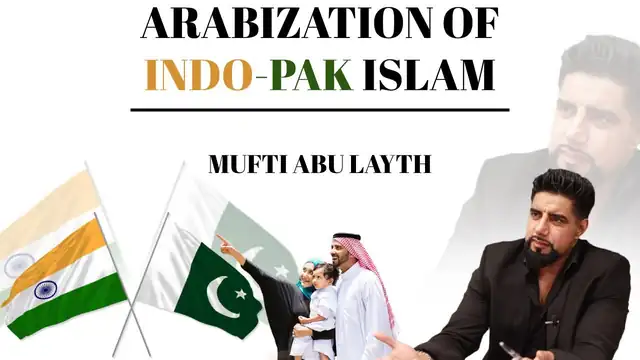 Play from 0:00
The video loads from YouTube only when you press play. Click a time in the transcript to seek.
Watch this part
Open on YouTube at 0:00The player starts at 0:00, the beginning of this part.
This segment0:00 to 5:34 · 5 min 34 sGeneral teaching
What this part covers
machinesummary, machine-writtenMufti Abu Layth dislikes the push to Arabise Indo-Pak Islam, from Gulf dress to saying Allah Hafiz, feeling it is political and that culture should be natural, not imposed.
In more detail
Mufti Abu Layth says there seems to be a new branding of Islam in the Indian subcontinent, an Arabisation of Indo-Pak Muslims, which he personally does not like. He notes that a few centuries ago India's economy rivalled a third of the globe and that the subcontinent's Muslims today roughly double the Muslims of all Arab states, and says they historically saw themselves as distinct, never part of the Umayyads, Abbasids or Ottomans; he doubts claims that the Mughals, such as Akbar, cared about the Ottomans. Mufti says Islam has been in the region since the first century, under al-Hajjaj with Muhammad ibn al-Qasim [?] reaching Sindh, and its culture was in harmony with those around it. He says a new push to say Muslims were never the same people as their Hindu neighbours breeds the fascism seen in the rise of the far right in India, and he objects to replacing Persian words with Arabic ones, Gulf-style black clothing and hijab, and refusing to say Khuda Hafiz in favour of Allah Hafiz. Mufti says there is nothing wrong with Allah Hafiz, but when people try to stamp such things he feels politics is at play, and things should be natural rather than imposed.
- Some terms in this segment are uncertain
Position stated
Mufti Abu Layth says he personally does not like the Arabisation of Indo-Pak Muslims, feeling that things should be natural and not imposed.
“I feel that there's a lot of politics at play that's all I personally don't like that kind I think that things should be natural you shouldn't try to impose things”
Category: teaching
Kind: general teachingTranscript
machine0:00 to 5:34 · click a time to seek · dotted terms open the glossary
have this and it's interesting that you see now this seems to be this new branding of Islam in the Indian subcontinent and I personally don't like if I'm gonna be honest I mean who cares what I like or don't like but this seems to be this new kind of this Arabization of the Indo Pak Muslims you see people you have to understand something a few
centuries ago only a few centuries ago India's overall economy was it kind of rivaled something like an entire third of the globe they were so wealthy now this is important because money always plays a significant role not only did they have a huge economy when you look at Muslim numbers so if we take a look at take the numbers today I mean you can read up the numbers historically Muslims in just the
Indian subcontinent right they themselves outnumber they they almost probably double almost the entire Muslims of all Arab nation states now that is something to just think about but that just in the Indian subcontinent than the Muslims they're the entire what is it 30 countries Arab countries the Indian Muslims are probably double that number in population now why why is that
why am I saying that you see I'm saying that because the Indian Muslim and by the Indian Muslim I mean the indo-pak Muslim today including Pakistan and let's say Bangladesh and maybe Sri Lanka and that the whole kind of Indian subcontinent these Muslims historically kind of saw themselves as slightly distinct they they kind of they were where they were they never considered themselves to be a part of the Abbasids or the Omegas or the Ottomans in that case and this is
all propaganda by the way that you know they people say that the Mughals used to rate the Ottomans that I really doubt it that the like people like you know Jalal Aldin Akbar and these people gave they couldn't care less about the Ottomans maybe at certain times there was they would have obviously been diplomacy you know like you say something kind to somebody else that always happens but in the real world they wouldn't care they were self-sufficient they weren't just self-sufficient they were like a very
incredibly wealthy Empire so yeah so and the purpose of me saying this I want to come back to this caliphate point as well but the purpose of me saying this is there was a culture that people saw as natural that Islam because Islam has been in the Indian subcontinent for arguably from the first century in some parts of it you know of the Prophet so from that time we're talking about under the you know the instructions of Hajj ad you've got Muhammad in a person who reaches sin so the point is that these
people have a culture which was a very naturalistic kind of like it was a very in sync in harmony with the other cultures around it but now there seems to be this push for like clear kind of us versus them separate to look Muslims obviously religiously they're separate from Hindus but they they are still in essence the same people but now there's this push to say that no they are you know we were never the same people to begin with it's not that our forefathers were Hindus who converted to Islam we
were never you guys in the first place and this is it's it breeds the kind of fascism that we have today like in the the rise in the far right in India so yeah and recently there's all this push to get rid of new Persian words and replace them with Arabic words and pure like kind of like the you know you know the golfer Islam importing a lot of Gulf Islam so like we mean you know whirring like let's say black kind of workers and and not only wearing black
but then changing the style of the hijab to the Gulf style of the hijab replacing words people refuse to say who the Hafiz anymore they want to just say Allah Hafiz and I know there's nothing wrong in saying that but the when people try and stamp these things I feel that there's a lot of politics at play that's all I personally don't like that kind I think that things should be natural you shouldn't try to impose things that's all
Paragraphs overlapping 0:00 to 5:34. Full text on the recording page.
Cite this segment
Stable id, transcript version and tier are part of the citation. Every change to a transcript is logged.Mufti Abu Layth Archive, segment 2019-12-19-S01, auto-transcribed, may contain errors. https://muftiabulayth.org/r/tinczqdqpgs/s/1/ (accessed 1 November 2026)
- APA 7
Mufti Abu Layth. (2019, December 19). Why are Indo-Pak Muslims adopting Gulf Arab culture? [Video, segment 2019-12-19-S01, auto-transcribed, may contain errors]. Mufti Abu Layth Archive. Retrieved November 1, 2026, from https://muftiabulayth.org/r/tinczqdqpgs/s/1/
- Chicago author-date
Mufti Abu Layth. 2019. "Why are Indo-Pak Muslims adopting Gulf Arab culture?" Video, segment 2019-12-19-S01, auto-transcribed, may contain errors. Mufti Abu Layth Archive. Recorded December 19, 2019. Accessed November 1, 2026. https://muftiabulayth.org/r/tinczqdqpgs/s/1/
- BibTeX
@misc{abulayth-2019-12-19-S01,
  author = {Mufti Abu Layth},
  title = {{Why are Indo-Pak Muslims adopting Gulf Arab culture?}},
  year = {2019},
  month = {12},
  date = {2019-12-19},
  howpublished = {\url{https://muftiabulayth.org/r/tinczqdqpgs/s/1/}},
  url = {https://muftiabulayth.org/r/tinczqdqpgs/s/1/},
  organization = {Mufti Abu Layth Archive},
  urldate = {2026-11-01},
  note = {Segment 2019-12-19-S01, auto-transcribed, may contain errors}
}
Something wrong here?
Tell us what is wrong and it will be checked against the recording. Nothing changes until a person has reviewed it.
Sending a note needs JavaScript, which is off or unavailable in this browser. Nothing has been sent.
No name, email address or account is asked for or stored, and the inbox does not store your IP address. For rate limiting it keeps an unreadable fingerprint of your connection for 48 hours, and our database provider's own logs record connections as every website's do. Only your note, its kind, the page and the moment in the recording are kept, for review.