
Recordings › Did the angels assist in the Battle of Badr? | Mufti Abu Layth · 31 Dec 2019 › Segment 2 of 2
Were the angels at Badr actually Persian knights?
muftis mecca makka mekka madinah madina al-madinah madeenah yathribA rare theory: Persian knights of the House of Karen at Badr
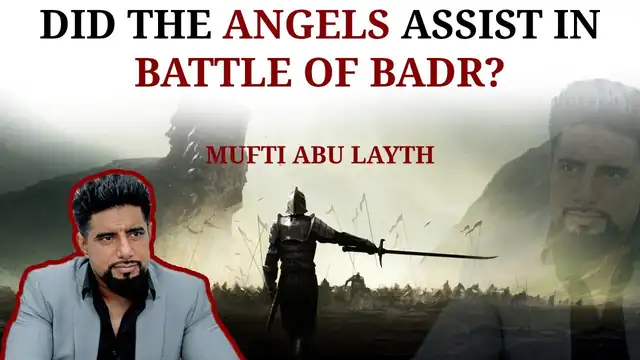 Play from 7:42
The video loads from YouTube only when you press play. Click a time in the transcript to seek.
Watch this part
Open on YouTube at 7:42The player starts at 7:42, the beginning of this part.
This segment7:42 to 15:06 · 7 min 24 sGeneral teaching
What this part covers
machinesummary, machine-writtenMufti Abu Layth finds the theory that Persian knights summoned by Salman al-Farisi were taken for angels at Badr interesting but most likely untrue, and harmless even if true.
In more detail
Mufti Abu Layth presents a rare interpretation he came across, while saying it is most likely untrue and that he has not looked into it deeply. Mufti relates that some historians of Persia have hypothesised that Salman al-Farisi, from a Zoroastrian priestly family, was originally sent by the Persian Empire to gather intelligence and mobilise the Arabs against the Byzantines, without claiming that his conversion was fake, and that he was close to the House of Karen, a Persian noble house that rivalled the Sasanians. They cite a story in which green-armoured, masked knights of the House of Karen rescued a famous Persian ruler against a Turkic army about two generations before Islam, and argue that Salman sent word for the same knights to help at Badr, after which they disappeared and the Muslims took them for angels. Mufti says this would need much exploration of the history, and that even if true it would not be problematic, since the believers, told of angelic help as a literary device, would simply have assumed this help to be it.
Position stated
Mufti Abu Layth says the theory that knights of the House of Karen helped at Badr is most likely not true, but that even if it were true it would not be problematic.
“make any sense I mean I'm not saying it's true I don't most likely wasn't true but I feel even if it was true it's not in any way problematic”
Category: historical claim
Kind: general teachingTranscript
machine7:42 to 15:06 · click a time to seek · dotted terms open the glossary
midst of the battle that's what it felt like to them that they felt that oh my god were people did I see something did I and they felt they saw these things so you know whether those things were actually happening but they felt it and that's fine so that's another into that's another interpretation now I did come across recently a rare interpretation now I'm not saying this interpretation carries any has to be has to carry any truth but it was an
interesting one and it was just intriguing I mean most likely it isn't true I don't believe it's true but I just found it interesting and I haven't looked into it so deeply but from what I came across you see some people have proposed that and and these are some kind of historians and non-muslims know and people who specialized in in kind of Persian history and things like this they have proposed and hypothesized that
Salman al-farsi rhodiola one who was a Persian and he'd come from a he had a very illustrious kind of history like somebody who initially was from the family of his rastering background and that too from a kind of priestly lineage and then he converts to Christianity and then he baked and then he becomes a very like a successful trader and then moves to Makkah now the interesting
thing is that a sorry - to Medina and embraces Islam now the interesting thing is that these people feel that Salman al-farsi was originally sent with a kind of military intelligence perspective from the Persian Empire and he because the Persian Empire had fallen into a bit of disarray as well and it was quite insecure and because he was from a family that were of highly priests they were close to this you know the the
kisses and the rulers and things like this so they feel that as a very intelligent person they nominated him and sent him to kind of gather intelligence and hopefully this is what this some of these historians have alleged that salman al-farsi was to mobilize these southern forces who were these bedouin and non bedouin but these Arabs who were neglected people because you had the you know you had the Byzantine and you had the Persian Sassanid dynasties and at the south you just had these Arabs who were neglected
negligible force so he was to mobilize them and use them to attack the Byzantines eventually in time to come this allegedly is was some kind of conspiracy that some people are I have argued that salman al-farsi was originally sent with and then he may have truly embraced Islam whether so they've not I mean from what I've heard they've not argued that whether his embracing of Islam was fake so they feel that maybe he truly embraced this
message but he always kept a and he was close to the house of Karen now sometimes just written in English as Karen like the the English name Karen like of a woman but here Karen was a mean it was a man not a woman in Farsi who were a particular that like a fiefdom they had like a like a miniature Kingdom if you like within the Persian Empire and they were rivals with the current sassanids but they were still Persian at the end of the day part of that kind of
heritage and now this historian argues that there was an incident when a new chauhan the famous leader of the persians is is facing a turkish kind of onslaught that from you know the torque the original from up north central asia and he's going to fight them and he stands there and they standoff and he's losing he's losing you know he doesn't seem to be able to hold his ground and then this army turns up that are not a part of his army but they come you know with this kind of green armored clad clad Adama
sorry and the horses have this green cladded kind of armor and they have the faces covered and they fight off the torque and save under sherwin under sure one is before Islam he's probably about two generations before Islam now you see he's a famous Persian one of the the epic kind of leaders so he then at the end of the battle once they've won allegedly gets these people and managed to kind of encircle them and he forces them to oh look to who they are and they are from the household or they they then reveal that we are from the household we
are Knights from the household of current of caring now these historians like George Ani Jason Jordanian others have then argued that they feel Salman al-farsi had sent message to the household of Kuran of Kareem who then sent those same Knights because this description is what he feels and some of the people I can feel the description of the household of the Knights of the household of caring so they came and helped the Muslims beat
the Battle of Badr and then they just disappeared so two Muslims it felt that maybe they were the Angels because they didn't expect anybody to be this so when they saw these things you know these horses in cladded armor and and the knights in green clad in armor and masks and they associated this with maybe an angelic help or because they were told there is angelic help as well they assumed that this was the angels that's an interesting kind of interpretation obviously it requires a lot of exploration into the history into
looking into these these armors sorry these armored Knights of the house of Karin and what role they really did play in history and how powerful they were I mean even if it is true it in no way is it's not worrying or anything like this it just even if it be true it simply just goes to show that okay that there was help but and some people because they were told there was angelic help as a literary device they assumed this help to have been the angelic one as an assumption because otherwise it didn't
make any sense I mean I'm not saying it's true I don't most likely wasn't true but I feel even if it was true it's not in any way problematic but I found it an interesting theory nonetheless I did find it interesting cool so I hope that's broadened some research horizons for some of you out there so what else is going on me think there
Paragraphs overlapping 7:42 to 15:06. Full text on the recording page.
Cite this segment
Stable id, transcript version and tier are part of the citation. Every change to a transcript is logged.Mufti Abu Layth Archive, segment 2019-12-31-S02, auto-transcribed, may contain errors. https://muftiabulayth.org/r/gxbzy_ph7bg/s/2/ (accessed 1 November 2026)
- APA 7
Mufti Abu Layth. (2019, December 31). Were the angels at Badr actually Persian knights? [Video, segment 2019-12-31-S02, auto-transcribed, may contain errors]. Mufti Abu Layth Archive. Retrieved November 1, 2026, from https://muftiabulayth.org/r/gxbzy_ph7bg/s/2/
- Chicago author-date
Mufti Abu Layth. 2019. "Were the angels at Badr actually Persian knights?" Video, segment 2019-12-31-S02, auto-transcribed, may contain errors. Mufti Abu Layth Archive. Recorded December 31, 2019. Accessed November 1, 2026. https://muftiabulayth.org/r/gxbzy_ph7bg/s/2/
- BibTeX
@misc{abulayth-2019-12-31-S02,
  author = {Mufti Abu Layth},
  title = {{Were the angels at Badr actually Persian knights?}},
  year = {2019},
  month = {12},
  date = {2019-12-31},
  howpublished = {\url{https://muftiabulayth.org/r/gxbzy_ph7bg/s/2/}},
  url = {https://muftiabulayth.org/r/gxbzy_ph7bg/s/2/},
  organization = {Mufti Abu Layth Archive},
  urldate = {2026-11-01},
  note = {Segment 2019-12-31-S02, auto-transcribed, may contain errors}
}
Something wrong here?
Tell us what is wrong and it will be checked against the recording. Nothing changes until a person has reviewed it.
Sending a note needs JavaScript, which is off or unavailable in this browser. Nothing has been sent.
No name, email address or account is asked for or stored, and the inbox does not store your IP address. For rate limiting it keeps an unreadable fingerprint of your connection for 48 hours, and our database provider's own logs record connections as every website's do. Only your note, its kind, the page and the moment in the recording are kept, for review.