
Recordings › Shaykh Omar Suleiman & the Yaqeen Institutes On Age of Aisha (r.a.) -Mufti Abu Layth · 30 Nov 2018 › Segment 2 of 4
Why was a marriage suggested to the Prophet after the year of sorrow?
muftis da'wah dawat da'ee invitation nikah nikkah nikaah nikah nama nikahnama as-salamu alaykum assalamu alaikum assalamualaikum salaam salaams salam alaykum wa alaykum as-salam greetingThe year of sorrow and Khawla's suggestion: what a wife could bring the Prophet
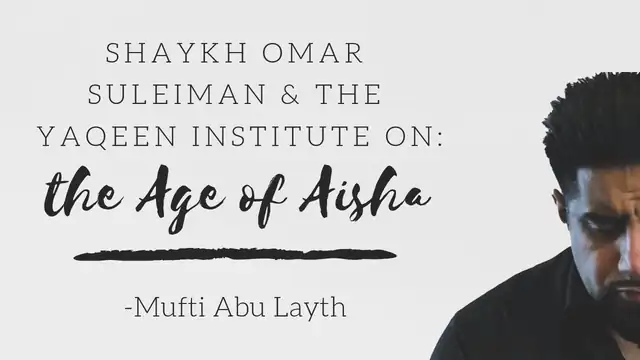 Play from 6:33
The video loads from YouTube only when you press play. Click a time in the transcript to seek.
Watch this part
Open on YouTube at 6:33The player starts at 6:33, the beginning of this part.
This segment6:33 to 10:27 · 3 min 54 sGeneral teaching
What this part covers
machinesummary, machine-writtenAfter the year of sorrow, Khawla suggested the Prophet marry and named Aisha and Sawda. Mufti Abu Layth says a wife was meant to help him with the home and children, companionship, intimacy and his mission.
In more detail
Mufti Abu Layth says what settled the matter for him is the narrative of the Prophet's life. In the year of sorrow the Prophet lost Khadijah, who supported him and his household, and within months his uncle Abu Talib, who gave him social protection, leaving him vulnerable to attack and boycott, and he was then humiliated and attacked at Ta'if [?]. At that point Khawla [?], who had a maternal role in his life, saw him depressed and suggested he marry, naming a young woman, the daughter of his friend Abu Bakr, and a divorcee, Sawda; he sent proposals to both, and the marriage to Aisha did not go ahead at once because she was already engaged. Mufti then sets out four ways a wife could help the Prophet in that situation: looking after the home and his children, emotional support and companionship, intimacy and tranquillity, and freeing his time for work and helping with his mission, which he says is common sense.
- Some terms in this segment are uncertain
Position stated
Mufti Abu Layth says that the marriage was suggested by Khawla to support the Prophet after the year of sorrow, and that a wife could help him with the home and children, companionship, intimacy and his mission.
“so these aspects are well how a wife could have helped the Prophet at that time of tragedy”
Category: historical claim
Kind: general teachingTranscript
machine6:33 to 10:27 · click a time to seek · dotted terms open the glossary
let's just take look the thing that did this for me clearly the thing that did this for me is look at the narrative human beings we can look at we can look at human lives and we can winnow out other things and we can have a result in the year of sorrow when the prophet salallahu alaihe salam went through the most tragic of his years because he lost his wife Khadija who was a support for him and he had children at home he had children he had to look of them he had lost his wife
he had he used to earn for the family he's got that to worry about he his his social protection came from his uncle Abu Talib or the Elan and Abu Talib died in the same year within months and now his social so he became vulnerable to attacks to boycotts and then the Prophet goes to a party and is humiliated and attacked now that there is nothing more than that as a nail to seal that kind of depressive catastrophic atmosphere for
the Prophet at this stage he is approached by Holland this is in the sight you this Asahi Adid he is approached by halle who has who is like an aunt to the Prophet she has a very maternal role in the prophet's life and she says to the Prophet look I see you very depressed why don't you marry and the Prophet kind of he says to her well who do you have in mind and she says I've got two people in mind and one she says a young a young lady and one she says somebody a divorcee and the Prophet says well who's the divorcee and she says soda and the prophesies and who's
the young lady and she says well the daughter of your friend of work arise sure so the Prophet sends a proposal to both now let's just pause there for a moment Isis doesn't go through immediately because she was already engaged and hence the Prophet Marie so the first who was the prophet's age now let's just pause there for a moment how lessees the Prophet depressed because of this tragic year so she advises marriage what could marriage do marriage could help the profit in full aspects okay it could
help the profit first of all through by taking care of the home a woman in the home could look over his children help him with his children to to free up some time and space for the property could help that's one way another way is there could be emotional support and companionship for the Prophet he could find some solace with with the wife he could he could do that that's another way there could be intimacy and sorry with the emotional support they could be intimacy and providing not only emotional support but also peace
tranquility and intimacy as well another way right that she could be looking it would free up time for the Prophet to be working okay so the Prophet could go to work he could do these things and but perhaps she could help the Prophet with the Dawa with the mission so these aspects are well how a wife could have helped the Prophet at that time of tragedy now let's just take that into perspective that's a real you don't need to be a genius to understand that that's this common sense that a wife coming
could help you emotionally she could give you intimacy fine that's excellent she could take care of the kids and she could help you in your Dawa these are four key areas now let's just go back to this picture that they painting the Profi approaches Ayesha according to Bihari and she's six that's younger than his own children what is the point of bringing another child home like what was the point like I know I've got children to take care of let's just bring another child home well she can't help you emotionally she's younger than your own children and she can't which is
Paragraphs overlapping 6:33 to 10:27. Full text on the recording page.
Cite this segment
Stable id, transcript version and tier are part of the citation. Every change to a transcript is logged.Mufti Abu Layth Archive, segment 2018-11-30-S02, auto-transcribed, may contain errors. https://muftiabulayth.org/r/chyxri7trnk/s/2/ (accessed 1 November 2026)
- APA 7
Mufti Abu Layth. (2018, November 30). Why was a marriage suggested to the Prophet after the year of sorrow? [Video, segment 2018-11-30-S02, auto-transcribed, may contain errors]. Mufti Abu Layth Archive. Retrieved November 1, 2026, from https://muftiabulayth.org/r/chyxri7trnk/s/2/
- Chicago author-date
Mufti Abu Layth. 2018. "Why was a marriage suggested to the Prophet after the year of sorrow?" Video, segment 2018-11-30-S02, auto-transcribed, may contain errors. Mufti Abu Layth Archive. Recorded November 30, 2018. Accessed November 1, 2026. https://muftiabulayth.org/r/chyxri7trnk/s/2/
- BibTeX
@misc{abulayth-2018-11-30-S02,
  author = {Mufti Abu Layth},
  title = {{Why was a marriage suggested to the Prophet after the year of sorrow?}},
  year = {2018},
  month = {11},
  date = {2018-11-30},
  howpublished = {\url{https://muftiabulayth.org/r/chyxri7trnk/s/2/}},
  url = {https://muftiabulayth.org/r/chyxri7trnk/s/2/},
  organization = {Mufti Abu Layth Archive},
  urldate = {2026-11-01},
  note = {Segment 2018-11-30-S02, auto-transcribed, may contain errors}
}
Something wrong here?
Tell us what is wrong and it will be checked against the recording. Nothing changes until a person has reviewed it.
Sending a note needs JavaScript, which is off or unavailable in this browser. Nothing has been sent.
No name, email address or account is asked for or stored, and the inbox does not store your IP address. For rate limiting it keeps an unreadable fingerprint of your connection for 48 hours, and our database provider's own logs record connections as every website's do. Only your note, its kind, the page and the moment in the recording are kept, for review.