
Recordings › Monday Nights with Mufti #210 | Q&A Unscripted & Unrestricted! 😉 | Mufti Abu Layth · 13 Apr 2021 › Segment 15 of 50
Will traditional religious institutions survive if they do not adapt?
muftis sufis sufism soofi ulema ulamaa deobandis deoband barelwi brelvi barelwisDenominations that refuse to adapt will fossilise: Deobandi and Barelvi institutions
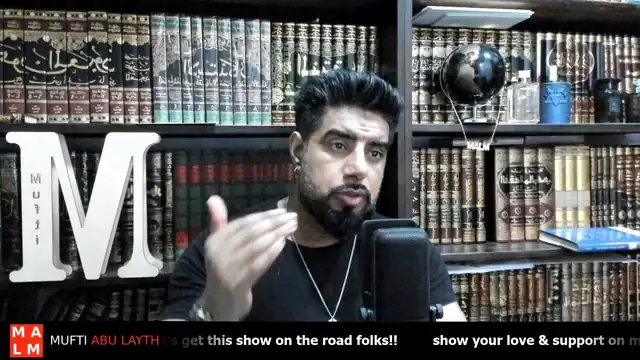 Play from 1:01:00
The video loads from YouTube only when you press play. Click a time in the transcript to seek.
Watch this part
Open on YouTube at 1:01:00The player starts at 1:01:00, the beginning of this part.
This segment1:01:00 to 1:03:39 · 2 min 39 sGeneral teaching
What this part covers
machinesummary, machine-writtenMufti Abu Layth predicts that institutions refusing to adapt, such as many Deobandi madrasas, will fossilise, while Barelvis who modernised their style stay approachable.
In more detail
Mufti Abu Layth says younger Muslims no longer accept such ideas and predicts that within five years some denominations will have to adapt or become fossils. He says this is a problem for many Deobandi institutions, which were the first to build large madrasas in the UK and the West but refused to adapt, whereas in the last decade many Barelvis have become more contemporary in their own way, connecting with Arab scholars and adopting a Moroccan and Syrian Sufi style that keeps Islam approachable to young people, though he says many still have work to do. He describes the unadapted style in mocking terms.
Position stated
Mufti Abu Layth predicts that denominations which refuse to adapt, including many Deobandi institutions in the UK, will become fossilised, while those that adapted, as many Barelvis have, remain approachable to young people.
“five years from today some of these very kind of neanderthal kind of like uh denominations will just be absolutely fossilized they'll either have to adapt or they'll just become fossils”
Category: other
Kind: general teachingTranscript
machine1:01:00 to 1:03:39 · click a time to seek · dotted terms open the glossary
and if you go back five years people were they were actually saying it very probably and look today it's it sounds so dumb to say well you know what and that that's why i was just thinking that when i saw that i thought you know i said that didn't i that give it five years and people will be embarrassed to even make such a claim publicly because the muslims have changed the younger muslims don't buy into this kind of nonsense so there you go there you go see i was i should have gambled on it and i'm telling you give it five years from today
five years from today some of these very kind of neanderthal kind of like uh denominations will just be absolutely fossilized they'll either have to adapt or they'll just become fossils and that's one of the problems unfortunately with the the a lot of the the urban de institutions you see not as much the braves because the braves what they've done is in the last decade they've kind of um in their own way
become kind of contemporary to some extent like they've latched on to arab ulama they've changed the way they look they've kind of changed their style they've become kind of like a like in their own way stylish um you know the whole kind of moroccan vibe the syrian vibe they've kind of like absorbed that whereas first if you went back 15 years it was just this indoor pack they see see this sea uh and it wasn't gonna work here in the uk but i suppose with the sufi thing what brilliance kind of
did it you know it still it gave it life because they kind of like made it in a way where it's still has its kind of cool vibe to it um obviously they need a lot of work still because some of them a lot of them still haven't done that but there's enough personalities that have done that for islam to be still approachable for the younger people and unfortunately this is where a lot of the ubundis who were advanced in building madrasas in the uk or in the western world because they're the first people to have built such huge institutions but because they refused to
adapt give it five years from today and watch all of that you know if you continue to appear as this kind of like uh untidy um this kind of like you know kalahari bushmen i mean the kalahari bushmen seem you know if they came across the kalahari bushmen the kalahari bushmen would start studying them for anthropology they'd be like yeah i think we need to study these people realize the human journey [Laughter]
Paragraphs overlapping 1:01:00 to 1:03:39. Full text on the recording page.
Cite this segment
Stable id, transcript version and tier are part of the citation. Every change to a transcript is logged.Mufti Abu Layth Archive, segment 2021-04-13-S15, auto-transcribed, may contain errors. https://muftiabulayth.org/r/8xuhmcz2n3u/s/15/ (accessed 1 November 2026)
- APA 7
Mufti Abu Layth. (2021, April 13). Will traditional religious institutions survive if they do not adapt? [Video, segment 2021-04-13-S15, auto-transcribed, may contain errors]. Mufti Abu Layth Archive. Retrieved November 1, 2026, from https://muftiabulayth.org/r/8xuhmcz2n3u/s/15/
- Chicago author-date
Mufti Abu Layth. 2021. "Will traditional religious institutions survive if they do not adapt?" Video, segment 2021-04-13-S15, auto-transcribed, may contain errors. Mufti Abu Layth Archive. Recorded April 13, 2021. Accessed November 1, 2026. https://muftiabulayth.org/r/8xuhmcz2n3u/s/15/
- BibTeX
@misc{abulayth-2021-04-13-S15,
  author = {Mufti Abu Layth},
  title = {{Will traditional religious institutions survive if they do not adapt?}},
  year = {2021},
  month = {4},
  date = {2021-04-13},
  howpublished = {\url{https://muftiabulayth.org/r/8xuhmcz2n3u/s/15/}},
  url = {https://muftiabulayth.org/r/8xuhmcz2n3u/s/15/},
  organization = {Mufti Abu Layth Archive},
  urldate = {2026-11-01},
  note = {Segment 2021-04-13-S15, auto-transcribed, may contain errors}
}
Something wrong here?
Tell us what is wrong and it will be checked against the recording. Nothing changes until a person has reviewed it.
Sending a note needs JavaScript, which is off or unavailable in this browser. Nothing has been sent.
No name, email address or account is asked for or stored, and the inbox does not store your IP address. For rate limiting it keeps an unreadable fingerprint of your connection for 48 hours, and our database provider's own logs record connections as every website's do. Only your note, its kind, the page and the moment in the recording are kept, for review.