
Recordings › Monday Nights with Mufti #210 | Q&A Unscripted & Unrestricted! 😉 | Mufti Abu Layth · 13 Apr 2021 › Segment 10 of 50
How has the internet changed who gets to speak about Islam?
muftis iman imaan eemaan eeman deen al-din ad-deen ad-dinTechnology saved his voice: no institution would have given him a platform
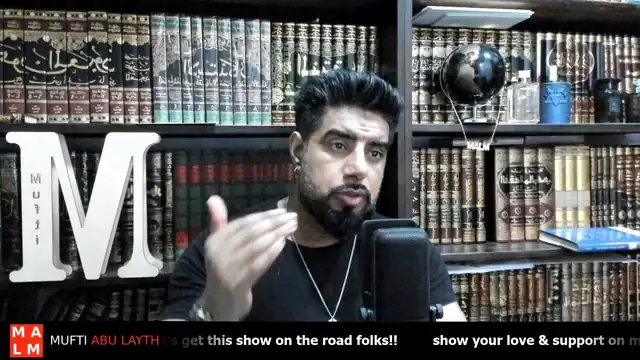 Play from 36:04
The video loads from YouTube only when you press play. Click a time in the transcript to seek.
Watch this part
Open on YouTube at 36:04The player starts at 36:04, the beginning of this part.
This segment36:04 to 40:01 · 3 min 57 sGeneral teaching
What this part covers
machinesummary, machine-writtenMufti Abu Layth says the internet let him reach people without the backing of mosques or organisations, which would never have given him a platform.
In more detail
Reading a message that technology has saved his work for future Muslims who value reason, Mufti Abu Layth says technology has saved him and his message, not only by archiving it: without it a voice like his could hardly have reached anyone, since people like him never fit in institutions, and mosques, organisations and denominations would never give them a platform. He wonders how many similar, perhaps more enlightened, voices died unheard in the past. He recalls replying to calls from what he calls religious cancel culture to boycott and shut him down by saying that he only sits at home with his broadband and livestreams, at no cost and without petrodollars or institutions, and that this is enough to loosen the hold such people have on the Muslim public.
Position stated
Not yet double-checkedA summary of the view expressed is published here only after a second, independent review has found the sentence in the transcript where he says it. Until then, the transcript and the recording speak for themselves.
Kind: general teachingTranscript
machine36:04 to 40:01 · click a time to seek · dotted terms open the glossary
years later or something we we won't it's it's not that it's that we won't even blink at that to us it'll be like just doesn't matter the fact that we'll read things which sound horrendous and we'll just be like oh it doesn't matter this is one of the best criteria always in your mind think how would i have held somebody of another faith to account
and then reflect that am i being a hypocrite so some words you'd like to let me know for those who champion reason the legacy of abu leith has been solidified undoubtedly will go down as one of the greatest in our day and age true champion in our time of making the team easy technology has your work saved for the future muslims who value reason to benefit from much appreciated much appreciated honestly i feel that you know you say technology has saved much of what i've
done and i feel that it has saved it has really just saved me my message everything and i don't mean saved as in archived which it has done but if it wasn't for technology a voice like mine could never have reached hardly anyone because you see people like me will never fit in institutions you understand i've my spirit
has never been born to be in a cage that these shackles and these the mold that institutionalized religion presents unfortunately the masjids the you know the organizations the denominations these things would never allow a platform and and many you know it makes me think at times that how many similar voices maybe much more enlightened than me were there but just died to death
because there was nothing to carry their voice and and that's something that we you know i'm so grateful that in this day and age technology that i can just sit here at home i mean i said you know a few years ago i don't know if you guys remember there was um i was speaking about how these people are so uh they were saying i mean they still say it but uh i'm saying this whole council culture you know obviously the religious cancel culture that oh boycott this musty boycott this mufti shut him down
boycott they were like uh you know how does he how do people allow him and and so on and and i responded by saying ability i sit at home this is just my broadband i'm not you know all i'm doing is just sitting at home just as i be at home and i just live stream and just connect with people and that's all it takes it's nothing no it doesn't cost anything it doesn't i mean apart from just normal costs which are already running within the within you know at home internet and
stuff but that's not really costs it doesn't cost anything it doesn't require some kind of like i don't know some petrol dollars and it doesn't require institutions it doesn't and yet it's enough to dissolve these kind of chains and bonds that these people have on the muslim public and i'm so grateful for that right a message for all those who champion reason all right i've read that shukran shukran so much love much love i do feel i've said this before i even said this as a message to
Paragraphs overlapping 36:04 to 40:01. Full text on the recording page.
Cite this segment
Stable id, transcript version and tier are part of the citation. Every change to a transcript is logged.Mufti Abu Layth Archive, segment 2021-04-13-S10, auto-transcribed, may contain errors. https://muftiabulayth.org/r/8xuhmcz2n3u/s/10/ (accessed 1 November 2026)
- APA 7
Mufti Abu Layth. (2021, April 13). How has the internet changed who gets to speak about Islam? [Video, segment 2021-04-13-S10, auto-transcribed, may contain errors]. Mufti Abu Layth Archive. Retrieved November 1, 2026, from https://muftiabulayth.org/r/8xuhmcz2n3u/s/10/
- Chicago author-date
Mufti Abu Layth. 2021. "How has the internet changed who gets to speak about Islam?" Video, segment 2021-04-13-S10, auto-transcribed, may contain errors. Mufti Abu Layth Archive. Recorded April 13, 2021. Accessed November 1, 2026. https://muftiabulayth.org/r/8xuhmcz2n3u/s/10/
- BibTeX
@misc{abulayth-2021-04-13-S10,
  author = {Mufti Abu Layth},
  title = {{How has the internet changed who gets to speak about Islam?}},
  year = {2021},
  month = {4},
  date = {2021-04-13},
  howpublished = {\url{https://muftiabulayth.org/r/8xuhmcz2n3u/s/10/}},
  url = {https://muftiabulayth.org/r/8xuhmcz2n3u/s/10/},
  organization = {Mufti Abu Layth Archive},
  urldate = {2026-11-01},
  note = {Segment 2021-04-13-S10, auto-transcribed, may contain errors}
}
Something wrong here?
Tell us what is wrong and it will be checked against the recording. Nothing changes until a person has reviewed it.
Sending a note needs JavaScript, which is off or unavailable in this browser. Nothing has been sent.
No name, email address or account is asked for or stored, and the inbox does not store your IP address. For rate limiting it keeps an unreadable fingerprint of your connection for 48 hours, and our database provider's own logs record connections as every website's do. Only your note, its kind, the page and the moment in the recording are kept, for review.