
Was Imam Al-Ghazali Responsible For The Decline In Muslim Science? | Mufti Abu Layth
imam ghazali imaam imams prayer leader maaliki malikite malikiyyah maliki school muftis iman imaan eemaan eeman ahl al-sunnah ahl as-sunnah ahlus sunnah ahl al-sunna sunnis 'alim aalimvideo · 8:20 · 6,400 views · 26 Mar 2022 · Open on YouTube
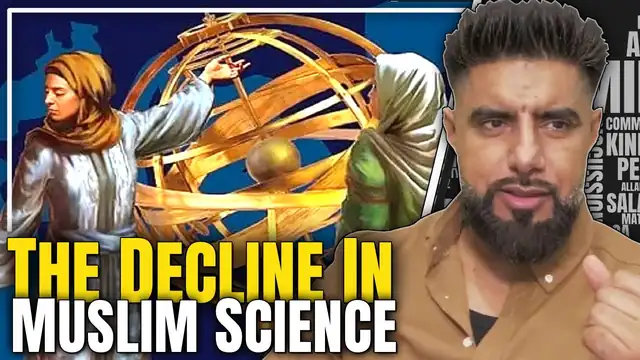 Press play to load from YouTube. Nothing loads until you do.
Transcript
machineauto-transcribed, may contain errors · source: youtube auto · click a time to seek · dotted terms open the glossary[Music] much love for the super chat may allah bless you why are muslims not developed in science today uh neil degrasse tyson who is a legend by the way claims is responsible for that and ending the islamic golden age thoughts i mean i have answered this before so without going into much detail um i'm not sure i have a video about it on um on youtube so that's it i
don't right so naturally there could be some um some elements that to what neil degrasse tyson is saying i don't think it's entirely directly causative however maybe through exponential causation played a um a significant role
in in i don't know maybe blacklisting um philosophical thought so yeah i i could accept that he he discouraged it because he it's interesting i mean allah bless him was an incredibly complex personality who went through a lot in his lifetime and a lot of he went through a lot of permutations and changes so he um he's a a great chef ai scholar and an osuli one
of his texts the mustafa is one of the um of usual is one of the major books of usual he is above that a philosopher so his discuss a lot of philosophy in fact uh some cartesian um really a one would say a lot of what descartes is presenting several centuries later is already in imam razali's rasa so that's fascinating you know people don't credit him for that and i don't know whether they're aware of that so
and he was a theologian he was a great theologian as well ashadi scholar and i feel that he in addition to that became a um i'm not sure what events in his life directly led to him seeking the path of consciousness he definitely did and became a person of um seeking that path of the of the soul for him it manifested itself in a root
in a root of asceticism he kind of took his whatever he had or whatever he could carry with him and set off to a desert and was there for many years and kind of a renunciation of the dunya in its entirety almost which is i'm not sure if asceticism is something that it's not going to be really many most people's cup of tea that ascetic hermitic naturally influenced his
outlook on life and and i feel he felt that the voice of reason could only take him so far and he felt that he'd maybe struggled he had a crisis of faith and so some people even claim that he um gave up on islam for maybe a number of days allahu adam if that's true but he definitely struggled and
and then he felt that the only way out of this abyss is to to to kind of cast aside philosophical inquiry and to to firmly take a blind leap of faith now i admire his kind of tenacity and his his rigidity in the face of such a crisis of faith
that said i'm not saying i necessarily agree with how he would have done it each person to their own i'm sure for him it worked but imam razali lived almost 900 years ago the world has changed since the last 900 years dramatically and drastically and even reason and the voice of reason has learned so much more since then and i would i would feel that if imam razali knew what we knew today his approach may have been slightly different slightly i'm not saying massively but slightly different i don't feel he would have
um today we do like with quantum physics it has opened for a certain explanations that have brought us a step closer to understanding reality and and and to to by reconciling or marrying it with um [Music] the mystique that these are not necessarily divorced entities and i feel that was imam ghazali's biggest struggle and therefore he wrote to have philosopher the incoherence of the philosophers whereby he kind of
refutes neo-platonism and a lot of that but i think what razali does is he projects neoplatonism onto the entirety of philosophical thought and thereby refutes it naturally within a hundred years uh the great maliki legend of muslim spain ibn rush refutes razali by writing his incoherence of the incoherence called the hafta and i feel ima ibn rush does a great job but you know maybe was philosophy to become as fashionable again in the muslim world
as it was becoming by razali's time maybe not one could argue but it does continue i don't think philosophical thought discontinues in the muslim world you have great people after imam razali in the east i don't just mean in the west with like ibn rust in the east you have you have many people uh that will kill sahar words
what i'm trying to say is independent philosophical thought within the sunni paradigm does continue sure it stagnates but whether that stagnation is a direct result i feel it's difficult to say it's a direct result of imam was early could it be an exponential um causative element as in it triggered this which triggered b which triggered c which triggered e and f and then maybe g impacts sure i like that i i accept that but i hope that's of some help cool
Something wrong here?
Tell us what is wrong and it will be checked against the recording. Nothing changes until a person has reviewed it.
Sending a note needs JavaScript, which is off or unavailable in this browser. Nothing has been sent.
No name, email address or account is asked for or stored, and the inbox does not store your IP address. For rate limiting it keeps an unreadable fingerprint of your connection for 48 hours, and our database provider's own logs record connections as every website's do. Only your note, its kind, the page and the moment in the recording are kept, for review.
Cite this recording
Stable id, transcript version and tier are part of the citation. Every change to a transcript is logged.Mufti Abu Layth Archive, auto-transcribed, may contain errors. https://muftiabulayth.org/r/z3hp9wtugco/ (accessed 1 November 2026)
- APA 7
Mufti Abu Layth. (2022, March 26). Was Imam Al-Ghazali Responsible For The Decline In Muslim Science? | Mufti Abu Layth [Video, auto-transcribed, may contain errors]. Mufti Abu Layth Archive. Retrieved November 1, 2026, from https://muftiabulayth.org/r/z3hp9wtugco/
- Chicago author-date
Mufti Abu Layth. 2022. "Was Imam Al-Ghazali Responsible For The Decline In Muslim Science? | Mufti Abu Layth." Video, auto-transcribed, may contain errors. Mufti Abu Layth Archive. Recorded March 26, 2022. Accessed November 1, 2026. https://muftiabulayth.org/r/z3hp9wtugco/
- BibTeX
@misc{abulayth-Z3hp9wtugCo,
  author = {Mufti Abu Layth},
  title = {{Was Imam Al-Ghazali Responsible For The Decline In Muslim Science? | Mufti Abu Layth}},
  year = {2022},
  month = {3},
  date = {2022-03-26},
  howpublished = {\url{https://muftiabulayth.org/r/z3hp9wtugco/}},
  url = {https://muftiabulayth.org/r/z3hp9wtugco/},
  organization = {Mufti Abu Layth Archive},
  urldate = {2026-11-01},
  note = {Auto-transcribed, may contain errors}
}