
Recordings › Ramadan Q&A Fast & Fiqhious
Q: Can I have a full meal for Iftaar & then go to pray Maghrib? Mufti Abu Layth
salat namaz salaat namaaz as-salah al-salah salawat hadeeth ahadith ahaadeeth hadis hadees ahaadith madhab mazhab school of law madhahib mazahib madhaahib malik ibn anas malik bin anas imam maalik imam malik ibn anas zuhr zohr zuhar dhuhur salat al-dhuhr dhuhr prayer zuhr prayer midday prayer maghreb magrib salat al-maghrib maghrib prayer sunset prayer esha ishaa salat al-isha isha prayer night prayer imaam imams prayer leader iftari breaking the fast maaliki malikite malikiyyah maliki school hanafite hanafiyyah shafi shafei shafiite fatwah fatawa fatwaa fataawa legal opinion muftis sunna sunnat sunan prophetic practice al-muwatta muwatta malik muwatta imam malik muwata sunni ahlus sunnah ahl al-sunna sunnis shiah shiite shi'i twelver ithna ashari ulema ulamaa scholars umma ummat community astagfirullah astaghfirullaah astaghfarvideo · 7:58 · 3,500 views · 17 May 2017 · Open on YouTube
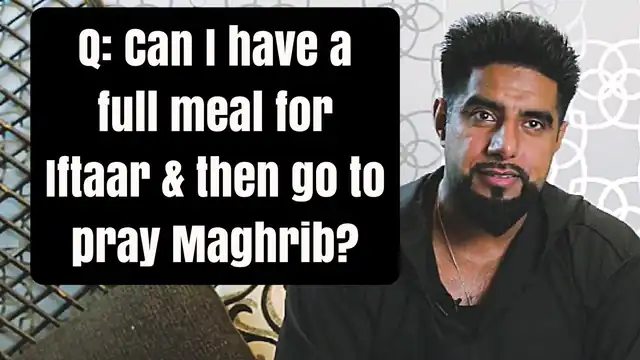 Press play to load from YouTube. Nothing loads until you do.
Transcript
machineauto-transcribed, may contain errors · source: youtube auto · click a time to seek · dotted terms open the glossaryQuestion time. Take it away. I prefer Another question from Faisal. I prefer to have a full meal for iftar. Allah. Look at that. And and then pray Maghrib. Look at that. Is that wrong? Mhm? That Is that wrong?
I mean, if you're going to ask like that, then oh, no, no, no, no, no. It's okay. It's not wrong. As most people pray Maghrib first. All right. So, what are the madhhab on this? Okay. Well, you see, there's there's two things here. First of all, almost all ulama, especially within Ahl al-Sunnah wal Jama'ah, I mean that by its very broadest, not the 0.01%
position, the broad position that encompasses the majority of the ummah, uh they generally all do believe as the hadith says that uh that people will remain upon goodness as long as they uh as long as they hasten with the iftar.
Okay. So, that is the general position. I believe there's some differences with the Shia where they uh delay their iftar. But, all of the majority of Ahl as-Sunnah, and by that I mean in contrast, as I said, to the Shia, they do believe in opening the fast before Maghrib, before praying Maghrib. I don't mean before Maghrib so time kicks in.
Just take that snippet, and everybody's just munching, and they say, "Well, I've got the fatwa." So, as in before Maghrib salah, but after the time has obviously kicked in. The difference is, do you just open your fast as in Cheers. Uh astaghfirullah man tashabbaha bi qaumin Whoever said uh Ahem.
Do you just simply open your fast? Uh have a quick bite, as in a quick date, a quick something, a quick little snack. You know, a quick uh 3 4 minutes of a snack exam- example. And then go to pray Maghrib. Or do you sit down and think, "Well, let's just munch." I'd say I'm going to have a big, fat, massive, bulging kind of diet, and then I'm going to go and pray.
Ideally, most people would say that you you know, you pray Maghrib, as in you have something, and then uh go and pray Maghrib, and then carry on later on, have your food. The question here is, but what if you're not feeling it? You know, what if you've had a very long day, and you're feeling hungry, and you really just want to eat? Can you do that?
Well, the understanding is that well, according to majority of the ulama, waqt ul-Maghrib is mu'assa. It is the time of Maghrib is is stretched. It is an ex- expanded kind of time. And even uh and I know within the Maliki madhhab there is a difference of opinion, but that is the understanding that is transmitted in the Muwatta by Imam Malik the waqt-us-salaah ma lam tadkhul il ukhra is the time of one prayer until another one doesn't kick in.
And likewise, that is what Ibn Wahb and these other students of Malik say about his understanding that the time of Maghrib lasts until Isha kicks in. Okay. Now, that is the Hanafi understanding. That is I mean there there are some differences among some of the Shafi'is. size of praying straight away that's what that's Maghrib for me. Because it is generally the best time to pray Maghrib as in the more virtuous time is at its beginning at its beginning time.
so it's in the sense that no it it is the time is very short. Are you talking about Malikiya? No, Hanafi's. Uh I think the What they don't they don't know we better pray quickly because time for Maghrib is only short. No, the time for Maghrib does last until Isha uh until Isha time. But uh the point is that does is that a um So according to the Hanafi's the same thing.
It's not that uh oh All right. I think I've just uh All right. So it's not that um the time of Maghrib runs out. As for example, there are some opinions in other schools that say the time of Maghrib is mudayyaq and it's very like you have I don't know like it within the Shafi'i school there's some understanding. Even some Malikiya like to present that understanding. But that oh it runs out in I don't know 15 minutes or it runs out in but that's definitely not the the understanding presented in the Muwatta by Imam Malik and it's not the Hanafi school in general.
So, the point is that most ulama do will accept that the time of Maghrib is muwassa. It is stretched. And they all do accept that it is better to pray in its early time. That is an an agreed-upon concept, but especially with Maghrib. The other salahs there's a disagreement like so over Dhuhr, some people say it's better to delay because it's too hot.
Some people say it's better to pray in the early time. But with Maghrib more or less they all agree. So, in the Hadith of Jibril when the Jibril leads the salah leads the prophet in salah in different times. But when it's Maghrib he prays in the same time. He doesn't change the Maghrib time between the two days. So, Maghrib time it is definitely most virtuous to pray in its early time.
But that's an issue of virtue. If you were feeling hungry and you felt that look sorry, but I want to pray. Sorry, I want to eat. Then I feel there's no harm in eating finishing your meal and then praying Maghrib. But I mean if you that's once again it's subjective. Some people may feel okay to just have a little bite and then get up and pray Maghrib.
Some people may be too hungry and too distracted. And you know, it's it's actually transmitted that from people like Imam Abu Hanifah actually that he said Allahu alam, but this is you know, part of you know, what I've come across that it's in in certain lectures that it's been transmitted that Imam Abu Hanifah said that I would rather or that my you know, that my that I was eating and then I could go and focus on my salah rather than be in my salah and all I can think about is food.
Do you understand? So, I think that's that's absolutely fine in that understanding if um if you if you have the need. Once again, it's subjective. In countries like this one, it's really long. Well, the the the fast is, then why not? All right.
Something wrong here?
Tell us what is wrong and it will be checked against the recording. Nothing changes until a person has reviewed it.
Sending a note needs JavaScript, which is off or unavailable in this browser. Nothing has been sent.
No name, email address or account is asked for or stored, and the inbox does not store your IP address. For rate limiting it keeps an unreadable fingerprint of your connection for 48 hours, and our database provider's own logs record connections as every website's do. Only your note, its kind, the page and the moment in the recording are kept, for review.
Cite this recording
Stable id, transcript version and tier are part of the citation. Every change to a transcript is logged.Mufti Abu Layth Archive, auto-transcribed, may contain errors. https://muftiabulayth.org/r/yrti4hxdw9g/ (accessed 1 November 2026)
- APA 7
Mufti Abu Layth. (2017, May 17). Q: Can I have a full meal for Iftaar & then go to pray Maghrib? Mufti Abu Layth [Video, auto-transcribed, may contain errors]. Mufti Abu Layth Archive. Retrieved November 1, 2026, from https://muftiabulayth.org/r/yrti4hxdw9g/
- Chicago author-date
Mufti Abu Layth. 2017. "Q: Can I have a full meal for Iftaar & then go to pray Maghrib? Mufti Abu Layth." Video, auto-transcribed, may contain errors. Mufti Abu Layth Archive. Recorded May 17, 2017. Accessed November 1, 2026. https://muftiabulayth.org/r/yrti4hxdw9g/
- BibTeX
@misc{abulayth-YRTi4hxdW9g,
  author = {Mufti Abu Layth},
  title = {{Q: Can I have a full meal for Iftaar \& then go to pray Maghrib? Mufti Abu Layth}},
  year = {2017},
  month = {5},
  date = {2017-05-17},
  howpublished = {\url{https://muftiabulayth.org/r/yrti4hxdw9g/}},
  url = {https://muftiabulayth.org/r/yrti4hxdw9g/},
  organization = {Mufti Abu Layth Archive},
  urldate = {2026-11-01},
  note = {Auto-transcribed, may contain errors}
}