
Recordings › Ponderings on the Holy Quran
Abrogation in the Holy Quran -Mufti Abu Layth
shari'ah shariat sharee'ah maaliki malikite malikiyyah maliki school muftis koran quraan al-quran ayah aya ayat ayaat aayah aayat nasikh nasikh wa mansukh hijrah hijra hijrat migration 'alim aalimvideo · 3:13 · 5,600 views · 3 Feb 2020 · Open on YouTube
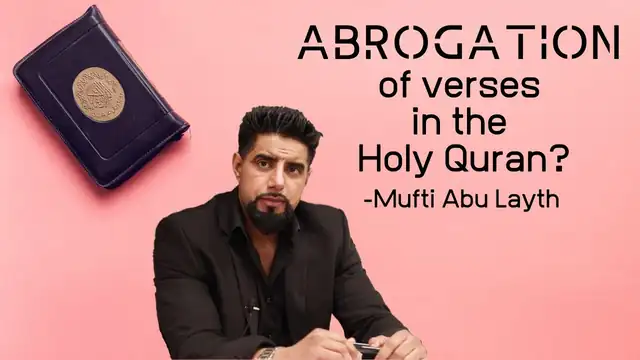 Press play to load from YouTube. Nothing loads until you do.
Transcript
machineauto-transcribed, may contain errors · source: youtube auto · click a time to seek · dotted terms open the glossarySomebody's asking some questions here. What is What is your opinion about Naskh Mansukh in the Quran? Is any of the verses abrogated or not? Please answer. Okay, this is an interesting question. I do accept the concept of abrogation, but I feel that there's a number of things I disagree and with people on it as well.
So, I do feel that rulings do change over time. As they change, they may outdate or sorry, outrule prior rulings. I agree with that as a concept at the concept of abrogation just as each civilization is different to a civilization before it. So, so I'm I'm I'm fine with that. I disagree with I think there's a lot of guesswork as well in how many verses are abrogated, what kind of things are abrogated.
I think what does abrogation mean? I would disagree maybe with some of this stuff. So, people would feel that once something is abrogated, it has no lesson in it at all, but I I I disagree entirely. I feel that there's still so much relevance for even the abrogated verses in understanding that there was once a time like that. In understand So, if you take for example the verse of the verse of cutting the hands of the thief.
Now, I would feel that that was abrogated and changed and this change was mandated by the Sharia when the time came as Abu al-Qasim al-Burzuli, the great Maliki scholar, you know, he wrote and taught that in his time, which is about 800 years ago. So, the the Sorry, about 600 years ago. He was in about the 800 Hijri. So, now the the point of that is that the verse would still carry relevance in saying that these acts are serious acts.
Was sariq was sariqa. That they are serious acts. That these this matter needs to be taken in into great consideration. That the public property must be protected at all times. That crimes must not go unpunished. That there must be justice. That the justice must not only exist, but be seen to exist by the public.
Okay, that nakalam min Allah. That sometimes that these can be as a deterrent. That Allah mentions these things. Now, you So, there's many that there was historicity to this verse. That the Quran was dealing with people's actual problems. And just the delivery, the method of the punishment is what has varied over time.
So, I do agree in with abrogation. I just feel that maybe my way of looking at it might be slightly different. I also feel that these verses several other verses went on with the day and age to become abrogated, which people may not agree with me like things like capital punishment or um cutting the hands of the thief and things like that.
So, okay. I I hope that's of some help.
Something wrong here?
Tell us what is wrong and it will be checked against the recording. Nothing changes until a person has reviewed it.
Sending a note needs JavaScript, which is off or unavailable in this browser. Nothing has been sent.
No name, email address or account is asked for or stored, and the inbox does not store your IP address. For rate limiting it keeps an unreadable fingerprint of your connection for 48 hours, and our database provider's own logs record connections as every website's do. Only your note, its kind, the page and the moment in the recording are kept, for review.
Cite this recording
Stable id, transcript version and tier are part of the citation. Every change to a transcript is logged.Mufti Abu Layth Archive, auto-transcribed, may contain errors. https://muftiabulayth.org/r/xbvbl4a5bbu/ (accessed 1 November 2026)
- APA 7
Mufti Abu Layth. (2020, February 3). Abrogation in the Holy Quran -Mufti Abu Layth [Video, auto-transcribed, may contain errors]. Mufti Abu Layth Archive. Retrieved November 1, 2026, from https://muftiabulayth.org/r/xbvbl4a5bbu/
- Chicago author-date
Mufti Abu Layth. 2020. "Abrogation in the Holy Quran -Mufti Abu Layth." Video, auto-transcribed, may contain errors. Mufti Abu Layth Archive. Recorded February 3, 2020. Accessed November 1, 2026. https://muftiabulayth.org/r/xbvbl4a5bbu/
- BibTeX
@misc{abulayth-xbvBL4A5BBU,
  author = {Mufti Abu Layth},
  title = {{Abrogation in the Holy Quran -Mufti Abu Layth}},
  year = {2020},
  month = {2},
  date = {2020-02-03},
  howpublished = {\url{https://muftiabulayth.org/r/xbvbl4a5bbu/}},
  url = {https://muftiabulayth.org/r/xbvbl4a5bbu/},
  organization = {Mufti Abu Layth Archive},
  urldate = {2026-11-01},
  note = {Auto-transcribed, may contain errors}
}