
Recordings › Monday Nights with Mufti #188 | Q&A Unscripted & Unrestricted! 😉 | Mufti Abu Layth · 27 Oct 2020 › Segment 8 of 33
What does 'justice' mean in the Quran's verse on marrying more than one wife?
shari'ah shariat sharee'ah muftis hukm ahkam hukum hukam ahkaam jahannam jahanam jahannum koran quraan al-quran sura soorah surat suwar soora chapter ayah aya ayat ayaat aayah aayat mecca makka mekka ahl al-sunnah ahl as-sunnah ahlus sunnah ahl al-sunna sunnis shiah shiite shi'i twelver ithna ashari 'alim aalim ulama ulema ulamaa nikah nikkah nikaah nikah nama nikahnama as-salamu alaykum assalamu alaikum assalamualaikum salaam salaams salam alaykum wa alaykum as-salam greetingMufti Abu Layth on justice to orphans and the polygamy verse
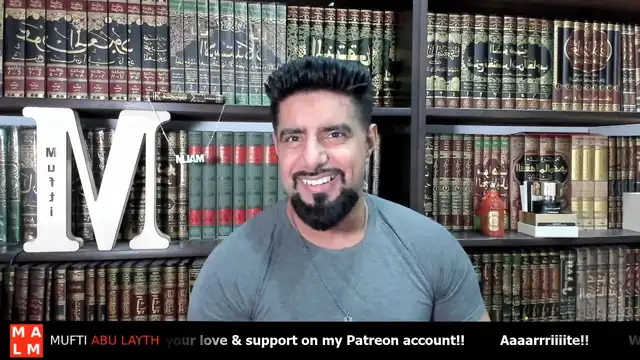 Play from 50:22
The video loads from YouTube only when you press play. Click a time in the transcript to seek.
Watch the answer
Open on YouTube at 50:22The player starts at 50:22, where the answer begins.
This segment50:22 to 1:00:13 · 9 min 51 sGeneral teaching
The answer in brief
machinesummary, machine-writtenMufti Abu Layth says the verse requires equal treatment of wives as the benchmark, accepting human shortfalls, and does not rule polygamy out.
In more detail
A viewer asks what justice means in the verse about fearing that one cannot do justice to the orphans. Mufti Abu Layth says the verse is about having more than one wife, jokes about being equally unfair, and explains that 'orphans' does not mean little children: in a tribal, raiding society like the Vikings, protection came from the clan, and orphans extended into the late teens. He says marriage to orphaned girls was offered as an incentive for selfish men to give them protection, shelter and sustenance, and mentions that he personally goes with the opinion, which he attributes to a scholar whose name is garbled [?], that the verse sets no limit of four. Justice, Mufti says, means treating wives equally; the Quran accepts that one will not always manage it, but equality must be the benchmark. He disagrees with those who read the later verse as ruling polygamy out, since the passage would then begin by permitting it only to take it back. He also says non-alcoholic beer and wine are fine.
Question as read aloud · questioner not identifiedIf you think you can't do justice to the orphans, can you explain what justice here means?
- Some terms in this segment are uncertain
Position stated
Mufti Abu Layth says the verse on never being truly just does not mean that polygamy cannot really be done.
“some people said that that meant that oh you can't really do polygamy then I think that that's not what the verse is saying”
Category: teaching
Kind: general teachingTranscript
machine50:22 to 1:00:13 · click a time to seek · dotted terms open the glossary
I haven't. Do send that to me. It'd be interesting. I have heard that it was used in um as an incense and it was definitely drunk as uh Roomie and other people mention it but I haven't read any of the literature on it. I haven't read the Shia literature or any Sunni literature on it. Kamal, I found your super chat. Much love. Salam Mui 43. If you think you can't do justice to the orphans, can you explain explain what justice here means?
[clears throat] Oh, this is to do with UH [laughter] I understand this is to do with marrying polygamy. Uh uh what is it? If you fear that you will not be uh and then Allah goes on to say and you will never truly be just.
This is about having more than one wife. I suppose one solution is to just be unjust fairly [laughter] to be equally unfair. [laughter] Not don't quote me. Don't quote me. Okay. So, [laughter] right. So here by the way this
[clears throat] I know here the term that it begins with is orphans and people here think this somehow means little children. It doesn't it does not mean that you see in a tribal society um in a tribal society and a tribal warlord society.
So I want you to and I keep giving this approximation always because people sometimes can't we can't truly fathom and I know because we've watched a lot of movies and things. So if you picture things like the Vikings and who were a warlord kind of uh raiding society and then reverse several centuries [laughter] and put that lifestyle in the Middle East and in the Arabian Peninsula that's what it was like in that lifestyle which was it was tribal you were everything your protection
your sovereignty if you had any, your freedoms, your uh wealth, your rights, human rights were ultimately protected by the Sabah by the family. Now what would happen and and that that that's a non-negotiable.
So even if you take the prophet's lifetime uh you see the prophet sallallahu alaihi wasallam if you look when why he wasn't attacked in Makkah or why they didn't just try to kill him in the beginning when they got frustrated with the prophet was because of the tribal protection given by Abu Talib uh you know primarily this was a powerful thing now we don't have it today So it's um it's difficult identifying with it because we're just reading it and thinking h like we're picturing them through our lens.
So in that society orphans were not just I mean obviously orphans were like three year olds one year olds they were orphans as well but orphans extended right into the late teens because if you've got a boy now let's say 17 years old everybody around him in an attack is killed because the way they would just they would just raid villages and they would just butcher people and take people away and maybe one two people children run away whilst this is happening.
Now they come back, the village has been destroyed, almost everyone killed or enslaved. Now you've just got a 16y old, you've got an 18y old, they are still in that society even though they may be in some way seen as bordering adulthood, but they are just children. what an a 16-year-old is still considered a child in many parts of the world.
So when Allah begins by saying look if you find these these people who have been orphaned and you take care of them now sometimes people are not you know we're all kind of selfish to some extent I mean we're all selfish by default we're selfish so we might feel sorry like let's say you see someone now 17year-old old, everybody around them killed, they don't know what what to do that, you know, place ruined.
Um, what do they do? How do they survive? What do they Now, you might feel sorry, but you're not going to bring them into your house. You're not going to bring everyone into your house. And so, marriage was an incentive that look, well, if it's a girl, obviously, this was primarily addressing the men, that's why. Well, why don't you marry them? Give them some protection. Give them shelter. give them sustenance.
Now that's an incentive because look ultimately we as human beings are selfish. People always ask you know the five most powerful words what's in it for me. So people say well you can marry her and that is incentivizing for many men. Okay. They will think that h but [laughter] they think point point
actually the humanitarian in me has awoken [laughter] the philanthropist. So here Allah is saying that look you know twos three four personally I don't I go with the opinion that there is no restriction on how many marriages a person has which is the view of shani and so on but um I know many people say this means four is a limit but because the verse doesn't say four it says in twos in threes in fours so some scholars read that as this is just enumerating saying like no matter how many you do
not that this is a restriction. Anyway, that's a different discussion for a different day. Uh but here you were told hey but if you do be mindful of being of justice of being just like don't just see this as an opportunity to exploit because obviously it comes back to the what's in it for me and you say well oh well actually a sexual relationship and that look unquestionably people just lie.
If we're in a day and age where people just like, you know, when but most men will automatically be like [laughter] the lights will just switch on automatically. So they'll be like, "Yeah, okay." And this might make them overstep their reach. Like they might say, "Okay, I'll marry her. I'll marry her. I'll marry her. I'll marry her. I'll marry her." And but you you don't even have the provisions.
And then what are you going to do? you're just going to well the ones you like you might favor them and the others you'll just let them kind of starve and you know not maybe fully starve but you know you're not really they're just destitute because you're not really um caring for them and you didn't have the provisions to start off with but you you know you grabbed much more [laughter] wrong metaphors here okay you bit more than you could chew [laughter] But this is the thing.
So Allah is saying ah but remember you must be just and it's not just it's not just it's more about you must be equal with them treat them equally and then Allah does go on to say acknowledge that look even though truthfully and this is an important part of the verse that like it's understandable that one will not truly be able to always be equal in everything and that doesn't just mean in emotions obviously emotions is a powerful part there but also in other
things like maybe you might end up giving a bit more here a bit more it might happen in life and Allah accepts that in the Quran saying look this is human nature may happen but for the most part you must endeavor to have equality must be the benchmark If you fall short on some you know occasions it happens but you know this must be the benchmark.
So that's the understanding of this verse uh in surah it's um some people said that that meant that oh you can't really do polygamy then I think that that's not what the verse is saying because then why would the verse begin in such a way and then say ah I'm only messing [laughter] why would the verse begin how I go out marrying multitudes marrying multitudes I'm only messing Don't bother.
Don't you dare. Don't you dare. [laughter] That would just be like, what the hell? What kind of reasoning is that? So, I I disagree with that. Um, somebody said, [laughter] that's a good one. Right. Um, is said, "Like non-alcohol, non-alcoholic beer and wine." Yeah, that's absolutely fine.
What do you think about Sharia compliant ethical investing? How extensive is your knowledge in this space? Peace and love. Afab right much love. Uh Kushki, you're doing it. Much love for the super chat. Muhammad Aman, much love for the super chat. You're doing it guys. You're doing it. Fitzar OG means original gangster. Ah, you you you haramies.
Paragraphs overlapping 50:22 to 1:00:13. Full text on the recording page.
Cite this segment
Stable id, transcript version and tier are part of the citation. Every change to a transcript is logged.Mufti Abu Layth Archive, segment 2020-10-27-S08, auto-transcribed, may contain errors. https://muftiabulayth.org/r/w6tqwuuumcg/s/8/ (accessed 1 November 2026)
- APA 7
Mufti Abu Layth. (2020, October 27). What does 'justice' mean in the Quran's verse on marrying more than one wife? [Video, segment 2020-10-27-S08, auto-transcribed, may contain errors]. Mufti Abu Layth Archive. Retrieved November 1, 2026, from https://muftiabulayth.org/r/w6tqwuuumcg/s/8/
- Chicago author-date
Mufti Abu Layth. 2020. "What does 'justice' mean in the Quran's verse on marrying more than one wife?" Video, segment 2020-10-27-S08, auto-transcribed, may contain errors. Mufti Abu Layth Archive. Recorded October 27, 2020. Accessed November 1, 2026. https://muftiabulayth.org/r/w6tqwuuumcg/s/8/
- BibTeX
@misc{abulayth-2020-10-27-S08,
  author = {Mufti Abu Layth},
  title = {{What does 'justice' mean in the Quran's verse on marrying more than one wife?}},
  year = {2020},
  month = {10},
  date = {2020-10-27},
  howpublished = {\url{https://muftiabulayth.org/r/w6tqwuuumcg/s/8/}},
  url = {https://muftiabulayth.org/r/w6tqwuuumcg/s/8/},
  organization = {Mufti Abu Layth Archive},
  urldate = {2026-11-01},
  note = {Segment 2020-10-27-S08, auto-transcribed, may contain errors}
}
Something wrong here?
Tell us what is wrong and it will be checked against the recording. Nothing changes until a person has reviewed it.
Sending a note needs JavaScript, which is off or unavailable in this browser. Nothing has been sent.
No name, email address or account is asked for or stored, and the inbox does not store your IP address. For rate limiting it keeps an unreadable fingerprint of your connection for 48 hours, and our database provider's own logs record connections as every website's do. Only your note, its kind, the page and the moment in the recording are kept, for review.