
Recordings › Islamic Psychology › Your Journey - Your Being
A Mirror To The Divine - [Qaf v16] Negative Thoughts & The Nafs | the Mirror Stage | Mufti Abu Layth
haj pilgrimage hadj hadeeth ahadith ahaadeeth hadis hadees ahaadith tafseer exegesis tafasir tafaseer commentary al-bukhari imam bukhari sahih al-bukhari sahih bukhari saheeh al-bukhari saheeh bukhari imam al-bukhari takbir takbeer takbirat takbeerat muftis atharis atharism athariyyah djinn jin jinnat jinni shaytan shaytaan iblees shayateen shayatin satan devil koran quraan al-quran sura soorah suwar soora chapter ayah aya ayaat aayah aayat hifz hafidh haafiz hifdh huffaz hafiza memorisation madinah medina al-madinah madeenah yathrib sufi sufism soofi aalim scholar shaykh shaikh sheik shuyukh shaykhs umma ummat community bismillah ir-rahman ir-rahim bismillahir rahmanir rahim bismillahi salam as-salamu alaykum assalamu alaikum assalamualaikum salaams salam alaykum wa alaykum as-salam peace greeting zikr zikar dhikar zikir adhkar azkar remembrance duaa duaas supplication al-din ad-deen ad-din religion rahmah rahma rahmatlive stream · 1:04:01 · 4,000 views · 2 May 2024 · Open on YouTube
 Press play to load from YouTube. Nothing loads until you do.
Transcript
machineauto-transcribed, may contain errors · source: youtube auto · click a time to seek · dotted terms open the glossary[music] [laughter] All right. All right. So, we is live. Let me just [sighs and gasps] All right.
Just get refresh this. Allow some of you to just log in. All right. Click live. Click share. Allahu Akbar. [gasps] And I'll just refresh this till then. Bismillah.
All right. So, one second. Let me just uh straighten this. All
right. So, Bismillah al-Rahman al-Rahim. Innal hamdalillahi wa kafa was salatu was salamu ala rasulihil Mustafa wa ala ibadihil ladhina atba'a wa man bihada ihtada wa bi athari ahlil Madina iqtafa wa ba'd. Fas salamullahi ala al-qawm.
Allahu Akbar, people. Allahu Akbar. [snorts and sighs] Ah, I thought to myself, let's Yarkui live stream watcher. Let there be a little reflection and rumination. Although rum [sighs and gasps] [snorts]
Right. So, some thoughts I um Right. I wanted to share with you all tonight. Allah. Right. Our our essence, our being as mirrors to the divine.
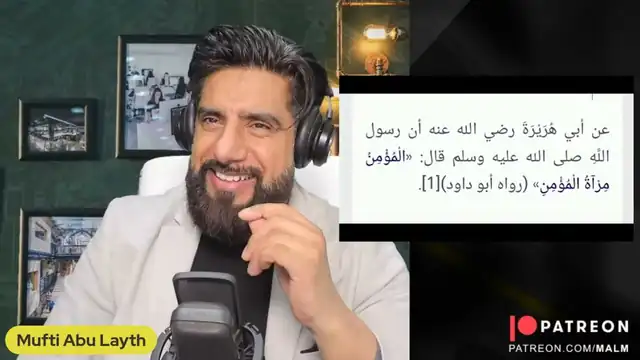
Allahu Akbar. And Right. One second. This is not coming up here. Just give me one momentico. Till then, I'll let you read this hadith. I'm just going to check why this is not refreshing. Hello.
All right. So, hopefully that's been all cleared. So, Bismillah. [snorts] I want to share with us today some an echo and a reflection on our very essence. You know, [snorts] people often find themselves riddled with negative thoughts.
They You know, s- [snorts] people cannot shake it off. These drowning [clears throat] catastrophic plaguing thoughts that remind people that they or tell people that they are a failure.
That they amount to nothing. That they have you know, no meaning, no success, nothing. This can often even lead people from anxiety, angst, unsettledness to depression, to suicidal ideations [gasps] to catastrophizing within.
You are not these negative thoughts. Okay? You are not even your thoughts. You are a being much more profound than that. I want you to think about that for a moment.
That [snorts] you know, when you're having these thoughts, you know, when if this inner voice is telling you something, you need to you are such and such, you need to you know, you're a failure, you're like you're miserable, you're this, you're that. Or maybe it's not so negative, but it's still anxious.
Or it's just noise, noise, noise. This waswasa. Quran so beautifully uses this term of waswasa. Just the sound of it. You waswis. Are you the one Are you that voice that is saying that?
Right. Bismillah. Bringing back to this topic. You see, we're often plagued with thoughts. And they can to many people become highly destructive. That you can they can think not just belittling, denigrating, lowering self-esteem, creating anxiety, um leading to depression and even suicidal ideation.
And the question is that people often confuse that for them. You are not these voices. You see, are you the waswasa [sighs] or are you the one listening to them?
Being made aware of them. See, which one is you? You hear these voices within your head. These thoughts. These echoes. Is that you? Because that's not you. These are thoughts which are occurring in your being.
But they are not you. You are the deeper, more profound essence. This is what I want us to explore today. We'll take a look at some teachings.
A fascinating hadith which I want to come back to. That al-mu'min mir'atul mu'min. Allahu Akbar. Now, this Many of you may know this hadith. It's in Abu Dawud. Um amongst some other books as well. That the believer is a mirror to the believer. And what we'll also be taking a look at is I want to tie it in with with some psychoanalysis
reflecting whilst reflecting on these verses from Surah Qaf which will give us some insight to this waswasa. Our purpose as on this green earth of Allah's. And our potential as a manifestation which will answer for us this very question.
So, before anything let's zoom out for a moment. What is the purpose of a mirror? You know, you think, well it reflects. It shows you. It allows you to fix.
To resolve. To enhance. It is an invaluable asset when you think about it. It can also feed the ego. [laughter] The mirror is such a a complex phenomenon when we think about it from a psychological perspective.
What it does. And here we have this Hadith Al Mu'minu Mir'atul Mu'min. And many people understand this that you could as a believer, the believer is a mirror to the believer. So on a one lay layer, you know, one stratum of understanding is that you can you see, you can do Islah.
You can reform your fellow Muslim. You know, that they through you enhance their behavior, their etiquettes, their aspirations their sense of being. And you know, this being thing, I I really want to I I was thinking about this. You know, there's something Eckhart Tolle he he said once that I um it caught my attention.
He said that, you know, in many languages um humans we're referred to differently. And and he was mentioning in German, I think he said Mensch can refer to it's been a while, but he said, you know, I think he can refer to male, female, but this term in English, he said, was incredibly fascinating. And I thought about that and I thought you know, I actually it's very I do like what he said.
This term human being. Because it's true, even in Arabic, insan, technically can refer to male or female. But there is something about the word human being in English that captures both sides of our essence. That we are humans but being a sense of being, wujud.
That there is almost this you know, dichotomy of essence. And I do that that is something. Hold on to that thought. So a mirror we can help each other enhance our joy. All of this Al Mu'minu Mir'atul Mu'min. And this is at one stratum, you know, one layer of understanding.
Another layer and stratum of understanding that the mystics have given this is Al Mu'min is one of the names of Allah. That and you often see Abdul Mu'min. Al Mu'min Mir'atul Mu'min.
Allah. That the believer [sighs] is a mirror to the divine. You, me, every single one of us we mirror the potential of the divine attributes on earth.
That Allah the the Hadith we covered in the previous lesson and we'll take a look at it in Bukhari and Muslim that Allah fashioned human beings in his image. Meaning not anthropomorphically [snorts] but as a divine potential. And manifestation for the potential of divine names.
So, Allah's Allah being knowledgeable insan having knowledge. Al Alim. Allah being Raheem insan being a manifestation of Raheem. On earth. Allah being Qawi insan being a manifestee. And not just insan, in the cosmos around us we see the ayat and the manifestations of the divine names all around us.
But insan is the epitome of that. And this human being, the Al Mu'minu Mir'atul Mu'min. And this thing about a mirror you see, it's fascinating because Sheikh Muhyiddin ibn Arabi he highlights that in in very in many ways the reflection captures or mirrors or is a symbol of our being.
You see, does the reflection actually exist? See, if I ask you does the reflection in the mirror exist? It both simultaneously exists and does not exist. Because you know that yes, I can see my reflection. So, it does exist.
Yet you are aware that that what is being shown to you over there in the mirror is not over there. And even though that is you but it is not you, it is a reflection of you. And therefore it does not exist.
So, this limbo state between being and non-being manifests through the phenomenon of the mirror. And that is something that I'd like us to unpack because when Allah has created insan with this potential to mirror his divine attributes on earth.
To be a token of mercy, a token of risk for other people, a token of compassion token of um you know, of all all of these great attributes of greatness. This insan comes you see, not just this this human exists. The human is is born.
It's it's no different from a creature. But what is created in the process, this sense of self this emerges through what is often called by psychologists, especially psychoanalysts as through the mirror stage. That when the infant becomes aware of him or herself often through reflection they become to I they come to identify
that that is them. Thereby creating a sense of self. That prior to that, the infant the human infant does not recognize itself distinct from other entities until this sense of self, this identity is not born.
And and that self in many ways is an illusion. [laughter] But it is real just like the reflection in the mirror. It is both in existence and non-existence simultaneously. Ironically, before the infant develops this identity of selfhood through this mirror stage it assumes itself to be at one with everything.
Part and parcel. It does not see itself distinct from the mother. It thinks it is just an extension of the mother. So so as to begin our journey this personal legend that we have insan must first break away from this unity of being and this nafs.
Nafsi nafsi. [laughter] Allah Allah Allah. And it is this nafs that will through this journey plague us with different thoughts, with different At times it may be positive. But often negative as well. At times destructive thoughts.
This Here is something referred to within Lacanian psychology as the Borromean knot. And I thought I'd share this with you because this is incredibly significant in our sense of not only self but the world around us.
And what I've done is I've borrowed this from Lacanian psychoanalysis, but you see I've [gasps] I've tweaked and adjusted certain features in accordance with our Islamic uh thinking. This is where I'm at with this. So you have these three um circles that you can see, the imaginary, the symbolic, and the real.
And this A that you have in the middle that that what kind of intercepts all three of these, this Borromean knot, um in Lacanian psychoanalysis is called object petit a. The um the It's referred to as the the kind of object A. Or the lacking in a better sense. Object petit a is There's a whole explanation what why he used petit a.
It's to contrast it with the capital A, but that's irrelevant for now. But it is essentially a lacking that we will all have. This serves as the fundamental of our desire. And it's something I'll just very briefly touch upon, but you know, it's we can expand on this in other times. Our world our own world comes into emergence around us through an interplay of these things.
Through the imaginary. So this So as a baby, as a child, as we are developing our identity, we are developing It begins within there. Imaginary from the image. The imago, the image, the surah.
You know, the Hadith that in Allah khalaqa Adam ala suratihi. You will see that that Allah created insan on his surah. This surah begins in here. It is an image. This is what what See, imagine imagination is the place where image is created in the mind.
Today imagination has often been um [clears throat] It's often um you know, misunderstood by people. Or if not misunderstood, it's given it's very it's belittled and just pigeoned into a pigeonhole into a section of something um that is fantasmatic and that is only flimsy and you know, oh and imagine oh as if it's not real.
You know, we say oh the that's his imagination. It's used almost to deride something. Derision that oh oh it's you know, that's it's a figment of your imagination as if you made it up. It did not happen. That is very I mean although that is usage of the word imagination, but that's not what we're talking about.
We're talking about the our world that although we may not be aware of it, is mostly manifest to us through [snorts] our so-called psychosocial realm, which is the imagination. So and this is what often helps us to gain meaning in life.
So the imaginary from for the child he sees these images, beginning with the image of himself. And what was interesting is that and this was actually where the psychoanalyst Lacan built some of his work originally or was inspired from is that some creatures amongst them some birds and other creatures, they do not even reach uh sexual maturation unless they see the image of another uh bird for example of their species.
So if they were to be kept into isolation, they would never ever reach sexual maturity. That it could only be attained by having laid eyes on an image that is of their species. Now keeping in mind these animals don't understand reflection. They don't have a sense of They would not uh So most animals and although there are some exceptions when looking in a mirror do not understand the mirror to be them.
So until they don't lay eyes on another form that is their own, they don't they do not enter a stage of maturing in in that particular case sexually. But so similarly yet different humans once they lay eyes on their own image in the mirror because and when they become capable So up until around 18 months, the child then becomes capable of recognizing that is me.
So this me is internalized. And here the ego, the nafs starts to evolve. This is what I would call call an extension of Ibn Arabi's world of alam al-khayal. And imaginary is an apt and Ibn Arabi uses the word khayal. So this is an it's an apt um um meeting of these ideas.
The symbolic is where we we we we embrace or absorb all these symbols around us. Language are symbols. You see, the child does not is not born with these symbols. He does not understand them.
But in this world he comes to learn of ideas, beginning with with just words, utterances. They signify the symbol that this is my parent. I am their child. This is our home. This is safe. This is food. This is rules, do's, don't.
All of these are symbols. They are codes that we take like to us these things may be so obvious that we forget they are symbols. They don't actually exist in the world. They only exist in our symbolic, our alam al-mithal. Taking that term from Muhyiddin Ibn Arabi.
This alam al-mithal, this symbolic realm which we somehow there's this field almost like a Wi-Fi signal around us. We are connected to and we start to pick up. We start to absorb. We We understand these things. Con- Rules, laws, rights, uh emblems. All of these things do not actually exist.
Most of our world only exists to us through the imaginary and the symbolic. Although we think it exists. Money, possessions, home. What is a home? How is it different from a house? How is that different from an abode?
How is that different from shelter? What makes it distinct? All of these are simply symbols which we project and then introject. When you look up into the stars and you see a constellation, a group of stars, and you say, "Well, you know, this is uh the this is the constellation of Orion or this is the constellation of such and such." That is our projection onto the stars.
Now the stars do exist out there, but they don't exist in that group that we think they exist in. That constellation is but a projection of our mind onto the world out there, which we are doing on everything. And this alam al-mithal it shapes our world.
Social etiquettes, norms, expectation, this theater upon which we perform. Which riddles us with anxiety. Riddles us with pressure. Living up What will people say? What will people say?
How many dreams, ambitions, lives have these four words crushed and destroyed? What will people say? It is all part of this realm. The real, this is fascinating because I've taken this away and moved away from psychoanalysis where uh Lacanian psychoanalyst he
where he's using this to mean a a sense of although he's a sense of something we cannot fathom and not truly access except through the imaginary and symbolic, but he sees this almost as it's too deeply unnerving and traumatic. Now, I would remove the sense of trauma from it.
Unnerving it may be and this real I would take the word al-haqq. Which is the divine. Which is what the mystics of Ibn Arabi, all of these people have used that there is this underlying sense of the real.
Which we as humans we cannot directly access. Not like that. This would be a tajalli of the divine. His being. And this we find very shaking, unnerving, you know, the uh mysterium tremendum.
At fascinans. This the great mystery that terrorizes almost terrifies, sorry. Allah jalla jalaluhu. It would you know, falamma tajalla rabbuhu lil-jabali. And when your Lord expressed a tajalli to the mountain, it crumbled before Moses.
This tajalli as if we get close to it, it we do find it unnerving. Because of our, you know, incapability. But this is where people either through sometimes mindfulness, maybe through other practices, some people maybe through um entrancing dhikr of Allah, maybe through deep reflection.
This where people experience an ego death. People have done this through other means, through uh deep meditation, through psychedelics, through uh through breath work. They have When they have reached a deep a sense of ego death.
What they are doing is removing, shattering the imaginary and the symbolic. That nafs that you created, this identity as a child through this mirror stage. Ironically, as it return When this meets Ibn Arabi's mirror stage, which is that you are a mirror to the divine.
And you try to break away from this ego, this nafs, you experience something called an ego death. With that, the reason why it shakes and it absolutely turns lives around is because a person has tasted from afar a tajalli of the real.
You see, being in the divine sense. See, our being is an emergent property from the being of Allah. W- Our being it does exist, but simultaneously it's like the mirror, you see. Does it exist? Does it not? Now,
Allah says in Surah Qaf verse 16, wa laqad khalaqna al-insana. Wa na'lamu ma tuswaswisu bihi nafsuhu. Wa nahnu aqrabu ilayhi min hablil warid. That we have created insan and we are closer to my person, to my people than these thoughts.
You know, these things that plague us, that we often can confuse as being us. We think that this is us. It isn't. You know, it is like ripples that appear on the lake. They are not the lake.
Okay. One may even say that there is no such thing as a ripple. Cuz what is it? You can't take it out. It is but a formation, a pattern that has appeared. The these thoughts we have, often people having And at the reason I'm saying negative is it's it's wild how the insan, the nafs is more prone to negative
than they are to positive. That's fascinating. You know, in a study that was done, they found people who said out positive things that look, I will for example, I will achieve this or I will accomplish this or I'm going to win this race or I'm going to make this promotion or I'm going to buy that or I'm going to It could be great things, you know, I'm going to memorize the Quran.
People who make expressions, they express positive aspirations. In a study where people who did that versus people who expressed negative, that oh, I'm going to oh, I'm going to ruin this event. Oh, I'm going to, you know, I'm going to fail at this. Oh, I'm going to Those who expressed negative manifestations were seven times more likely to achieve them.
[laughter] [gasps] You see, the nafs is more prone to the negativity. It creates this layer. Ma wa na'lamu ma tuswaswisu bihi nafsuhu. But Allah says wa nahnu aqrabu ilayhi min hablil warid.
Yet we were always closer to insan than even the very source of life for him. Ah, but he did not realize. [laughter] See, the answer was always there within reach all along.
It was hidden in plain sight. It is amazing that something I love this term in Urdu, bekhudi. Bekhudi, if you think about it, it means to lose the ego, to lose the self.
And in Urdu poetry, it is used as a term almost where a person is appears lost or almost symbolically intoxicated almost. Not intoxicated in a wine sense, but as in they're out of it. Bekhudi. But at the same time in the Urdu poetry, it is used as a trope for a deeper insight.
Ghalib says bekhudi be sabab nahi Ghalib. This losing the self is not This losing the self is not without reason, Ghalib. That there is something which this remains as a veil for.
And that is al-haq, the true being of the divine. And as we lose this, we go into this bi-khudi state, [gasps] this ego mirror ego starts to dissolve. This tawassus, you know, that al-nafs tawassus disappears.
The thoughts disappear. The default mode network in psychology and brain neuroimaging becomes less active. One starts to return to a more unitive experience with being. These are different disciplines looking at things from their own lens.
You know, whether it's neuroimaging, neuroscience, psychology, psychoanalysis, Islam, you know, mystic analyses of the great Sufis and great thinkers of Islam, or whether it's poetry, they're all looking at it differently, but talking about something very similar.
So, you return to this state, that quiet the the you that is listening and aware of the which is the deeper you. That Allah has chosen. You see, for people who feel riddled and it's a beautiful verse in Surat al-Hajj.
Allah says, "Who wajtabakum." You. Allah chose you. Every single one of us here today, Allah chose us specifically. There is only and will only ever be one of you.
Just one. Wajtabakum. He chose you. Don't get caught up in these cobwebs. Your legend, your story, your personal is much greater than that.
Here's the verse in Surat al- um Hajj, you see, verse 78, I believe. Wajahidu fillahi haqq jihadi. That strive to attain this. When it comes to Allah. [snorts] And this can mean also when it comes to getting close to Allah. Comes to learning about Allah.
Wajtabakum. Wa ma ja'ala alaykum fid-dini min haraj. He did not place any inconvenience for you in this deen. Ah, but perhaps you stumbled into it and created it for yourselves. [laughter] Allah Allah.
You know. Bi-khudi le gayi kahan humko. Der se hai intizar apna. That is a great line by Mir Taqi Mir. Where he says that this losing the self, where has it taken? Bi-khudi le gayi kahan humko. Where has Where has it taken me to?
Der se hai intizar apna. It's been such a while I've been waiting for myself to return. People, your story, your journey, your personal legend, your you are so great if only if only you could recognize that.
You know, people ask that if uh if things if we've come on to this earth and Allah knows that we will choose certain things and do certain things, then what is the purpose? What is the, you know, what Today even science, many scientists are hard determinists, you know, fatalists almost. They believe in uh that everything is predetermined.
Many scientists are going that way. So, somebody may ask that you know, I heard this being asked and and there was a beautiful reply. It said that if if this is everything has already been determined, if I've already made these choices in the knowledge of Allah, then what is the point of it all?
And the reply was, "Sure, you've made them, but you're here to learn why you've made those choices." [laughter] Allah. And in that, meaning will appear. Never allow this journey of yours, this which is truly a journey belonging to the divine, never allow it to be hijacked by these by this waswasa,
this negativity. These are stains, these are marks on the mirror. [gasps] We need to clean that, [snorts] but in it lose the self. This sense of ego. Even if for a moment we try to lose it.
You know, it's crazy that we Allah You see, this dunya that we're in, it's a configuration. Okay. I'lamu annamal hayatud dunya la'ib wa lahw. Allah says in the Quran. Know this is just a game. It's a configuration. [laughter] It's a lahw. It's a distraction from what really is.
Ma yalhu an shay'in ghayrihi. It is a lahw. It is a entertaining distraction, a game, a configuration. You know, if you see a child who let's say a child is, I don't know, 4 years old, 5 years old, 3 years old, and they're playing with something, but they but they're distressed.
They're stressed out. Because the child, you know, he's put a particular toy somewhere or he can't find the toy or you or let's say the toy something has happened to it. And he feels he's really stressed or he uh has had some misunderstanding with or she with with a friend and they're children, but they're stressed over I'm sure most of us have witnessed this at some point in our lives.
Child stressed over something. You know, they Oh, my piece of cake. Oh, this sweet this wrapper is damaged. Oh. [laughter] And it's almost cute to the adult. Not in the sense that the child is stressed, but in the theatricality of this almost adult-like stress with a phenomenon that is so trivial and means nothing.
[laughter] [gasps] That is what we are like in the greatest sense, in the presence of God. You know, these things that are we're worried about. Oh, this is Why hasn't that happened? Oh, I've not got this promotion. Oh, I've not made these sales. Oh, I've, you know, this year I've not done this or I've Sure, there's nothing wrong do those things.
You know, there's nothing wrong with the child playing or, you know, wanting that sweet or that cake or uh you know, this particular toy or playing There there's it's all good. But the level of worry and concern, it gets [laughter] high. [gasps] You know, I was shook.
Jo nahi tha kabhi. High was in the key. Jo As Johnny Elias says. Says that that wanton desire which never truly was and that life you know, I was in the key that life which never truly was in any case. [laughter] So I want us to think about this.
But the actual potential we have and where at times we lose ourselves. And we do find that when Allah says this Hadith which is in Bukhari and Muslim for in Allah Adam Surat then Allah created Adam in his form, in his image.
Not anthropomorphically. But as manifestation for the potential for divine names on earth. That this there is something. You know, even when you think about it, even in your oneness that there is that you that there will only ever be you.
But we are so lost. And so incomplete. And it's crazy because you know there's this teaching that insan was created hollow. [laughter] You know, a giraffe. You know, there's this story that um that when um Adam was created because you know with this symbol when you see the overlap of these three things, the imaginary realm the symbolic and the real.
This this A where it says A the inter you know, the overlapping of all three this is a sense of lacking. And what that lacking does is it is what is the origin of desire. So we often find and this and this is taught in Lacanian psychoanalysis but also holds true in the Islamic sense that desire
is not the object of what we think we desire. So if I wanted something the moment I obtain it, all that happens is something else becomes desired. Because all along it was never the object. It was the wanting. This gap, this hollowness, this emptiness which always this void which always remains.
So the object what we objectify as the object, the target of our desire. So you will find people that will for you know, fantasize over something. You know, if only I if only I got married to this person. If only oh my god. And the moment they do it falls to pieces. Or even if it doesn't fall to pieces, it's not what they because it was not the object, it was the wanting.
And the moment you acquire the acquisition just results in then the void being projected onto another thing. [laughter] [snorts] You know, there's this story told in the Tafsir book that um when Allah created Adam it says Iblis Shaitan came up to him and Adam was he was just lying still lifeless,
you know, didn't have the rule in him. But Shaitan is told that this is this amazing sensational being insane. But it just like this is something. So he comes up to insan and he can't figure out what's so special about this thing. And it says that insan is then given life.
He's given this So what Shaitan does is he in this story he's so curious, he goes inside of insan and comes out and he says and he's and he he kind of that he taps and kicks and says it is hollow in the whole edge with.
[laughter] Says that he had he he's he's empty from within. [laughter] But I that what what is this special this it's not even whole. This being is edge with empty, hollow. Has a void, a lacking. And it's and it says that as the rule is breathed into Adam he sits up.
But it hasn't yet gone into his legs. [laughter] So Adam says he wants to stand up the eagerness of insan. In the insan who had a low heart. See insan has I want this unsettledness. See because the true hustle is to be settled.
Still. The lake without ripples. But the nerves that we carry, it is full you are sway it's all full of movement, agitation, excitation in this field. So Adam sits up. And he wants to get up but he's his legs in this story don't yet have life in them.
They don't have the rule. And he's he he stuck. So he says yeah Allah. He says yeah [laughter] yeah Robbie I chill. [snorts] Allah he says he says yeah yeah Allah hurry a little will you. Yeah Robbie I chill.
And then it says he sees that the light is as if sunlight is disappearing. [laughter] At least let me get up before sunset. You know, you find this story in the Tafsir book under um So we come I had to fill out the statue. Allah.
Allah says I will show you. I will manifest my signs and symbols. Do not hasten with me. You know. That So we come I had to fill out the statue. Allah has written a legend of meaning for each and every one of us.
Now to arrive at that meaning ah that's our personal story. Do not let this journey, this story, this meaning be hijacked by these negative thoughts. Whether they come from the whispers or from people.
Men and jinn that he won us. Whether it's this negativity, the Shaitan or whether it is people feeding this to you. You are great. [laughter] Allah. You are so great. You know, you we would go mental with laughter if only we knew.
[laughter] May Allah unveil his mysteries to us. Amen. I want to share that with us. And Allah keep you all blessed. You know, these things are a a a lifetime of uh discovering and of uh just really bringing our self along this way.
Mysterium tremendum. At first glance this great mystery. And you know, one of the definition, one of the etymologies that people argue that where is the name God derived from? And so one of the roots that people linguists claim that it has its origins in also is to bewilder.
To bewilder. Beyond you know, something that it it leads you know, if you try to fathom it, it leads to just like you you're so confused with bewilderment. but the all Allah. And each and every one of us is a mirror of Allah's compassion on earth.
And let me tell you something. You know, I hear from people sometimes the struggles people are going through, and we're all going through struggles and you know, on some unfathomable unfathomable. What is happening today in Gaza? Unfathomable. This image every one of us is facing secondary trauma by even just having seen these horrors through images and videos.
You know, there's certain things once you see them, you it shakes you to your core with helplessness. And then people have their personal struggles going on. And some people feel they can't take it. But let me tell you you know, Allah says akrabu ilayhi min habli l-warid.
And who watched the battle? He chose you. Believe me, before this story of yours ends there will be a at least a person, if not many who to them your your being just your being has saved their entire story.
You being just being kun fayakun. You will have made such a difference whether in spirit, whether in in just meaningful strength, whether in actually you I mean, each one of us our story will be different.
But there will be if not one, many who your being there made the difference between their being or not being. Never underestimate your presence in this dunya. Allah bless you all. I make dua for you all.
And likewise, [clears throat] remember me in your kind duas. May Allah grant ease to all who are suffering, our brothers and sisters in Palestine, Gaza. May Allah grant them ease. You know, I shared a video the other day that when people say that before you the the nations, the ummah and the messengers in them said, "Where is the help of Allah?" Allah says, "Indeed, his help is near." Do not give up.
Take very good care of yourselves. I'll wrap this up. Uh those of you who uh do [clears throat] want to reach out to me, you can do so on Instagram. You can reach out to me on Patreon. patreon.com / uh Mal. You can see it in the bottom right-hand corner. There are different tiered services. Those of you that uh seek one-to-one consultations you can make bookings from there.
Or you it gives you other options to join my Discord group as well, where we do have group meetings uh you know, reasonably often. Right. Allah, take very good care of yourselves. People, I want to just end on one note. And that is and I practice this myself. Anytime you are riddled with some anxiety and negativity or some you know, you feel down first thing you do as soon as you catch yourself doing that smile.
Just force yourself. Just hold the smile. Okay. There are secrets and gems and mysteries that Allah's hidden as cheat codes in this configuration. Allah bless you all. Wa salaam Allah alaykum. Wa khuda hafiz.
Something wrong here?
Tell us what is wrong and it will be checked against the recording. Nothing changes until a person has reviewed it.
Sending a note needs JavaScript, which is off or unavailable in this browser. Nothing has been sent.
No name, email address or account is asked for or stored, and the inbox does not store your IP address. For rate limiting it keeps an unreadable fingerprint of your connection for 48 hours, and our database provider's own logs record connections as every website's do. Only your note, its kind, the page and the moment in the recording are kept, for review.
Cite this recording
Stable id, transcript version and tier are part of the citation. Every change to a transcript is logged.Mufti Abu Layth Archive, auto-transcribed, may contain errors. https://muftiabulayth.org/r/vtvystjs3lc/ (accessed 1 November 2026)
- APA 7
Mufti Abu Layth. (2024, May 2). A Mirror To The Divine - [Qaf v16] Negative Thoughts & The Nafs | the Mirror Stage | Mufti Abu Layth [Video, auto-transcribed, may contain errors]. Mufti Abu Layth Archive. Retrieved November 1, 2026, from https://muftiabulayth.org/r/vtvystjs3lc/
- Chicago author-date
Mufti Abu Layth. 2024. "A Mirror To The Divine - [Qaf v16] Negative Thoughts & The Nafs | the Mirror Stage | Mufti Abu Layth." Video, auto-transcribed, may contain errors. Mufti Abu Layth Archive. Recorded May 2, 2024. Accessed November 1, 2026. https://muftiabulayth.org/r/vtvystjs3lc/
- BibTeX
@misc{abulayth-vtVYStjS3lc,
  author = {Mufti Abu Layth},
  title = {{A Mirror To The Divine - [Qaf v16] Negative Thoughts \& The Nafs | the Mirror Stage | Mufti Abu Layth}},
  year = {2024},
  month = {5},
  date = {2024-05-02},
  howpublished = {\url{https://muftiabulayth.org/r/vtvystjs3lc/}},
  url = {https://muftiabulayth.org/r/vtvystjs3lc/},
  organization = {Mufti Abu Layth Archive},
  urldate = {2026-11-01},
  note = {Auto-transcribed, may contain errors}
}