
Variant Qira'at, 7 Ahruf & Tawatur | Mufti Abu Layth
hadeeth ahadith ahaadeeth hadis hadees ahaadith combining prayers jam' al-salah jam bayn al-salatayn jam' al-salatayn ramadhan ramzan ramazan ramadaan muftis mutawatir mutawaatir mass-transmitted koran quraan al-quran ayah aya ayat ayaat aayah aayat qira'ah qiraa'aat qira'aat recitations wahy wahi wahee sahabah sahabiyyah sahabiyat companions ulama ulema ulamaavideo · 8:50 · 5,500 views · 29 Dec 2020 · Open on YouTube
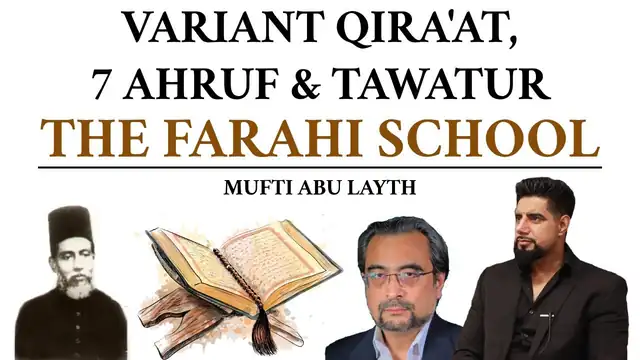 Press play to load from YouTube. Nothing loads until you do.
Transcript
machineauto-transcribed, may contain errors · source: youtube auto · click a time to seek · dotted terms open the glossaryright so just to so okay just to kind of keep the steps so people can also uh kind of keep up that first and foremost what we're saying uh or sorry what what you're saying here is um in the lifetime of the Prophet sallallah alaihi wasallam Quran was being revealed naturally in uh in whatever relevant uh order it was to the circumstances but as the verse of the Quran had taught Allah had already taught the prophet that look when the time comes we will give it its its absolute structure so so we
will so once we have laid out the sequence then follow it now say follow the new sequence important is which means that when we read this a fresh follow sequence and abandon the previous one of course so this one more thing I would like to point out is that if this is so simple I mean anyone can ask that why didn't people uh follow this verse of the Quran the answer to that also is that is not interpreted the way interpreted it and they interpret this verse in a different way our traditional Scholars and they actually rely on
Abdullah abbas's ass of in his Hadith in which he has a different meaning of jam and the word that he actually takes or he actually interprets is that the word Jama means that the Quran will be etched in the heart of the Prophet so it'll be collected in the heart of the Prophet uh and this is how they proceed so just giving you a preemptive answer no absolutely so what I was going to say is that so and then what what you're saying is at the end of The Prophet's life uh in the final Ramadan he repeats the entire Quran this time twice over uh in the in now the Divine sequence so where
you're going with the understanding as well just to be clear that the sequence in the Quran the is what the called it is uh it is divinely set that Allah has set set this and the prophet read this to the Muslims um in his final year twice and and in this reading when it was read to him some some changes may have taken place in PR nouns and things like this as uh not through the prophet but through Revelation so this was in contrast to
the previous let's say pronoun differences part of the origin of what becomes the complex later on so just to just to make sure okay so we've got that up to speed okay MH right now and part of what also has added to some of the differences with where words are actually different may have been the T the kind of over overlapping between certain verses and I can and I can point out two other sources as well so one of them is what we call you see what happened was that the sahab would teach the Quran as well and
they would place a synonym while explaining a quranic word and what happened is that in many instances if you look up for example the M of or ABD Rak you find out a sahabi typically teaching someone and telling them that oh this word means this f means so what happens is that that the meaning that they would tell itself became a and the the the teaching of the Quran in which a sahabi was simply explaining a a quranic word by replacing it with a synonym and that synonym actually became a quranic
verse in itself because they thought that the sahabi is telling us that oh you can read this verse like this as well however the sahabi never went that he just he was just explaining that this word means that so that is a third source and a fourth source which cannot be ruled out is concoction you see uh in the second or third Century just as our had were concocted they were fabricated in large numbers uh we know for various reasons so this Con concoction also cannot be ruled out and I think these are the four major sources which have result and just to add to your you know your third Point like in the palsis that
you have the the manuscripts uh for example one thing that's been pointed out before in as part of there was it said like the person had written I mean that kind of manifested in in part of the research and it was well that wasn't Revelation the these clearly seem to be the notes of the person saying you know he' uh so that just where people are adding notes themselves Okay so we've got this okay in the sense that the understanding is look the Quran was revealed it was rearranged divinely at the end of The Prophet's life there
may have been certain syntactical variations uh that were revealed at that stage so you know there's this verse that oh sorry there's this Hadith not verse that everybody brings up about is this Hadith just baseless is this what uh what you're going with or is it that it has a different interpretation or something so I think uh before explaining I'll just put before before you the conclusion which suti one of the famous Scholars ofum Quran and of course these Sciences has put put forth and he says that this is from among the mutab
the meaning of which has has yet to be known it is an ambiguous narrative and I have shown in my one of my chapters that uh all these explanations of the wordu uh there are basically 40 different explanations of what what the wordu actually means and I have taken about the seven or eight major of these interpretations and and shown that how they are inconsistent and how they don't actually match uh even the Arabic uh of the word the way it is translated and then I've also worked on the isad of these Nar then show that not only theu
ones but the M ones of course the m means mean the narratives which are reported by the sahaba they are not soundly reported although the question still may arise that even if all these narratives are not soundly reported there has to be some kernel of truth because so many people are saying so many different things yeah they claim it's m I was just going to show um in case some of you thinking what on Earth is Muti doing why is he looking down I'm just going to show to some extent from the book uh for you like just as in just holding it that this hold section is
really as you can see almost this whole chunk um as you can see that this what I've got in my hand there is dealing with really the the variations the and then each of the and the different interpretations I mean in great great detail uh but I mean the question is that is this it's definitely confusing to people but is it are we saying it's made up I mean some people will say but so many people transmit it well you see uh what happens is that it's not necessarily made up uh the prophet could have said something about
the Quran which was probably misrepresented and misinterpreted the way we find many other narratives uh I'm I'm these days I'm working on these narratives regarding the return of Jesus and they also uh proliferate we find them in huge quantities from the sahaba maybe in excess of 25 sahaba narrating them and here as well in the sa we find more than 20 sahaba but first we need to understand that the narration of more than 20 sahaba does not make something m is not what we actually uh what actually personally I think which what which is basically called by thei Hadi
Scholars as theat but I I subscribe to the definition of theat which is put forth by the which is the real definition which means a large number of people it's not just five or 10 or 15 and to be fair that you know the Hadith Scholars uh in early Islam for the first several centuries didn't have this term tat in their books it's it's actually introduced much later yeah later
Something wrong here?
Tell us what is wrong and it will be checked against the recording. Nothing changes until a person has reviewed it.
Sending a note needs JavaScript, which is off or unavailable in this browser. Nothing has been sent.
No name, email address or account is asked for or stored, and the inbox does not store your IP address. For rate limiting it keeps an unreadable fingerprint of your connection for 48 hours, and our database provider's own logs record connections as every website's do. Only your note, its kind, the page and the moment in the recording are kept, for review.
Cite this recording
Stable id, transcript version and tier are part of the citation. Every change to a transcript is logged.Mufti Abu Layth Archive, auto-transcribed, may contain errors. https://muftiabulayth.org/r/vokjwefhyn4/ (accessed 1 November 2026)
- APA 7
Mufti Abu Layth. (2020, December 29). Variant Qira'at, 7 Ahruf & Tawatur | Mufti Abu Layth [Video, auto-transcribed, may contain errors]. Mufti Abu Layth Archive. Retrieved November 1, 2026, from https://muftiabulayth.org/r/vokjwefhyn4/
- Chicago author-date
Mufti Abu Layth. 2020. "Variant Qira'at, 7 Ahruf & Tawatur | Mufti Abu Layth." Video, auto-transcribed, may contain errors. Mufti Abu Layth Archive. Recorded December 29, 2020. Accessed November 1, 2026. https://muftiabulayth.org/r/vokjwefhyn4/
- BibTeX
@misc{abulayth-vokjwEFHYn4,
  author = {Mufti Abu Layth},
  title = {{Variant Qira'at, 7 Ahruf \& Tawatur | Mufti Abu Layth}},
  year = {2020},
  month = {12},
  date = {2020-12-29},
  howpublished = {\url{https://muftiabulayth.org/r/vokjwefhyn4/}},
  url = {https://muftiabulayth.org/r/vokjwefhyn4/},
  organization = {Mufti Abu Layth Archive},
  urldate = {2026-11-01},
  note = {Auto-transcribed, may contain errors}
}