
Recordings › Ponderings on the Holy Quran
On the Etymology of Jahannam -Mufti Abu Layth
udhiyah qurbani qurbaani udhiya udhiyya kurbani muftis jahanam hell ibadah ibada ibaadah ibadatvideo · 5:33 · 9,300 views · 11 Oct 2018 · Open on YouTube
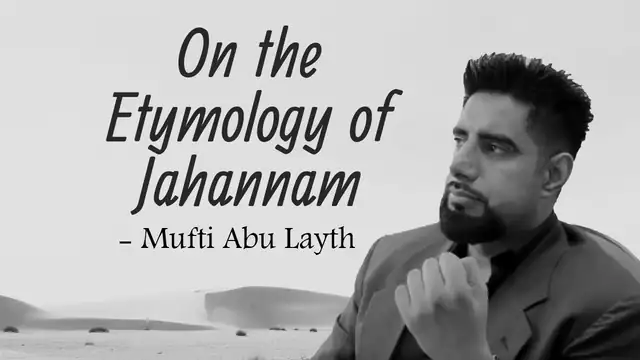 Press play to load from YouTube. Nothing loads until you do.
Transcript
machineauto-transcribed, may contain errors · source: youtube auto · click a time to seek · dotted terms open the glossarythings like Jahannam see jahannum is an interesting word if you I don't know if anybody's actually researched Jahannam I know we normally want nothing to do with John um my god I ain't gonna research II just in case you know I I appear to be too fond of you and but no on a serious note what Jahannam is interesting
etymologically okay etymologically speaking the term because Jahannam is not is an Aruba sized word the word in essence was not an arabic word okay now it comes from where you have the Greek and the Hebrew for E which is again now G Hinnom or Gehenna okay now Gehenna or Gehenna num as you find in the New Testament in the Bible
is mentioned and Jesus does mention Gehenna okay now it's interesting because it refers gear here is referring to the valley of the Hinnom people who were from the the kind of Israelites and part of that kind of God strayed and fallen into superstition and this was I believe it was south to Jerusalem I believe it was part of the the kind of Judah Kingdom but it was south to Jerusalem I believe and there was a valley in half with these people the
Hinnom people who were part of the Israelites greater you know the whole Israelite canna Kingdom they would had fallen victims too deep and evil superstitions and part of which they would sacrifice their children so they would they would actually kill their children as an offering to this God that they were trying to please and it wasn't Yahweh he wasn't God as in God they part of the practices they are deviated they've started to worship another god that would favor them now this God they they would - as a
sacrifice they would burn the Youngs or some of the young alive so they would burn them the children in this valley of the Hinnom people now this became known so this was this dark historic evil a kind of really tragic past - this place gannam and then there's other traditions that state that what happened after that is that this fire would they would keep this fire alight and then people would use after these people are kind of dissipated because of the the the tragic past that this place
had nobody really wanted to inhabit the Hinnom get Hinnom place the way they had this fire and his burning in this tract so people would chuck their trash there they would bring carcasses and other kind of traditions mentioned things like this although that's mean disputed whether people did used to burn their caucuses there and dead animals and and trash and garbage and this firewood that's what this place was used for this you had stench it was filthy it was disease-ridden almost it was a horrible place to be in and so what
happens is Jesus in the New Testament says that people that commit certain atrocities that God has preserved for them a place in Ghana or Gangnam this despicable dis this kind of almost disease-ridden allotment that is consumed by fire and filth and and pass and all this kind of trash and garbage and so this place Jesus gives a a kind
of he makes reference a very graphic illustrative kind of description in saying that the those who have those who have transgressed atrociously against the Lord against the father that there will be a place for them in Gehenna or genome that this fire of Jahannam now it's interesting that this then is brought up in the Islamic in our tradition so but that's the the place I mean so prior to the Israelites and the Hingham people
there was no this is what Jahannam in Gangnam is referring to so it's interesting that even the term in itself is arguably met I mean it's definitely metaphoric or symbolic of a greater kind of like misery and a horrible place that's what it's kind of denoting so I hope that gives some I want to share that because I find that I'm I'm just amazing just mind glowing in many ways to think about
Something wrong here?
Tell us what is wrong and it will be checked against the recording. Nothing changes until a person has reviewed it.
Sending a note needs JavaScript, which is off or unavailable in this browser. Nothing has been sent.
No name, email address or account is asked for or stored, and the inbox does not store your IP address. For rate limiting it keeps an unreadable fingerprint of your connection for 48 hours, and our database provider's own logs record connections as every website's do. Only your note, its kind, the page and the moment in the recording are kept, for review.
Cite this recording
Stable id, transcript version and tier are part of the citation. Every change to a transcript is logged.Mufti Abu Layth Archive, auto-transcribed, may contain errors. https://muftiabulayth.org/r/uqukwofhdfe/ (accessed 1 November 2026)
- APA 7
Mufti Abu Layth. (2018, October 11). On the Etymology of Jahannam -Mufti Abu Layth [Video, auto-transcribed, may contain errors]. Mufti Abu Layth Archive. Retrieved November 1, 2026, from https://muftiabulayth.org/r/uqukwofhdfe/
- Chicago author-date
Mufti Abu Layth. 2018. "On the Etymology of Jahannam -Mufti Abu Layth." Video, auto-transcribed, may contain errors. Mufti Abu Layth Archive. Recorded October 11, 2018. Accessed November 1, 2026. https://muftiabulayth.org/r/uqukwofhdfe/
- BibTeX
@misc{abulayth-UQUKWOFhdFE,
  author = {Mufti Abu Layth},
  title = {{On the Etymology of Jahannam -Mufti Abu Layth}},
  year = {2018},
  month = {10},
  date = {2018-10-11},
  howpublished = {\url{https://muftiabulayth.org/r/uqukwofhdfe/}},
  url = {https://muftiabulayth.org/r/uqukwofhdfe/},
  organization = {Mufti Abu Layth Archive},
  urldate = {2026-11-01},
  note = {Auto-transcribed, may contain errors}
}