
Recordings › Ponderings on the Holy Quran
Is Quranic Imagery Just Wish Fulfillment for Arab Men? -Mufti Abu Layth
muftis akhirah akhira aakhirah akhirat hereafter jannah janna jannat jahannam jahanam jahannum koran quraan al-quran ummah umma ummat alhamdulilah al-hamdu lillah alhumdulillah alhamdulillaah hamdulillahvideo · 5:54 · 2,600 views · 3 Mar 2019 · Open on YouTube
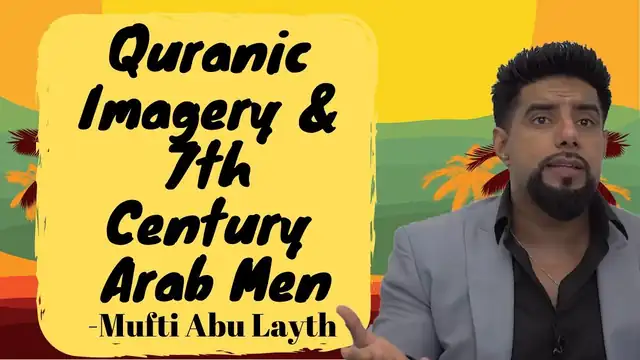 Press play to load from YouTube. Nothing loads until you do.
Transcript
machineauto-transcribed, may contain errors · source: youtube auto · click a time to seek · dotted terms open the glossarythis question heaven and its imagery that is mentioned in Islam is this but just a projection of sth Century men well look I've already said first of all so those of you that have a chance you can watch my clip on YouTube where I speak about the description the imagery in about hell and heaven mentioned in the Quran I already mentioned that look the prophet said heaven or the afterlife or these things are nothing even conceivable he said
that that no eye has seen no ear has heard but then more importantly and no human can conceive of it so then this begs the question what is all this imagery in the Quran then the imagery in the Quran was simply there as an uh as a motivational tool for the first recipience of the Quran that's all it was I mean if it helps somebody fine but it's not actually a meant to be a literal reflection of the
afterlife the afterlife is incomprehensible so that is um so that is what I've said before and I've given examples and uh of things like that like for example mentioning things like shade why shade because the Arabs obviously would long for shade whereas you know if Islam was revealed in I don't know some North Europe or in I don't know Greenland or somewhere freezing then obviously speaking about the shade would be quite meaningless because to those people that's the last thing they want
so the Quran when it was addressing the first community was addressing them as a primary recipient of the Quran from them the rest of the people are by extension so there are things in the Quran that we read today that don't have necessarily the same relevance to us today but it's important for us they still have a deeper message that's still relevant so you know so for example you can read the verses about the afterlife you understand that Allah is telling you that it doesn't stop here he's telling you that there is something he's telling you that whatever is will be wonderful
he's telling you that there will be you know that it is worth the struggle he's telling you all these things but then the actual description that is deployed that is used is something that was time specific more so if others relate to it alhamdulillah if they don't then that's not a literal description of the afterlife some Muslims May disagree with that I'm not saying they don't um but that's something I had explained ages ago and and there are many mu that for example when you read uh things like verses like where Allah says in the Quran that um you know that those people
will have a Jenna they will have a [Music] paradise the width of this Jenna will be as far as what the uh the heavens and the Earth this kind of vastness so many people you get all these people will say this is not literal this isn't that if you measured you would know the exact width this was just there to give some kind of symbolism to people about the vastness and to to kind of encourage them so they mentioned that on these kind of verses of the Quran so just to clarify the afterlife was not meant to be in my understanding the verses that
are there were just simply motivational uh tools and impetus for the people that would receive it so because you see the First Community were a make or break deal if they made it Islam made it if they didn't Islam would have just died with them so they were the most important people and then everybody else as well but by extension so that's um I hope that makes some sense and people may disagree with that and that same goes with the fire you know I've explained these things that this is something and I've got a video on the atmology of the term Janam and
how it comes from the term ganam and G ham the the Valley of the people of uh ham and when Jesus had first used this phrase and the Israelites in Judea and the kingdom of Judea sorry that what was this Valley and what you know where they used to dump trash and keep things on fire and burn it and why did Jesus use that reference and then how this gets later picked on picked up and people use it as a reference uh for a detriment of the afterlife so whereas the Jews prior to that had no specifics on the afterlife okay right so I hope that makes some
sense and it shed some light once again it doesn't have to you know it may not do it for all but what the hell not that there's something necessarily um wrong about certain descriptions I'm not saying that by the way I'm just saying that the descriptions were aimed at a particular recipient Community there's nothing wrong with harim and harim of beautiful HS I'm sure all men will conquer sorry all straight men all straight men and lesbians Will
Conquer anyway anyway what's what's going on
Something wrong here?
Tell us what is wrong and it will be checked against the recording. Nothing changes until a person has reviewed it.
Sending a note needs JavaScript, which is off or unavailable in this browser. Nothing has been sent.
No name, email address or account is asked for or stored, and the inbox does not store your IP address. For rate limiting it keeps an unreadable fingerprint of your connection for 48 hours, and our database provider's own logs record connections as every website's do. Only your note, its kind, the page and the moment in the recording are kept, for review.
Cite this recording
Stable id, transcript version and tier are part of the citation. Every change to a transcript is logged.Mufti Abu Layth Archive, auto-transcribed, may contain errors. https://muftiabulayth.org/r/sbkx2szn7ky/ (accessed 1 November 2026)
- APA 7
Mufti Abu Layth. (2019, March 3). Is Quranic Imagery Just Wish Fulfillment for Arab Men? -Mufti Abu Layth [Video, auto-transcribed, may contain errors]. Mufti Abu Layth Archive. Retrieved November 1, 2026, from https://muftiabulayth.org/r/sbkx2szn7ky/
- Chicago author-date
Mufti Abu Layth. 2019. "Is Quranic Imagery Just Wish Fulfillment for Arab Men? -Mufti Abu Layth." Video, auto-transcribed, may contain errors. Mufti Abu Layth Archive. Recorded March 3, 2019. Accessed November 1, 2026. https://muftiabulayth.org/r/sbkx2szn7ky/
- BibTeX
@misc{abulayth-SbKX2SZN7kY,
  author = {Mufti Abu Layth},
  title = {{Is Quranic Imagery Just Wish Fulfillment for Arab Men? -Mufti Abu Layth}},
  year = {2019},
  month = {3},
  date = {2019-03-03},
  howpublished = {\url{https://muftiabulayth.org/r/sbkx2szn7ky/}},
  url = {https://muftiabulayth.org/r/sbkx2szn7ky/},
  organization = {Mufti Abu Layth Archive},
  urldate = {2026-11-01},
  note = {Auto-transcribed, may contain errors}
}