
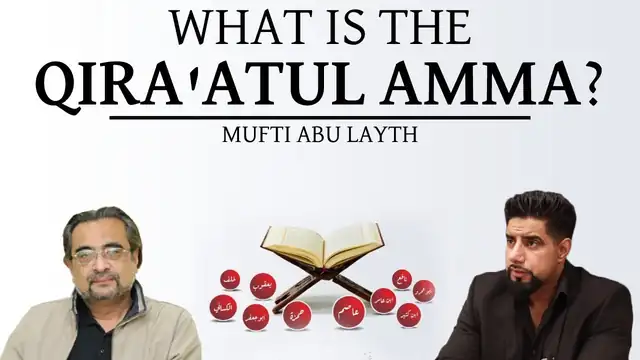
What is the Qira'atul Amma? | Mufti Abu Layth
hadith hadeeth ahadith ahaadeeth hadis ahaadith tafsir exegesis tafasir tafaseer commentary malik ibn anas malik bin anas imam maalik imam malik ibn anas imaam imams prayer leader faqih faqeeh fuqaha shafi'i shafei shafiite shafi'i school muftis koran quraan al-quran qira'at qira'ah qiraa'aat qira'aat tilawah tilawat tilaawah sahabah sahabi sahabiyyah sahabiyat companions 'alim aalim ulama ulema ulamaa ummah umma ummat jihad jihaadvideo · 5:21 · 2,800 views · 24 Mar 2021 · Open on YouTube
 Press play to load from YouTube. Nothing loads until you do.
Transcript
machineauto-transcribed, may contain errors · source: youtube auto · click a time to seek · dotted terms open the glossaryway that they were very they were so confident that they knew that the the reading in the masses is so well established and even like today you find these uh this this this this the quran that we read the quran on actually it was called the quran by ourself so they were so confident that this will be all pervasive and it will infiltrate far and wide that even if these singular readings are transmitted they will just be on the sides on the margins and of course this was the case and this is the case even today so whenever i talk give a talk to people who are not aware they say that this is the first time that that has come to
their knowledge that there are other readings as well and i said this is the design because the transmission of the ilmulcasa which is of course these karat was confined to the scholars so even today only the scholarly community knows knows about it so as far as the masses are concerned they don't have and just for the for people to know that uh this term uh that what this term what you from what i've understood is what you're saying is that it's it's like a proto kira but it is the reading of the quran it's called the general in arabic it just means the general reading
or the common recitation this existed and this was the quran and this is the must have we have today exactly i've understood this correctly right from the sahaba and this was this name was given by the tabernacle to this reading for example abu bakr ahmad sulami uh who lived in the first hundred years uh he was the person he said that this is how we were we were introduced to the quran as the and he said that the reading of abu bakr umar usman ali and the muhajiroun and the ansar was one and it was dubbed as there was no difference and it was being read this way so you can see that in the first 100 years
there was absolutely no problem and even the aha which were being transmitted were just marginalized they were just sidetracked later on actually these karats surfaced because of the fact that this distinction between what was the canonized version and what was the non-canonized version this got somehow mixed up and as i said imam shafi when he said that ilmulcasa belongs to the scholar the scholarly tradition made it upon themselves that it is incumbent upon them to preserve this this hassa so that preservation is what we find in our tafseer books in our quran books in our hadees books and in so many books but never in the masses in the masses
the only quran that we find is al-qaeda except except now there is an exception and those 11 countries which have a different quran of course and there are these 11 countries have four different qurans so i went there to morocco and i found out that uh this this was this was actually the work of a ruler in the third century who was the party of kirwan uh who said that at a certain point of time we will adopt this particular reading and the reason for that being that imam malik the fake of imam malik was in invoke in in the north african continent and imam malik preferred the reading of nafe which is
a different variation of the reading that we have it's different from the amma and they said okay because we prefer malik to be our fakie he's our jurist and malik prefers nafe so we'll adopt the reading of nafe so this is how the reading of nafe got imposed in the african continent in about the third century the later part of the third century and ever since then it has been going on so the only exception are those 11 countries in which a different recitation of the quran was imposed by the authority of the state masses don't have this ability to accept or reject so when you do it from the top it's like an interference in which people said okay this variation is
something that we will accept okay so this is how to so to kind of to kind of like compartmentalize that for for our viewers that what we're what you're saying um is that we've we've followed through that look the quran came through in this particular way there it was called the it was it was one particular recitation these things by the way for those that don't people that don't know these varied readings or these variants are called popularly known by the seven uh you know seven readers and then from
them you've got two further people transmitting 14 in total and and some people have taken them up to in their 20s 30s and even up to 50 different recitations that existed but there was a scholar called uh abu bakr ibn mujahid who kind of popularized these seven now what you're saying is all of these seven first of all these are not mutawati kira at something which uh personally i i do agree with that as well that they that these are not a muttawater they're not on the same level as the common kira the second thing all
of these variations what if i've understood you correctly dr saab you're saying that these are all in essence ichthy had
Something wrong here?
Tell us what is wrong and it will be checked against the recording. Nothing changes until a person has reviewed it.
Sending a note needs JavaScript, which is off or unavailable in this browser. Nothing has been sent.
No name, email address or account is asked for or stored, and the inbox does not store your IP address. For rate limiting it keeps an unreadable fingerprint of your connection for 48 hours, and our database provider's own logs record connections as every website's do. Only your note, its kind, the page and the moment in the recording are kept, for review.
Cite this recording
Stable id, transcript version and tier are part of the citation. Every change to a transcript is logged.Mufti Abu Layth Archive, auto-transcribed, may contain errors. https://muftiabulayth.org/r/ra8e5w_18hm/ (accessed 1 November 2026)
- APA 7
Mufti Abu Layth. (2021, March 24). What is the Qira'atul Amma? | Mufti Abu Layth [Video, auto-transcribed, may contain errors]. Mufti Abu Layth Archive. Retrieved November 1, 2026, from https://muftiabulayth.org/r/ra8e5w_18hm/
- Chicago author-date
Mufti Abu Layth. 2021. "What is the Qira'atul Amma? | Mufti Abu Layth." Video, auto-transcribed, may contain errors. Mufti Abu Layth Archive. Recorded March 24, 2021. Accessed November 1, 2026. https://muftiabulayth.org/r/ra8e5w_18hm/
- BibTeX
@misc{abulayth-Ra8e5w-18hM,
  author = {Mufti Abu Layth},
  title = {{What is the Qira'atul Amma? | Mufti Abu Layth}},
  year = {2021},
  month = {3},
  date = {2021-03-24},
  howpublished = {\url{https://muftiabulayth.org/r/ra8e5w_18hm/}},
  url = {https://muftiabulayth.org/r/ra8e5w_18hm/},
  organization = {Mufti Abu Layth Archive},
  urldate = {2026-11-01},
  note = {Auto-transcribed, may contain errors}
}