
What Distinguished Islam When It Came? | Mufti Abu Layth
sharia shariat sharee'ah muftis riba ribaa sood usury koran quraan al-quran ulema ulamaa alhamdulilah al-hamdu lillah alhumdulillah alhamdulillaah hamdulillah al-din ad-deen ad-din religion rahmah rahma rahmatvideo · 8:15 · 2,200 views · 7 Jan 2022 · Open on YouTube
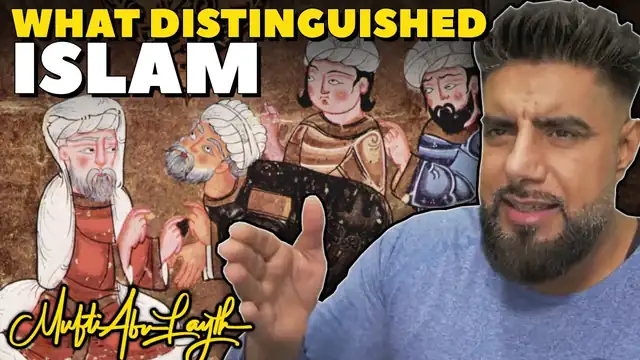 Press play to load from YouTube. Nothing loads until you do.
Transcript
machineauto-transcribed, may contain errors · source: youtube auto · click a time to seek · dotted terms open the glossaryyou know even in the quran you see glimpses you see what you see this kind of message in islam as well although it's not the main projection because what happened with the islamic tradition see you have to remember what people were in need of where islam came okay so let's let's let's talk about this um about the the central theme of islam being justice when islam came it came to a lawless
part of the world that was eclipsed with inequality with oppression transgression and just crimes it was it was really submerged in that so it was not the you see the primary message wasn't going to be i mean not sorry let me rephrase that the message at the vanguard at the forefront that was going to constantly echo was
going to be about justice the message of love and compassion and these things are equally important but the message of love you see allah constantly says in the quran so many verses in allah you have in allah you have allah constantly but why was this not the if you were to say the nectar of the message it's definitely there it's a powerful ingredient but the nectar definitely emerges as justice
because you see when a person is oppressed it's not you know just saying to them hey it's all about love or it's about you know it's it's you know just love everyone and it doesn't work for them because they are in a state of being oppressed and transgressed against they have a yearning an irresistible yearning for justice and this by the way hasn't changed this even today in most part of the world it you know in in i would argue the
majority of the world is still the number one yearning for justice because people have been wronged so the quran in that lawless state it ha it pushed forward the message of justice and then it nested it within mercy and then it it watered it with love and compassion so this is why the central theme that emerges immediately is one of justice
because that was what was needed it was the primary fundamental the the the the crisis and the instinctual yearning that people had so islam brought that now you see and so this is why the ulama most of the ulama developed on the back of a legal platform because legality was about establishing law and order it was about attaining justice it was
about setting up rules it was about structures in society remember this is a society that had none of these it was bereft of all of these so when islam brought this this is why and shariah it it had completely relevant overcame the like this was the the standing point of the dean this is why the scholars for the most part were always for kaha they were jurists why weren't the scholars for the most part why were they not father of the quran for the most why were they not are experts why were they not mufasirin why were they not i'm not saying they were many of these scholars but the
majority were always legal jurists because it was about setting up law and order establishing rights for people having structures having rules in society having giving people this which they did not have now you fast forward to a time where in some parts of the world like where we live in the developed part of the world alhamdulillah there is order for i'm not saying it's perfect but there is plenty of order there are plenty of structures in place there's rules there's
you know guidelines there's contractual um nuances and fine points there's bylaws there's there's cannons there's there's so much of this stuff where we live in the world today that this so you see so what happens as one pulls the other the the other kind of relaxes as the other pulls this relaxes so we we find ourselves with law with within with a reasonably good amount of
lawfulness with rules with structures with bylaws with you know um with guidelines with just with all these points in society in that point we start to see the other element blossoming more of the deen which is about compassion about love about humanity about because these things are there in society see people here yes i'm not saying they don't yearn but it's not the same in this part of the world some people have had enough there's too many rules
you know you park at this place you get fined you go into this lane it's like this you know they can't everything is about technicality now you know somebody does this they only get this this happens to this person this happens to this it's like people are like oh my god i've just got so many rules and laws and by-laws and and they've got too much emphasizing just this this aspect of the dean people can do it but i feel that that is a mismatch because people have that their roar it yearns for the other side for the love for the
for the compassion for that humanity so this is what how these things balance out so i think that's an important message and i think this is why people sometimes mismatch things and don't and i absolutely understand in many parts of the world justice and that is still clearly it you know it's way ahead of the the the requirements it is absolutely number one so many people are still oppressed and you're right that's why in many of the muslim countries that's the number one thing
but when people import those same things here this is why it doesn't gel as well you see you have to understand that the shariah has a a kind of tabitha to it and it gels with with with its surroundings so yeah i hope that's of um some interest you
Something wrong here?
Tell us what is wrong and it will be checked against the recording. Nothing changes until a person has reviewed it.
Sending a note needs JavaScript, which is off or unavailable in this browser. Nothing has been sent.
No name, email address or account is asked for or stored, and the inbox does not store your IP address. For rate limiting it keeps an unreadable fingerprint of your connection for 48 hours, and our database provider's own logs record connections as every website's do. Only your note, its kind, the page and the moment in the recording are kept, for review.
Cite this recording
Stable id, transcript version and tier are part of the citation. Every change to a transcript is logged.Mufti Abu Layth Archive, auto-transcribed, may contain errors. https://muftiabulayth.org/r/qx3yxsb7onk/ (accessed 1 November 2026)
- APA 7
Mufti Abu Layth. (2022, January 7). What Distinguished Islam When It Came? | Mufti Abu Layth [Video, auto-transcribed, may contain errors]. Mufti Abu Layth Archive. Retrieved November 1, 2026, from https://muftiabulayth.org/r/qx3yxsb7onk/
- Chicago author-date
Mufti Abu Layth. 2022. "What Distinguished Islam When It Came? | Mufti Abu Layth." Video, auto-transcribed, may contain errors. Mufti Abu Layth Archive. Recorded January 7, 2022. Accessed November 1, 2026. https://muftiabulayth.org/r/qx3yxsb7onk/
- BibTeX
@misc{abulayth-qX3yxsB7ONk,
  author = {Mufti Abu Layth},
  title = {{What Distinguished Islam When It Came? | Mufti Abu Layth}},
  year = {2022},
  month = {1},
  date = {2022-01-07},
  howpublished = {\url{https://muftiabulayth.org/r/qx3yxsb7onk/}},
  url = {https://muftiabulayth.org/r/qx3yxsb7onk/},
  organization = {Mufti Abu Layth Archive},
  urldate = {2026-11-01},
  note = {Auto-transcribed, may contain errors}
}