
Recordings › From the Mind of a Mufti
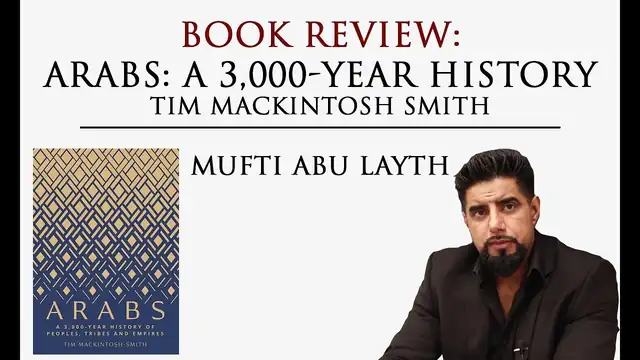
Book Review: Arabs: A 3,000-Year History by Tim Mackintosh Smith | Mufti Abu layth
takbir takbeer takbirat takbeerat shariat sharee'ah muftis iman imaan eemaan eeman jahannam jahanam jahannum koran quraan al-quran shiah shiite shi'i twelver ithna asharivideo · 17:24 · 5,700 views · 9 Oct 2019 · Open on YouTube
 Press play to load from YouTube. Nothing loads until you do.
Transcript
machineauto-transcribed, may contain errors · source: youtube auto · click a time to seek · dotted terms open the glossarymmm Oh guys an awesome achievement on a personal level that's for me that is that I finished just yesterday this book I mean it looks like some kind of sacred text you can't quite see it from the right I mean it's a great book comes
with pictures comes with a coloring in section but uh incredibly eloquent Wow honestly I'm just so mesmerized by ten Macintosh Smith rather why his eloquence honestly the guy is am a so eloquent I cannot believe it seriously I went through the audible version but I make us I was I got so into it what I'll do is I'm just going to share a few words
on this book give a little personal review so get ready buckle down people while others are tuning in rights of this book Arabs a 3,000 year history of people's tribes and empires and it's authored by Tim McIntosh Smith this book the title could not have been made more boring if he
tried but as it said people don't judge a book by its cover although this is decorative however it is but it sounds so goddamn boring and the title does you know Arabs are three thousand year history who wants to learn about goddamn 3,000 years of sit cuz this is what the attitude is gonna be you know going back to the earliest documented in the book coming right up to the modern day Middle Eastern crises
the Gulf crisis MBs everything that's going on in the Arab world who wants to reach 3,000 years over history it's like Nami it's like somebody when I shared this yesterday they said to me they looked at it and they they commented I can't disclose who they said mostly you must have one dead sex life if that's what you're reading one chooses to
differ you know this book I'm telling you when I got into this book right I was so mesmerized by the whole thing that I then purchased the the hardback I got them on Kindle I got the the you know think the Kindle version so as I would go through it because it's incredibly lengthy as you can see it flows very well I mean I most of it I went through inaudible what I would do is sometimes when I was incredibly fascinated by a particular point I would also when you open up the
the Kindle app it will it will automatically take you if you've got audible and Kindle on the same phone it will take you to where you are on there and it kind of cross-references with each other so what I would do is occasionally when I want to check up what what what was that what do they say take a screenshot maybe share it with someone have a little discussion on it so I would just go to the Kindle app and just highlight the notes there screenshot it take photographs discuss it in my little groups things like this
so but it flows so incredibly well it's not a boring book honestly by any standard and it's so much more than history history is inevitably being taught that is inevitable but it carries the book carries certain motifs certain kind of themes that like this whole identity thing what does it mean to be an Arab this elusive term and the author explores that in the beginning and how who isn't how is anybody actually an
Arab if we're linking it to the Arab the nomadic culture or is it to the tongue and people are Arabs because they are rubber phones they speak Arabic but then the irony or the intriguing irony is that nobody ever or hardly ever truly speaks the high Arabic nobody does today and did they in the past is equally questionable so he looks into the the settlement of the Arabs how the arrows became settled the diverse kingdoms the conflicts the development of the
language what did it mean to speak high Arabic and his theory of how higher Arabic developed because most likely Arabic FASTA clear Arabic developed perhaps about 2 3 centuries before the prophets lifetime it's not actually that old before the Prophet so when he emerges initially his understanding is that the Arabs if that's what we want to call them the Arab people because you had the southern Arabian kingdoms the Aksumite kingdoms which is perhaps modern-day Yemen and
places like this where you had the kingdoms of him ER and Saba the ancient you know the sheba kingdoms and the Marik damn civilization one of the greatest dams actually in recent modern history in fact in modern in human history that I stood for so long so what is this and that is referred to in the Quran as well so this whole thing of he looks at these civilizations the differences they would have had in languages but in a very exciting way you see this sounds dull this sounds boring when I'm saying but in such an exciting
way he ties these kind of themes together develops them that how it must have been that people initially the way you have this speaking in tongues concept that this is where high Arabic began this kind of speaking in like tongues like they're not actually you know making something I mean maybe they're making some sense but they're using these words and there's a lot of rhyming in the words a lot of kind of rhythm and from here you get the share I've the development of the share now the share I it is not what we think
of today as a shade a shy today is a poet simply a poet like you know I'll sit down I haven't got any books here but whether it's a leave me that they need da de la vie John a Leah these poets of all do for example these are poets this is not what the term Shia was in when Arabic was evolving so the Shelf seems to be someone who he's like a he's like almost he's not a preacher but he's somebody like a car so you have the kind who is this
soothsayer this kind of person who speaks in tongues and he does all these things and the shy he travels with that he goes to different places he he kind of does this and hence words are rhyming with each other and he adds these themes to him people and he enters a trance-like state a bit like a shaman today so hence in early Islam when they were saying to the Prophet that he is a Shariah this is the culture they were kind of relating to they weren't speaking like today a poet always a poet
they meant like a shaman and how this Sheriff aids then in the spread of this language called force 1/2 or higher Arabic and then how this language kind of continues to go on the script because the script we have today is a Nabataean Arabic it's not actually the ancient Arabian script so it was most likely it becomes embraced in he just during the lifetime of the Prophet and then Islam aids in the spreading of this script that we have today it's the Nabataean
Arabic script because once the Quran gets written in it then it it's on nitro boost I mean that becomes the currency that you its what kind of flows so but this this and all these struggles the politics as he starts to question things he speaks about in this book characters that went through certain things pre Islam after Islam he questions things like why why did the Prophet I mean it's understandable that the Prophet gained the support of people but the
Arab or a formidable people they were very wild free spirited people it's understandable that they would you know maybe even give allegiance it's understandable but why would they agree pay taxes to the profit you see this was very counter not only productive intuitive to the Arab people the the status the the free spirit so why would these people not only back the profit but they would decide to pay him taxes
which was an insult in the language of the era so it's very interesting how he explores that he has his theories that the perhaps I mean it's very interesting to look into it's very obviously you know to submit her into just a few bullet points would really rob the book of its status but he looks at all the geopolitical things going on and how they may have played a factor in this how he feels that Islam one of the things that incredibly aided Islam and increasingly promoted it or mobilized it
was the fact that it had slogans this is an interesting observation by the historian on things like how Islam had slogans like allahu akbar which is still continued to be used today as a slogan how la ilaha illa-llah is a slogan as well as obviously it's a professional faith but it's a slogan and how people it is you see when you rally a people you rally them with slogans and it's interesting how he explores these things of the the mindset of different people
different civilizations how islam when it does settle after the prophet the the problems the kingdoms the money media the abbasids the the politics oh wow and then right through to the age of you know the peak the age of knowledge and wisdom and you know the age of my moon and the early Abbasids and then the the you know that the kind of stagnation and then the decline and everything i mean i was just so seriously enamoured by this whole thing I have to give it absolutely top marks
it is it is for me the second most powerful book I've ever covered in the English language that's for me because it covers so much more than history politics psychology philosophy everything and so eloquent but that could be see people said to me that look Mufti so you definitely recommend we get it I don't know because as a true if I'm to be objective because look it's not like I'm gonna benefit it's not like I'm on Commission so if you buy the book I
get anything or if you get inaudible so a true statement from me is that look I don't know I don't know if it's for you that's the question because you see this book came to me with almost divinely you know like like at a divinely appointed time it came to me it came to me at a time when I was researching Islam origin theories I was looking at the arguments of Islam revisionists like Patricia crone and other people and I was going
through you know Fred Donner and all these other guys their works I was questioning a lot of what war is Islam history how did Islam begin what is the Sharia what is and I was coming through a whole very deep at an introspective level internal level I was going through a very deep turbulent kind of phase so you know from this is maybe late last year early this year within on trying to understand these things and enhance my understanding you know I've got this
lens trying to maybe clear the lens to see more accurately precisely what is in front of me now this came to me at a time when I was going through that and I came across it to be honest I wasn't that intrigued because the titles boring as hell but I read a review inaudible and the person said well I'm so amazed that this is so well written I can't and you know don't be kind of misled or something like this and I thought well what the hell I'll give it a go and it brought for me not all but so many of
the answers and there was a whole search obviously I was reading other works and I'm researching I was discussing with certain people and and this contributed significantly to me this was a godsend and then the fact that it was written so eloquently and especially when you're listening to it and I I do like to listen so I will you know I prefer things like audible and going through audiobooks and it's got an excellent Marita so to me it was brilliant and like I said it was really just kind of shook my whole world from my
understanding perspective but it may not do that for you you know if I've read this book five years ago it would have probably meant very little to me but at this stage in life it's my camper you know once we reach this maqam it's you know it's invaluable so that's my you know top marks for rich people and if you're into that you may love it if you're not into it don't say you know almost II what the hell [Laughter]
wasting our money and our audible credits so that's that what book are you discussing I'm discussing the book Arabs a 3,000 year history of peopled tribes and empires like I said boring as hell title book Wow book is too goddamn good I did say it was up to me I would make it mandatory I would make it compulsory in every Islamic studies curriculum if it were up to me that's so people who want to study Islam it's a must
perhaps at some stage for them matter slightly
Something wrong here?
Tell us what is wrong and it will be checked against the recording. Nothing changes until a person has reviewed it.
Sending a note needs JavaScript, which is off or unavailable in this browser. Nothing has been sent.
No name, email address or account is asked for or stored, and the inbox does not store your IP address. For rate limiting it keeps an unreadable fingerprint of your connection for 48 hours, and our database provider's own logs record connections as every website's do. Only your note, its kind, the page and the moment in the recording are kept, for review.
Cite this recording
Stable id, transcript version and tier are part of the citation. Every change to a transcript is logged.Mufti Abu Layth Archive, auto-transcribed, may contain errors. https://muftiabulayth.org/r/myunselmh2u/ (accessed 1 November 2026)
- APA 7
Mufti Abu Layth. (2019, October 9). Book Review: Arabs: A 3,000-Year History by Tim Mackintosh Smith | Mufti Abu layth [Video, auto-transcribed, may contain errors]. Mufti Abu Layth Archive. Retrieved November 1, 2026, from https://muftiabulayth.org/r/myunselmh2u/
- Chicago author-date
Mufti Abu Layth. 2019. "Book Review: Arabs: A 3,000-Year History by Tim Mackintosh Smith | Mufti Abu layth." Video, auto-transcribed, may contain errors. Mufti Abu Layth Archive. Recorded October 9, 2019. Accessed November 1, 2026. https://muftiabulayth.org/r/myunselmh2u/
- BibTeX
@misc{abulayth-MYunselmH2U,
  author = {Mufti Abu Layth},
  title = {{Book Review: Arabs: A 3,000-Year History by Tim Mackintosh Smith | Mufti Abu layth}},
  year = {2019},
  month = {10},
  date = {2019-10-09},
  howpublished = {\url{https://muftiabulayth.org/r/myunselmh2u/}},
  url = {https://muftiabulayth.org/r/myunselmh2u/},
  organization = {Mufti Abu Layth Archive},
  urldate = {2026-11-01},
  note = {Auto-transcribed, may contain errors}
}