
How did Hafs & Asim become the most popular Quran recitations? | Mufti Abu Layth
hadeeth ahadith ahaadeeth hadis ahaadith muftis mubah mubaah koran quraan al-quran qira'at qira'ah qiraa'aat qira'aat sahabah sahabi sahabiyyah sahabiyat companionsvideo · 5:29 · 5,900 views · 31 Mar 2021 · Open on YouTube
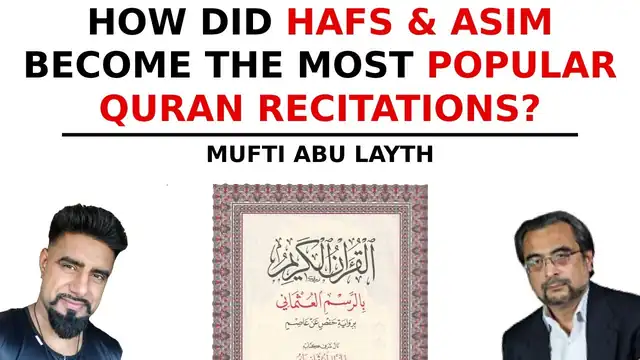 Press play to load from YouTube. Nothing loads until you do.
Transcript
machineauto-transcribed, may contain errors · source: youtube auto · click a time to seek · dotted terms open the glossaryfrom them now there's house who takes uh this person who who kind of recites from uh from asim uh and this is this is the main reading of the quran today now asim does have another student as well who would have some variations how does hafsan ask him from these 14 become the correlate for what is the man the other 13 miss it how does that happen because that's a a huge question mark it's the elephant in the room right so uh my teacher ramirez actually
has tried to solve this riddle and his uh his uh i would say his thesis is that huffs was the only person who read the quran without adding his without adding his his preference from the various choices that he had the rest they they added their if they are they chose from different readers uh the from different sahaba and they made up their own selection huffs was the only person so so before actually i elaborate on this let me also respond okay that's very very very fascinating because i you know i didn't have that answer before okay these leaders were actually very adept
they wanted to have the larger of the arabs so all of them they copied the arabs you'll see that most of them are non-arabs they are they're from different countries from iran from the from the across the nations so they wanted that they should the quran should be read in the laja in the in the accent and the dialect of the arabs so they would they would have this uh this pronunciation as close as they could and each of them had their distinction and what each of them did was that not only they had their own laja which they thought they would be copying from the arabs so each of them also exercised his if they are which of course as i said was the choice that they had in selecting from various readings
it appears that huffs was the only person who did not and this is especially stated in history as well that he just presented whatever was the reading of above the ramanasalami of course was some uh some he inherited from uh in the times of usman the same reading on which usman had guided our people on the muslim so he's the only person who maybe tried the laja he tried to teach people in the elijah of the arabs without adding any if they are without adding any preference you know but here there's a question that we've that would be faced with you know when if saying that and that is that obviously
these people they are exercising this license to kind of you know choose from here this is what in fact they call feet like choosing like let's say i want to pray i'm going to take this part i'm going to put my hands here like the chef at ease but i'm going to do this like the hanafi's i'm going to do now by them doing that demonstrates uh without stating it the fact that they believed that that was something permissible to do right absolutely so you see this is uh one of the reasons that these karat were given sanctity or they were regarded to be sacred was the hadees itself because one of the interpretations of
sabbath is that there are seven variations amongst the quran seven different types of variation for example in wahid jama for example in tahrir for example in the vowels coming at a certain place so one of the reasons which sanctioned these karat was this hadees according to them they said that the quran has been revealed on seven ahref and these are basically ah that we have and the next part of the hadith says which means that you can adopt anyone which is appropriate for you so this is the this is the choice which was given the only thing is that it was not given to everyone only people of insight were given this and as you said that abu
bakr abner only uh selected seven of them before then we have taburi actually selecting 30 readings we have above selecting 25. so there were different people who had had the only thing was that because in baghdad he became very popular uh abu bakr after and he was also state emissary or the state he had a state position as well so his his selection in his choice was as if it was being adopted by state authorities so it it received a lot of impetus and hence you find that his choice prevailed and because of the unzil quran saba of hadees and because of the fact that they
were receiving various uh uh narratives which had these uh uh this these quranic verses piecemeal so they said that okay on the one hand we have the permission from the prophet which says read any of these seven ah and on the other hand we actually have those in data being before us so we are just applying this hadees on that data and choosing
you know but there's still another interesting question here um if we take this uh this understanding of let's say kira was always one and then it correlated with hassan asim because and that was actually that's a very good explanation why because i was thinking uh uh how would you get past this point and and you did get past that that's definitely and so i didn't know that response before
Something wrong here?
Tell us what is wrong and it will be checked against the recording. Nothing changes until a person has reviewed it.
Sending a note needs JavaScript, which is off or unavailable in this browser. Nothing has been sent.
No name, email address or account is asked for or stored, and the inbox does not store your IP address. For rate limiting it keeps an unreadable fingerprint of your connection for 48 hours, and our database provider's own logs record connections as every website's do. Only your note, its kind, the page and the moment in the recording are kept, for review.
Cite this recording
Stable id, transcript version and tier are part of the citation. Every change to a transcript is logged.Mufti Abu Layth Archive, auto-transcribed, may contain errors. https://muftiabulayth.org/r/mbxcmoxcrxk/ (accessed 1 November 2026)
- APA 7
Mufti Abu Layth. (2021, March 31). How did Hafs & Asim become the most popular Quran recitations? | Mufti Abu Layth [Video, auto-transcribed, may contain errors]. Mufti Abu Layth Archive. Retrieved November 1, 2026, from https://muftiabulayth.org/r/mbxcmoxcrxk/
- Chicago author-date
Mufti Abu Layth. 2021. "How did Hafs & Asim become the most popular Quran recitations? | Mufti Abu Layth." Video, auto-transcribed, may contain errors. Mufti Abu Layth Archive. Recorded March 31, 2021. Accessed November 1, 2026. https://muftiabulayth.org/r/mbxcmoxcrxk/
- BibTeX
@misc{abulayth-mbXCMOxcRxk,
  author = {Mufti Abu Layth},
  title = {{How did Hafs \& Asim become the most popular Quran recitations? | Mufti Abu Layth}},
  year = {2021},
  month = {3},
  date = {2021-03-31},
  howpublished = {\url{https://muftiabulayth.org/r/mbxcmoxcrxk/}},
  url = {https://muftiabulayth.org/r/mbxcmoxcrxk/},
  organization = {Mufti Abu Layth Archive},
  urldate = {2026-11-01},
  note = {Auto-transcribed, may contain errors}
}