
Can we prayer in another language other than Arabic? | Mufti Abu Layth
salat salaah namaz salaat namaaz as-salah al-salah salawat hadeeth ahadith ahaadeeth hadis hadees ahaadith takbir takbeer takbirat takbeerat imaam imams prayer leader qiblah kiblah kibla direction of prayer fatwa fatwah fatwaa fataawa legal opinion muftis hukm ahkam hukum hukam ahkaam mubah mubaah da'if dhaeef zaeef da'eef da'if hadith koran quraan al-quran 'alim aalim ulema ulamaa ibada ibaadah ibadat worshipvideo · 9:45 · 6,500 views · 17 May 2020 · Open on YouTube
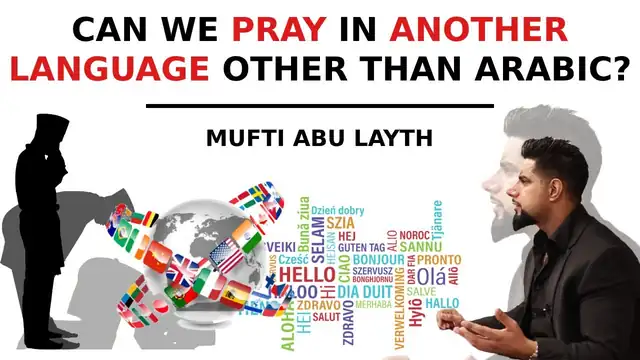 Press play to load from YouTube. Nothing loads until you do.
Transcript
machineauto-transcribed, may contain errors · source: youtube auto · click a time to seek · dotted terms open the glossaryomar cham has asked maybe uh would it be permissible for one to perform salah reciting the quran in translated version in another language other than arabic you see that's interesting because uh there's um uh there's because there are fatawa from the early ulama like early scholars like imam abu hanifa who argued that you could because imam abu hanifa himself
even though he spoke arabic obviously but was of persian descent and his ancestors arguably lived near kabul in afghanistan and then they were kind of brought down into the middle east and and then later on uh imam abu hanifa was born oh sorry no man see what's interesting is when you say uh uh you've also got the great fatimid um imam who's known also as abu hanifa called in
[Laughter] and you've got no man ibn who's imam abu hanifa so it's interesting so you have to i suppose to differentiate uh call you know imam abu hanifan maybe not man because he's also known as abu hanifa right so uh imam abu hanifa did have the fatawa that you could to create ease i would say if a person didn't know arabic and they were trying to learn arabic then during that stage whilst they still don't know how to read like if i they say i must have but let's say this was a uh
you know a must-have and a person they're struggling to read because they don't know the arabic how to read our week but they're learning then meanwhile if they've read in english or if they read in another language i would believe that's fine but i wouldn't say that for life like i would i would say this ought to be a kind of substitute effort until you can recite arabic because the quran you see there's something about the quran we have to understand that the quran is
it's it's kind of scripture in in almost like an art mode okay it has a a special um kind of ambience to it it's not i think the problem is we treat the quran and i get this as well we treat the quran just like a regular book except a holy book but really the quran came in a kind of like a a rhythmic almost art like
expression of scripture and i feel that there was a reason behind that you see i've let me share a thought with you people i was watching those of you that haven't still seen uh money heist or what is it la casa de papel uh it's obviously epic one of the best tv series ever but i was watching after i finished all uh i finished the fourth season i was watching um the they've got a documentary on netflix called uh
money heist the phenomenon um now and and it's it's going through it's interviewing the characters and it's it's very in fascinating for all the money heist fans but there's something that got me it provided an answer to me about something which i was thinking about for for a while and i couldn't quite fathom i mean i could it's like maybe fathom isn't the right word like i had the answer already but it just didn't fit and you see in in this documentary there's a part where he's asked that oh the directors are speaking about
all the producers whoever is they're speaking about why was this a success a success and they speak about several things why does it resonate with people so they speak about you know because of this it represents you know this tension this so on exciting amazing story blah blah blah blah blah all that you know cinematography but then there's a part that they speak about about symbols you see one of the reasons it was such a great success is because of the symbols it brought back
now or it it introduced it's not about bringing back but it introduced like an outfit it introduced a color red it introduced the kind of dali masks it introduced the bella ciao um kind of song and sung it in a passionate way it it introduced the concept of resistance la resistencia this now this is incredibly fascinating because human beings need symbols
and you know when i was watching that all of a sudden something that was a kind of concept that was already in the back of my mind for now i think maybe one to two years just kind of clicked and that was i don't know if you guys remember when i've reviewed the book arabs a three thousand year three thousand year history and in there he speaks uh macintosh he speaks about why he feels islam took off the way it did in the early stages and he says that you see it was
it was the symbols that people it was the thing like la illah was a slogan things like allahu akbar even till today he highlights that people use that as a kind of cry to to attack or to do things to kind of invoke uh or sorry to evoke strength allahu akbar that it was the fact they had a book the fact that they had a
a point of direction the qibla it was you see these things may not seem powerful but when you bring them together they are enough to mobilize an entire civilization because people so desperately in their lives need symbols and they this resonates with them so why am i and when i was watching this this thing this thought because when i'd heard that before and it was there i i mean i made sense of it but it didn't fully click and i was watching that documentary and it
just clicked and i thought wow i i you know it just makes so much more it's like a lens just comes into focus you know i suppose it's like that that hadith which isn't which is a weak hadith but it says that everything about the scholar is an act of ibadah even is sitting drinking sleeping because you never know what you're watching and what idea it kind of triggers in your mind so yeah so i thought wow that is so true
that you know the like you know that that book because the concept of the book is what is so powerful to people and it moves people and you know for for years i didn't understand that because i used to think well why do you know why do muslims feel so passionate about the quran yet they're not interested in learning arabic and understanding the quran because to them the quran is a symbol it's the symbol of the book that is powerful as opposed to even you know the actual
content even though i'm sure if you ask them they'll obviously say it's important but if you look at the reality like they're not actually that interested in learning about it but it's the concept that mobilizes them the symbol s now this this this book so you know but yeah i mean that's a thought i thought i'd kind of share that with you guys i'm not sure if it makes much sense
us
Something wrong here?
Tell us what is wrong and it will be checked against the recording. Nothing changes until a person has reviewed it.
Sending a note needs JavaScript, which is off or unavailable in this browser. Nothing has been sent.
No name, email address or account is asked for or stored, and the inbox does not store your IP address. For rate limiting it keeps an unreadable fingerprint of your connection for 48 hours, and our database provider's own logs record connections as every website's do. Only your note, its kind, the page and the moment in the recording are kept, for review.
Cite this recording
Stable id, transcript version and tier are part of the citation. Every change to a transcript is logged.Mufti Abu Layth Archive, auto-transcribed, may contain errors. https://muftiabulayth.org/r/m_mclfy_gvm/ (accessed 1 November 2026)
- APA 7
Mufti Abu Layth. (2020, May 17). Can we prayer in another language other than Arabic? | Mufti Abu Layth [Video, auto-transcribed, may contain errors]. Mufti Abu Layth Archive. Retrieved November 1, 2026, from https://muftiabulayth.org/r/m_mclfy_gvm/
- Chicago author-date
Mufti Abu Layth. 2020. "Can we prayer in another language other than Arabic? | Mufti Abu Layth." Video, auto-transcribed, may contain errors. Mufti Abu Layth Archive. Recorded May 17, 2020. Accessed November 1, 2026. https://muftiabulayth.org/r/m_mclfy_gvm/
- BibTeX
@misc{abulayth-m-MClfY-gvM,
  author = {Mufti Abu Layth},
  title = {{Can we prayer in another language other than Arabic? | Mufti Abu Layth}},
  year = {2020},
  month = {5},
  date = {2020-05-17},
  howpublished = {\url{https://muftiabulayth.org/r/m_mclfy_gvm/}},
  url = {https://muftiabulayth.org/r/m_mclfy_gvm/},
  organization = {Mufti Abu Layth Archive},
  urldate = {2026-11-01},
  note = {Auto-transcribed, may contain errors}
}