
Recordings › MindTrap with Mufti Abu Layth
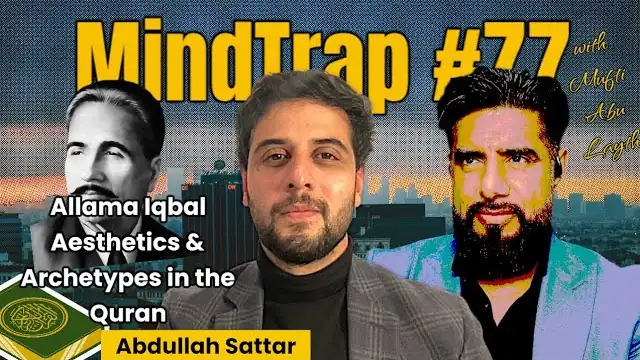
Abdullah Sattar | Allama Iqbal, Aesthetics & Archetypes in the Quran | MindTrap #77
salat salaah namaz prayer salaat namaaz as-salah al-salah salawat haj pilgrimage hadj fiqah jurisprudence fikh hadeeth ahadith ahaadeeth hadis hadees ahaadith sirah sira seera seerat prophetic biography musafir traveller musaafir safar malik ibn anas malik bin anas imam maalik imam malik ibn anas al-bukhari imam bukhari sahih al-bukhari sahih bukhari saheeh al-bukhari saheeh bukhari imam al-bukhari imam ghazali takbir takbeer takbirat takbeerat imaam imams prayer leader udhiyah qurbani qurbaani udhiya udhiyya kurbani ka'bah ka'ba kaabah maaliki malikite malikiyyah maliki school shafi'i shafei shafiite shafi'i school fatwa fatwah fatwaa fataawa legal opinion muftis waajib wajibat obligatory dalil daleel adillah adilla proof tawhid tawheed tauheed touheed shirk shirq mushrik mushrikin iman imaan eemaan eeman qadar qadr taqdeer qada wa qadar al-qada wa al-qadar predestination divine decree akhirah aakhirah akhirat hereafter afterlife jahannam jahanam jahannum koran quraan al-quran sura soorah surat suwar soora ayah aya ayat ayaat aayah aayat hifz hafidh haafiz hifdh huffaz hafiza memorisation sahaba sahabi sahabiyyah sahabiyat khalifah caliph khulafa khilafah khilafat caliphate khilafa makkah makka mekka madinah madina al-madinah madeenah yathrib al-andalus andalus moorish spain ahl al-sunnah ahl as-sunnah ahlus sunnah ahl al-sunna sunnis sufi sufism soofi 'alim aalim ulema ulamaa shaikh sheik shuyukh shaykhs dawa dawat da'ee invitation ummat community fitnah fitan strife deobandis deoband barelwi barelvis brelvi barelwis nikah nikkah nikaah nikah nama nikahnama in sha allah insha'allah in shaa allah insha allah inshaa allah alhamdulilah al-hamdu lillah alhumdulillah alhamdulillaah hamdulillah subhan allah subhaanallah subhanallaah ma sha allah masha'allah mashaa allah bismillah ir-rahman ir-rahim bismillahir rahmanir rahim bismillahi bismillah al-rahman al-rahim as-salamu alaykum assalamu alaikum wa alaykum as-salam greeting niyyah niyah niyat niyya niyyat sabr sabar duaa duas duaas supplication amanah amaanah trust deen ad-deen ad-din ibada ibaadah ibadat rahmatlive stream · 1:37:10 · 3,200 views · 26 Sep 2024 · Open on YouTube
 Press play to load from YouTube. Nothing loads until you do.
Transcript
machineauto-transcribed, may contain errors · source: youtube auto · click a time to seek · dotted terms open the glossaryWe're just firing up. Let me just see that this has gone live. I'm just going to let also a quick message here. Right, those of you that are just tuning in um
All right. I've just sent a message out to my Discord letting them know Fahad, Allahu Akbar.
As always, an avid keen viewer. Allah keep you always blessed. Right, we're back people with another episode of Mind Trap to take a deep dive into spiritual physical philosophical dimensions intertwined as always with a mystical lens.
Tonight's guest, a keen student of philosophy and metaphysics, who we've had previously, almost I believe 2 years ago on Mind Trap. That is all the way from Alberta, Canada, Abdullah Sattar.
So, Abdullah Sattar, assalamualaikum. Wa alaykumu s-salam wa rahmatullahi Mufti Saab. How are you? I'm good. I'm good. Allah be praised. Um right, I take it people can hear us loud and clear. Abdullah, welcome back and shukran for sharing your time and thoughts with us.
Right, it's As it was before, I'm sure it's going to be an incredible pleasure. Yeah. Inshallah. Shukran. Alhamdulillah. Um I'm really glad to be back. Uh you're like always, you've been doing amazing work, masha Allah. And I feel consider myself lucky to be part of that. Alhamdulillah. Allah bless you, man. Allah bless you. Yeah, you know, since I know we spoke previously on um a bit of philosophy, we spoke on linguistics.
Um it's been I I think about 2 years we spoke on Bulleh Shah, a you know, a mystic, a great mystic of our tradition. I've recently been taking a bit of a uh you know, a deep dive into the learnings and teachings of Sheikh ul-Akbar ibn Arabi Muhiyuddin. And really just trying to benefit from you know, from that.
And I've been trying to share it with uh you know, the viewers and people who watch and follow this channel. Wha- Tell us a bit about what you've, you know, your kind of journey during that time. You've also been looking into some philosophy. You've been uh there's Sheikh Ibn Arabi, of course, in the backdrop, but there's some other keen figures that you've been taking a look at, as well. So, navigate us through a bit of this, Ustad.
Alhamdulillah. Bismillah Rahman Raheem. Um you know, when we talk about Sheikh al-Akbar Ibn Arabi, one of my teachers used to say that Ibn Arabi flips your world upside down, and then you realize that this is the right way up, and you were upside down before. And uh that's kind of the epiphany I had when I uh read Ibn Arabi's works, and you know, I barely scratched the surface, but even that bit was enough to essentially blow my mind away.
Because his concepts on existence, on metaphysics, on ontology, on epistemology, on the self, it um it's so deep and has such substance to it that it opens up the doors of uh you know, a whole It's kind of like a a dream within a dream within a dream. So, for me, my journey, you know, I I actually when I initially became um like I mean, obviously, I was from a Muslim family, but when I I guess in a way reconverted, I came close to Islam again, it was actually through initially through the works of uh Sheikh al-Akbar um
uh Sheikh al-Akbar, but even before that, it was uh Hujjat al-Islam Imam al-Ghazali. So, you know, I looked at Imam al-Ghazali, I looked at some of his works, and Imam al-Ghazali is a figure that it's very He's not very disputed across uh the dimensions or the uh the the surface of the Muslim world, there's a lot of acceptance for his philosophy. But then you study Imam al-Ghazali in depth, and you realize some of the things he's saying.
And Imam al-Ghazali is actually talking about non-duality on a very deep level. Um some of his works such as, you know, The Marvels of the Heart, which is book number 20 of Ihya Ulum al-Din, or the Book of Knowledge, or the Book of Dua, or Kimiyaye Saadat, which is The Alchemy of Happiness. Mhm. The way he talks about God and God as essentially being the ground of all being, it seems to be like the other side of the coin of what Ibn Arabi was saying, which I found out when I started studying So, for me, my journey started with Ghazali, which led me, like alhamdulillah, to Ibn Arabi's works.
And then once you get introduced to Ibn Arabi's works, you start looking at all of philosophy from an Akbarian lens. Like we call it Akbarian because Shaykh ul-Akbar, and from Shaykh ul-Akbar comes the word Akbarian. So, that in of itself becomes the lens from which you view every other philosophy. So, recently, as you mentioned, I've been also looking into some relatively contemporary philosophers. Like they're not contemporary to our times, but they weren't medieval either.
Like people such as Muhammad Iqbal, for example. And then you look at Iqbal, and you look at his existentialist thought, his thought about the human struggle, the soul striving to become better, and, you know, essentially taking a flight like the eagle towards God. And even within that, you can find elements of Akbarian thought. So, you know, I can obviously, inshallah, elaborate on that, but the The point here was that I thought that all roads led to Rome, in a way.
And no matter what thinker I kind of went to, I always found some strands of Akbarian thought within it. And I think that speaks to the strength of a worldview that if you're able to look at two, four, five, 10 different things, and you see themes within it, which all point to something bigger, that speaks to how deep and how true that particular worldview is. And so that's why I got so convinced of that Bahrain worldview um and then the metaphysics of Islam through that thinker.
Yeah, I mean I it's difficult finding people that have influenced thought in such substantial ways. And sometimes in um almost I don't know if the right term for it is in subconscious ways. But in ways that people aren't even always aware that this has been influenced by the likes of Sheikh Ibn Arabi.
And so as an example, I mean you could take somebody just to give you could take um somebody like Freud. Mhm. And you know, he's in some way such a you know, a victim of his own success that you could take the unconscious mind. Which in many ways Freud is of clearly an unknown figure, but the unconscious mind is so popular it's just become a mainstay of our knowing.
Um to the extent that we don't even associate it with Freud uh necessarily the thought of the unconscious mind. So there's some things that they almost you know, they're so successful that we don't even necessarily always make the connection. And I felt that um the more I learned that Sheikh Muhyiddin, you know, Sheikh Ibn Arabi has in many ways been like that, you know, he's he's this uh mystic.
Uh uh I had this I had in my last mind trap with Sheikh Siddiq Bahal, we had this discussion and and he didn't really like the term mystic, but I said I personally do, you know, I'm I find it absolutely fine and I do use it. I'm not sure are you do you have an issue with the term mystic or Not at all. All right. Okay. Yeah. So, yeah, I thought I'd just ask. And so, he's he's a mystic who appears, you know, he's not the first of his kind.
Yeah. But he appears at a time where something is happening. Mhm. You know, in the almost in the the kind of umma um teleological landscape, you know, that this the 600s, something happens. He's in a time where there's all these great mystics appear. You know, there's him, whether whoever you're going to think of, uh whether it's going to be a Jalaluddin Rumi, Suhrawardi, even Sheikh Abdul Qadir al-Jilani just slightly prior to him, or whether it will be people like um um
you know, Moinuddin Chishti. All of these people are from the same kind of era. And the same There's something happening. Something's brewing. It's as if you know, there's this Cambrian explosion that takes place of um spiritual mystical thought. And but the thing about Sheikh Ibn Arabi is that unlike a lot of the other mystics or spiritual you know, personalities of Islam that come from that time, Yeah.
he turns to articulating his experience, his kind of mysticism through philosophical discourse. Mhm. So, unlike you know, let's say, you could take somebody like Khwaja Moinuddin Chishti who does the dawah of Islam and is very functional and practical.
You could take uh other people. You know, there's a lot of people are at at this time that even Shah Jalal of Bangladesh is from the similar era and all of these people, but there isn't their thing is it's it's incredible. It's on the ground. It's helping people. It's real work. But it's not really about trying to articulate in philosophy this experience.
It's more about conveying the experience that that were the Islam to people. Whereas you've got some one could say well there was I suppose uh you know, Shahab al-Din Suhrawardi who does try to articulate his works. But really Ibn Arabi he just goes to this incredible length writing in which in ways which bewilder people, you know, we can't even fully sometimes it's sometimes it's obfuscated by you know, all this like well like whoa, what is he saying?
But um and I suppose parallel to him you've got Jalal al-Din or Rumi who's capturing it in poetry. Mhm. Cuz poetry poetry is beautiful, but poetry is not so much about philosophy. It's still more about the experience. You know, you read poetry you go va. God just by Yeah, so so yeah, but this whole thing of wujud that you mentioned understanding that for Allah we say Allah is al-Hayy.
He is the living. Now, the living what it's kind of being understood as here because to for Allah life is not like life generally must be predicated on I believe it's nine factors, but you know, something can metabolize, it can grow, it can move, it can do so and so.
This is not what we're thinking about when we're saying Allah is al-Hayy. You know, Allah doesn't grow, he doesn't you know, he doesn't metabolize, he doesn't do these things. For Allah al-Hayy it is this it is tantamount or synonymous with his true being, that he truly is that his his hayat is true wujud.
You know, it is this beingness with you know, like in capital letters. That's al-Hayy. Because for us hayat cuz what cuz otherwise what what what does that even mean? Al-Hayy for Allah, you know, he's living. Of course, it doesn't that's you know, that it is true wujud in that sense. And then this wujud it is almost from that that this that beingness emerges from his being that you know, al-Qayyum this it it gives this kind of
al-Qayyumness of Allah it then brings into um kind epiphenomenal wujud. A kind of wujud which is things after that. But yeah. So yeah. You know, just to kind of add a couple of points to the earlier point you made and then to what you just brought up right now. Um in terms of your earlier point you mentioned, you know, you comparing Ibn Arabi to other scholars or other Sufis.
You had people like the Sufis of Hind, you know, Khwaja Moinuddin Chishti Khwaja Nizamuddin Auliya, uh Qutbuddin Bakhtiar Kaki, bunch of others in Punjab, Bulleh Shah, Waris Shah, Mian Muhammad Bakhsh. Um and you know, you notice there's a subtle difference between the thoughts of or the works of almost the way in in a Ibn Arabi and then these scholars. And I think a in many ways it also reflects the society that they are speaking to.
Um you have Andalusia and Andalusia was almost a periphery state to the Muslim ummah. Um Andalusia is a confluence it was a confluence of cultures and thoughts. And so the Muslim Sufis of that time their language was in a way engaging with people who did not necessarily believe in that. And they had to be intellectually dealt with or answered or talked to. And so you had scholars like you know Ibn Arabi um and many such other scholars.
Whereas if you look at places like India or as you mentioned the Bengal area, you know, you had people who were it was like folkloric poetry. You had simple people people who they did not necessarily engage with the philosophy of the faith but they associated with the essence of the faith. And so to them you had to use a medium such as poetry which had folkloric imagery. And this is something we talked about last time too that you know in Punjabi poetry they use metaphors, right?
Uh they use the metaphor of a for example the ghara which is that sort of like a clay pot on which you sit and the story of Sohni Mahiwal where Sohni sits inside that pot and tries to cross the river Chenab and the pot which basically um is supposed to symbolize the conduit. Uh Mahiwal is supposed to symbolize God and the Chenab is supposed to symbolize the tumultuous waters of the world.
So these these thinkers they tried to engage with that philosophy through poetry. But I also think that there's another thing that there is to it and this is just my personal thought. Allahu Allah knows this best. You know, you if you read people like René Guénon, he says that about Hinduism, right? He comments on Hinduism. He talks about this idea of the Yugas time being cyclical.
And you know, in Hinduism time came in Yugas it came in cycles. And according to Hindu thought or the Hindu calendar, currently we are now in the Kali Yuga. So, you You know, somebody had just asked a question about this, by the way. So, what timing, yeah. You know, I'll just bring it up. Is time cyclical or linear in the thought of Ibn Arabi? So, wow. See, see, it's great minds thinking alike here.
Look at and and there's this concept of like So, the Kali Yuga, which is according to the Hindu calendar, is what we're living in and that's the cycle that's going on. But, if you look at time in a cyclical fashion as opposed to linear fashion, and I'm not saying like it's linear or cyclical, I'm just saying as a thought experiment, if you think that it's all connected, well, then maybe Ibn Arabi coming at the time that he came to the world and talked about the things that he talked about, maybe he had to do that because in the 21st century his thought had to be engaged with and had to be used as a beacon of thought to counter post-modernism, right?
So, sometimes if we when you look at history, you know, hindsight is 20/20, but you really focus on certain things like had a character like Ibn Arabi not come about, well, you know, maybe Islam still would have spread, people still would have reached out or accepted the the ethos of Islam through other means, but maybe he wasn't writing for them. Maybe he was writing for us.
So, sometimes I think about that and it it blows my mind that, you know, Allah does things in such a subtle with such a lot, like a lotif, right? Yeah. Such bariki. And and you look back and it's like it's all fitting into place. So, you know, that Wow, you know, like the Lord works in mysterious ways. There is um you know, there there is a not so popular Hadith.
It's from a Hadith that has some discussion in its sonnet but where Allah is described with the name Ajib. That Allah is you know mysterious as in the Lord works in mysterious ways. But there is the verse of the Quran where um um the the wife of Ibrahim Alaihis Salaam I believe that the angels say that you know do you find strange or do you find it you know mysterious and strange the ways of Allah.
But the answer in that context is because you do you know we find the Lord works in mysterious ways. And this thing that you're saying having something set up yeah that I guess I never thought of it like that but you're right that it's Yeah in I recently and you could definitely comment on this a lot better than I could but I was watching this the seed video on Surah Yusuf.
And correct me if I'm wrong in this but I think near the end of that Surah you know when God mentions the story of Joseph peace be upon him. And he says that in the end when he seats Yaqub Alaihis Salaam on the throne and he says God is Khabir and Latif. Indeed Allah is knowing and Allah is the subtle one. And then you draw so you have that culmination of that what Young would call the hero archetype right.
So the hero had to struggle. The hero had to go through development. The hero had to face adversity upon adversity upon adversity and in the end the hero hero wins and the hero leaves his mark for all of eternity But then you look back and you're like subhanallah look how subtle the story of Yusuf was like God you know very carefully God made him go through trial after trial after trial and one thing led to another to another, which ultimately culminated in his victory.
And not just his victory, but a victory for all of humanity because it allowed for lessons to be drawn out for us even today. So, you know, I it's we talk about philosophy and we talked about talk about abstract thought, but sometimes it becomes so real in your own contemporary life that you have to stop and, you know, humble yourself that this is real. This is uh it's happening all around us.
Wow. And I I I love what you, you know, just uh alluded to there about the the kind of heroes arc uh with um with Yusuf Alayhis Salaam or with other prophets as well, one could see that in uh in different prophets or different developments of the journey of their story. And, you know, with Musa Alayhis Salaam, we could see that. I was having a discussion, you know, speaking with a friend, a sheikh of mine, uh a a sheikh friend of mine, Sheikh Sohail, and we speak often every now and then about uh different thoughts, and especially Ibn
Arabi, and I was mentioning that, you know, Ibn Arabi often refers to this term as Hadra. This kind of which he he will and and I'm still trying to you know, this is a work in progress. I'm trying to get my head around uh this this Hadrat that he uses. And he will sometimes name them after prophets.
And to me, I was thinking that these Hadrat or this Hadra is like a state of consciousness. Mhm. That there is like a Hadratun Musawiyyah, Hadratun Isawiyyah, Hadratun Nuhhiyyah. And but in that and that's something I'm still trying to that can we somehow have almost planes or names given to certain consciousness.
Um and and that's almost like a work in progress, but whilst we were doing that, Sheikh Soheil, he'd kind of said to me that you know, he said, "You know what's interesting?" And he and he kind of this suggestion. Uh so I guess credit to him for it that you know, there's almost this archetypal mold of each prophet that we could see from the Quran.
This you know, this kind of almost like we could call it that as well, like a habra, a state of consciousness, but this kind of mode of being, this almost uh Musa Alayhis Salaam's archetypal mold, this Isa's Alayhis Salaam's archetypal mold, which incorporates their struggle, their being, their story. And maybe through our lives, we either you know, all or some or at least one, we identify with through the Quran in you know, their archetypal mode of being, we
uh identify our with our own journey as us, like we can be in that kind of consciousness, if you like, of and experience, you know, that oh, that maybe my struggle I can see something from that story, let's say, that I find um or maybe it doesn't have to maybe it's a certain lesson or it's a certain um so I I did think, "Wow." And we we were just talking about this.
And since you mentioned the kind of the the developing arc of a story, you know, whether it's the hero's arc or the traveler, you know, the the this kind of journey uh within a story, uh that just came to my mind that when that how we can um I I don't know if the right word is to Yeah, I guess identify or to put ourselves in that frame.
In that archetypal frame and think well and to take lessons and morals and Yeah, inspiration. I guess inspiration is a good one. This is a I'm really glad you brought this topic up. It's actually something I've been thinking about a lot recently. There's the the connection of the archetypes to the Quranic uh the Quranic um personalities essentially. So, you know, Ibn Arabi in the Fusus al-Hikam, that's essentially like the premise of the Fusus al-Hikam.
He goes through Each chapter is actually dedicated to a prophet. Then one of the main prophets of the Quran, right? Culminating culminating towards the Prophet Muhammad, peace be upon him. And he He says, you know, this this theory what you suggested, the reason I can I agree with that is, you know, you look at Musa Moses was a figure that had Jalal.
Right? Now, Moses, you know, he he punched that that person who was doing injustice to to the people to the Israelites. He stood up to Firaun. Musa's character had the archetype of Jalal. And then Isa's character had the archetype archetype in a way of Jamal or of Yeah. You know, like a ruhaniya, a kind of very uh yeah, yeah.
Very like very uh like very very soft and very subtle. And you know, he I mean, in the Bible it says, you know, turn the other cheek or this idea of like, you know, he he who has no sin shall cast the first stone. Like this idea of like, you know, like rahmah basically. And then you One of my you know, obviously all of prophets have beautiful stories, but one of my favorite stories of the Quran about the prophets is that of Ibrahim.
You know, Abraham is a prophet. If you think about him, Alayhis Salaam, we call him the father of monotheism. Abraham's archetype is almost in a way of that of a builder because he built the Kaaba again. And then he built the monotheistic civilization. So, today of the 7 billion people on Earth, close to maybe 5 billion people or 4 billion people, they think of Abraham as a prophet.
And Abraham was able to build that civilization of monotheism. So, so the Abrahamic archetype is that of building in a way. And you look at somebody like Ayub alaihi salaam, right? The trial of Job. This idea that, you know, like Albert Camus, he's I I've really um enjoyed some of his works recently. He says uh you know this the story of Sisyphus?
Like who So, for the for maybe the audience For those here, yeah, go go for it. For the So, Sisyphus was basically um it's like a mythological character, I believe, in Greek mythology. And he was cursed by the gods to roll a stone up a hill for eternity. So, once he finishes the top of the hill, the hill becomes bigger again and he just continues rolling it, rolling it, rolling it. And Albert Camus, he said that you must imagine Sisyphus smiling.
And you know, you think about that and this this idea of this there's this lazzat in a way. There's this taste in struggle. Like when you're struggling, sometimes you get you enjoy it, you know, you're in the gym and you're pumping weight and you're enjoying that struggle. Or you're running a mile and right at the last minute when your knees are about to buckle, but you're loving that last bit of like struggle, right? So, you look at Now connect that to somebody like Ayub alaihi salaam, right?
Yeah, what's that I was going What's that Yeah. You know, the uh What was it? There's a very famous poem about that as well. But yeah, sorry. Carry on. Yeah. Yeah, no. I mean like you know, Urdu poetry kind of almost romanticizes that in a way, right? Mhm. And then there's this and you connect that to the prophet's story of Ayub alayhis salaam and and you know, obviously Ayub's struggle was not meaningless.
Like he knew that it had meaning. He knew that God had put him into a trial and that he had to be patient and that ultimately God will do what's best. And then God took him out of it. But if somebody's going through a trial, maybe they need to think about the psychology of Ayub alayhis salaam, right? And relate to that. If somebody's about to start something, maybe they can connect to the archetype of the builder from Abraham.
If somebody has to stand up for something just against an unjust unjust person, maybe Moses the Mosaic archetype is something you have to associate with. And the beauty is, you know, that like Rumi calls the prophet, peace be upon him, he says, "Sayyid us sadat Muhammad Nur e Jahan." "May tero behtar shafi e mujriman." "Oh Muhammad, you are our lord and our liege and you are the best of the intercessors of those of us who sinned." You know, like our Sayyid Muhammad Mustafa, it's almost like all of the archetypes were culminated into the final prophet.
And so, you know, we talk about the prophet's finality from a legal and religious perspective, but if you think about it from a philosophical perspective, it's almost like you had the Mosaic principle of standing up for justice or the Isa alayhis salaam principle of rahma or the Abrahamic principle of building or the Job Ayub principle and it's all culminated into the prophet, peace be upon him. So, Sallallahu alayhi wasallam.
So so so true and so beautifully captured. Alhamdulillah, yeah. Yeah. Cuz you know, you cuz we're seeing on one hand we're seeing prophets like Ibrahim alayhis salaam, in one way his archetype is embodying that. Like you said, he is a father, a symbolic religious faith father to most of humanity on Earth almost today, you know, to to a huge proportion of humanity as a whole.
But as he's doing it, he is he he's kind of uh embodying and manifesting this the statement of build it and they shall come. Because he he in his own, you know, he is saying that do I build this Kaaba? Who Where is, you know, "Wa adhin fi al-nasi bi al-Hajj." But where you know, you know, where where where are But there's nobody here, you know, in this As he says, you know, I leave my children here.
"Bi wadin ghayri dhi zar'in." You know, there's nothing nothing even grows here. I don't see people coming. "Wa adhin fi al-nasi bi al-Hajj." They say, "You call out to them, they will come." You know, they'll come flocking, but you won't see it though. Mhm. It will be so much after you. But you you you plant it now.
So we're seeing that. You're seeing, like you mentioned, the suffering. You're seeing uh Musa alayhis salam who you know, he stands up to a uh uh an or we what appears as an insurmountable force, this pharaonic legion, uh this civilization that is uh being so treacherous to his people.
And he's saying, "Look, let me and my people go. We just want to worship Allah. And let us go." And he then sets off on this epic. And he kind of saves his people, rescues them, takes them. But then Musa alayhis Salam passes away before they reach the the holy land, so to speak. You know, he doesn't actually enter the holy land, so to speak.
Now, you've got all of these prophets, the huge, you know, amazing accomplishments and achievements and their journeys. And then you're putting them together and you can see them manifest in the Prophet Sallallahu Alayhi Wasallam, like you mentioned. The building of the ummah from scratch to the extent that in his lifetime the ummah does appear.
You know, the whole in his lifetime the whole of Arabia does appear. The holy land does appear. He does rescue his people. He does go there. He does, you know, take on the uh the the Roman legions, although they don't turn up to the Ghazwah Mu'tah, you know, Ghazwat Tabuk, sorry, at the end. But in the Prophet's lifetime he but he embodies that jamal. That peace. He's not this, you know, this kind of angry person going around.
He has this tranquility about him. Uh you see his suffering, his personal suffering, that he buries every single, apart from one, apart from Fatima, his child, that all of his children Sallallahu Alayhi Wasallam were buried by him. I mean, that's that in itself is, you know, to people with we can't imagine things like that.
Just what one, you know, going through one kind of grief, you think, "Whoa." What it does to a person, that So, you're seeing all of these uh different journeys, these different epics, these different um you know, just successes, accomplishments, all of these parts manifesting, these kind of springs manifesting in the spring of the Prophet Sallallahu Alaihi Wasallam.
So, I feel that that was really well said. I didn't think of it like that until you said it and um I thought, "Wow, yeah." And it is undeniable. You know, it is whether people like the the Prophet Sallallahu Alaihi Wasallam or don't like him, uh you know, non-Muslims, whether they whether they just disagree with him or challenge him or whatever, disbelieve or could be very stubborn or some people unfortunately try to and that's another story as well.
I'm always very hurt and disappointed by this age of Aisha thing that people unfortunately some naive Muslims push it wrongfully and therefore in an you know, inadvertently have our prophet insulted. Um I'm sure that's not their intention, but then that's what happens. But, put that aside for now this whether people like the prophet or don't, what they cannot deny is that the Prophet Muhammad Sallallahu Alaihi Wasallam sealed the last of the great faiths.
That there is never a world faith to appear after Islam. Mhm. Never. I mean, that is a a fact of anthropology. You know, I'm not speaking about whether people have to believe in Islam. Islam sealed the deal on world faiths. You know, there's an interview by Yuval Harari. You know, he's a renowned academic and historian and his world renowned books of like Sapiens and Homo Deus and but there's an interesting and he's an agnostic, I believe, but there's an interesting interview of his on YouTube
where he's being asked questions and you know, what you see cuz he's always talking about the human journey and where humans came from and where they're going and they ask him okay, speaking of religions, do you see another religion could appear? And he says as well, he says that if you mean by religion like you know, just theories and philosophies and you know, things like technology like are you a Samsung person or you Apple then that stuff is always appearing but if you mean a world faith like Judaism, Christianity, Islam like he said that humanity it's as if that window has closed.
Yeah. Humanity now will never collectively adhere to a new faith. That ship has sailed. And you know, it metaphorically it sailed with Islam with the advent and you know, with the arrival of the the prophet and I feel that that in itself is a testimony that he is that the the prophet just anthropologically there is never to be things like Sikhism don't count.
They're not really a global faith, you know, it's just for an ethnicity. So, yeah. This I think it's such a beautifully well put thought. Going back to this concept of you know, this even idea of the common which is the perfect man and then the perfect man is such that he is able to perfectly reflect the attributes of God in the way that they were are meant to be reflected because according to like the human is the locus of the manifestation of God.
And so who is the absolute perfect of men or who is the metaphysical in common? It's the prophet because he you know, like again and this is not us speaking as Muslims, you know, we're having an academic talk right now. This is not an Islamic lecture. But if you were to look at it as an academic topic from a sociological perspective, from a psychological perspective, from a philosophical perspective, to be able to change the trajectory of world thought from deep materialism to a spirituality that is that is rooted in the oneness of
God as opposed to polytheism and to move those people away from basal desires to desiring for something deeper and higher. You know, one of the things that the Quraysh used to objected the most was this idea of the day of judgment. And then you as Mufti, you know, you're somebody who's mashallah well-versed in psychology. The day of judgment is also symbolic of, you know, sacrificing your immediate desires for something that's delayed.
And, you know, they've done studies on children actually that children who as kids they were given, you know, "Hey, I'll give you one marshmallow right now or if you wait 20 minutes, I'll give you two marshmallows." And, you know, from my understanding of those studies, it's this idea that those children who had the ability to show delayed gratification ended up living more prosperous lives. And so the Prophet salallahu alayhi wa sallam was able to change the psychology of those people from from a delayed gratification mindset to a long long vision mindset.
You know, this hadith where, you know, the Prophet salallahu alayhi wa sallam said he saw noor from Sham and Yemen, right? This indication that you will have those things you need to struggle for that in the path of God, have need to have patience, and you need to sacrifice these basal desires. So that alone, like changing the psyche of people while engaging in military campaigns, while running a state, while having interpersonal relationships, while showing kindness, and this is the part that, you know, kind kind floors me the most.
When you're in that sort of environment and you have that much power, you know, it you know, if if if you look at it, for example, somebody else or if this was just, you know, anybody, there is this idea that when you you become a bit detached, right? You're like thinking from a macroscopic level. But the Prophet Sallallahu Alaihi Wasallam, I think this in and of itself is a testament of his Nubuwwah, which is that despite having that position, he had a macroscopic vision.
So, he was able to think about his people and his state, but he was also able to think about children and birds and camels and plants and those subtle things in life. So, how does one balance that, right? So, all of these things they indicate to like a student like myself, a student of philosophy, that if one were to talk about the Insan al-Kamil or the perfect archetype of a man, one had to look at the Prophet Sallallahu Alaihi Wasallam.
And we're lucky like we're lucky to have so much of his life recorded and presented to us, right? In many ways. So, yeah, sorry that was a bit of a No, no, though. That was beautiful and it's so true that look always taught us, you see, the Prophet Sallallahu Alaihi Wasallam is is given the title, a description in the Quran as a Rahmatul lil Alameen.
That a mercy and he is an embodiment. He is a Rahmah incarnate. Mhm. You know, he is Rahmah. As in and right throughout his life, one of the things always the Prophet did was teach positivity. You know, he teach he taught a positive positive outlook. Like just what you were saying right now, these things.
I mean, the point that you mentioned that look even through Ibadah, he was also this teaching you discipline of delayed gratification. Having the discipline to delay gratification and thinking look I'll have it all. Not only is it are you you know it's benefiting you in your akhira, but like you mentioned the studies show that people with that were more prosperous in the dunya.
That's what the studies show that you know if you have the ability to delay gratification, you often when they've done longitudinal those people lived far more prosperous and rewarding lives. Now right to you know what you mentioned like seeing the noor that look at a time of Khandaq where everybody where people where there is an air of panic.
There is a potential genocide that could take place. You know the the Arabs had coalesced as this huge coalition to come to wipe out Medina. You know that's everyone. Old, young, you know, woman and child, man, woman, child does not matter. I think they say something like maybe 30,000 or 40,000. This was what they'd heard what people were coming that they had the tribes had come together Ghatafan and all the others and these big tribes and and you can imagine the air that of you know of being of
of just fear of thinking well what's going to happen. And you know and and people thinking and then at that time the trenches, let's dig the trenches. Salman al-Farsi gives this suggestion. And and that is you know by the way this is the true definition of courage. It is not the absence of fear.
That the absence of fear would be sociopathy or psychopathy. You know like somebody doesn't have any fear at all. They just don't have that in their brain. They don't You know, they they that part the amygdala for example in the brain is too small or it doesn't That's That kind of a person just has like you know, death wish kind of attitudes. That's the definition of courage is having you It's human to have fear, but in the face of fear you still step forward, stand up for justice, you stand up for truth.
That So, the people in Medina are setting about they're doing the trenches. People are starving. They haven't got enough food. This is the famous you know, they people have tied stones to their stomach. They're kind of pressing them in so they don't feel hungry. There's an air of dis- dismay, you know, despondency. It is in this time and they can't break that boulder.
And it's almost symbolic of them giving up almost, you know, because you're hitting this big rock and it's not breaking. It's not breaking. And the prophet comes out and he sees them, you know, in this state of despair. And he says, "Give it to me." And he, you know, rises and he smacks it and it kind of makes this tiny and then he says, "Allahu Akbar." Again.
And on the third one it cracks. And everybody, you know, yells Allahu Akbar. And the prophet says He says, "You know, with the first He says, "With the first crack He says, "I saw the no And he's showing them these visions in a state of despair that people are despairing. They You know, they they they're sad.
They You know, they they don't They're uncertain of what's about to happen. They And And the prophet is saying that "I saw the lights. I saw I saw I could see the palaces of the Sassanid palaces, you know, in in Persia. I could see the noor of Islam having reached the people are they're thinking we don't know what's going to happen in Medina.
Some people are thinking, you know, they're not and the prophet said he's telling them oh, so far ahead. I can see the noor having reached there. That this this kind of contagious spirit of it doesn't matter, you know, if things look down, if things look bad. I shared recently this um incident of Hudaibiyah.
And I said um you know, I said that when it was the the day of Abu Jandal, he he came out and he comes to but as the Muslims are a bit distraught with the whole Hudaibiyah incident and the person who comes is uh Suhail ibn um Suhail ibn Saad, I believe his name is Suhail. And and the prophet says like he says to people around him, he says oh, look he says that's the he sees Suhail is coming and as a play on words for positivity and inspiring that spirit, he says
he says qad sahala lakum min amrikum. You know, ja'a Suhail, qad sahala lakum min amrikum. You know, because Suhail comes from the word sahal in Arabic which means ease. So, the prophet is saying he says to them oh, look Suhail as in this ease has come, look ease has come in your matter. Like ease is about to come. Like you know, don't this is like meaning at all times even if it felt like a you know, it wasn't a success.
To to a lot of the companions, they felt Hudaibiyah wasn't like why why have agreed?" Like they felt that where's the success? We can't see the success. But the prophet's telling them, "Look, it's a success." You know, it's come. We just can't see it yet. But this thing that you were saying as you were saying it, I was just thinking that that this being an you know, this being a Rahma incarnate sal Allah alayhi wasallam in spite of and in spite of having power like you know, like you said it wouldn't
be difficult in certain times to just own that power. Yeah. To say, "Well, you know, like when the prophet sal Allah alayhi wasallam's child passed." And and and and I believe that his child was probably around two. You know, Ibrahim was around I think two or so. And the prophet was deeply you can one can only imagine one can't even imagine the kind of grief.
And at that time there was the eclipse, the solar eclipse. And people said, "Oh, see, look the prophet that even the cosmos comes together grieving." You know, that when the prophet is grieving. And to be honest that you know, the prophet could have just you know, just just gone with it.
But he's he kind of just stopped them and said, "Look, no." These are signs of Allah. They don't eclipse because of the life and death of someone. You know, like don't start attributing this stuff to me. Like like let's just keep it real. That yes, we are grieving. Like the prophet said that look, my tears come out and the heart hurts and it cries.
But you know, this I'm not going to start pretending this happened because of me. Like that that in itself Yeah. You know, salallahu alayhi wasallam. You know, you think about uh Aristotle's rhetoric and he says that he talks about the trivium, right? He says uh Okay. For for for speech to be effective or for leadership in a way, there's this idea of ethos, pathos, and logos.
So, there's almost this idea that ethos, ethics, pathos, passion, and logos, logic. And you look at different leaders around the world, um contemporary times or pre-modern times, and you see those qualities in bits and pieces here and there. But then you start studying the seerah from multiple angles, right? Like there's obviously a way to study seerah from end to end, that's one way. But I like to study it from a from a thematic perspective.
Like for example, I'll read the seerah, like what are the themes of um strategy in this in the seerah that I'm reading, for example. Or what is this what are the themes of uh intellectual thought that I'm, you know, the Prophet salallahu alayhi wasallam as peace be upon him as a thinker, the Prophet peace be upon him as a military strategist, the Prophet as a prophet. So, you look at that and then you see that the Rasulullah salallahu alayhi wasallam embodies ethos, pathos, logos in the perfect way.
Because, you know, obviously his speech had passion and it had effect on people. And you know, it goes all the way back to when he collected the people of Mecca and said, "O people, if I told you that there was a giant army behind this mountain, would you believe me?" But then also he had ethical standing. Like he had a reputation of being truthful and honest. And then on top of that, he was a truthful man in his speech and what he said made sense in terms of logical coherency.
You know, believe in one God. Don't oppress the orphan. Don't oppress the beggar. Don't oppress the widow. Don't treat slaves badly. No white has preference over a black. These things which are so innate to human beings now, he took a stand for them back then. Yeah. And again, like you said, it's very easy for people to, you know, not take a stand when the chips are down, but, you know, he did the exact opposite.
So, to me, it's like I talked to this with my friends who are not Muslim, too. And uh Okay. You know, obviously, they're very respectful. We have respectful discussions, but my I always tell them that, "Look, read the prophet, peace be upon him, with the eye of love once. Read about his life with the with the heart of a lover just once. And after that, you won't be able to go back. Because Yeah.
you know, if you put blindfolds on your eyes, you will find things always, like you said, you know, you'll you'll put yourself off from the truth. It's like that idea of like, you know, the person who saw the moon being split, and he still didn't believe. I believe it was Abu Jahl, if I'm not mistaken. Um Could be. Yeah. Um but this idea that, you know, you people blind themselves from the truth. But if you were to genuinely read about the prophet Muhammad, from a neutral neutral perspective, and again, with the philosophical background or with a background history, you you can't deny the truth of it.
Yeah, no, I love I love that because it's so, you know, in khuluqin azim. Mhm. That you have an undeniably great quality of character about you that that is not just, you know, this is it it's like you said, when the prophet, he comes to Khadijah, radiyallahu anha, telling her about his experience, and she comforts him and consoles him, and then she takes him to Waraqah ibn Nawfal, you know, her um her relative who's a Christian learned man.
and he says that, you know, I feel this is the same being that visited Moses and so on and, you know, meaning that this is and and he says to the prophet, he says, "Your people they, you know, you you feed the poor, you help the helpless, you um you know, you do all these things, these great things that your God wouldn't, you know, God would never forsake you." But he says to that, "But I if only I could be there when your people evict you from this town." And and, you know,
and the prophet says, "Our Muhajirun, what my people would what chuck me out of this town?" That because the prophet standing amongst them was a Sadiq al-Amin. They never had ever an issue with the prophet. He was you know, he was somebody that they all admired. They he was very dignified.
He was dignified you know, before his maqam, the station of public prophethood. He was dignified and uh honored amongst them. And even right after you have even amongst the Muslims, there's there's the famous there's a famous incident where somebody uh he'd hit he you know, he'd wronged the Muslims and he'd done certain things and um and he comes asking for forgiveness and then the prophet forgives him.
But as he forgives him and and he goes I believe it's said now Omar radiyallahu anhu who says that, you know, he says to the prophet I wanted to, you know, because this person had done a lot of damage that I wanted to take him to account whilst he was standing in front of you. I wanted to grab him and and he says to the prophet and everybody knew it that the person deserved that.
And the prophet says, well, he kind of asks him, well, okay, well, what stopped you then? And you know, if you wanted to do it because you knew this person had done all this wrong and he's he's now made his way here and you know, you could have stopped him first and you could have done What stopped you? And he says, well, I was waiting for you to give me He says, I was waiting for your eyes to kind of give me a a kind of sign like to go, you know, like to say, like do something like this.
And the prophet said, you know, that the He says the He says it's not befitting that we have I am. That we do things like this. You know, that there is a dignity to this station of prophethood. We don't, you know, we're not going to do things like make these kind of signs with our eyes and do stuff This is this is not befitting. Yeah. Of the of of a messenger of Allah.
And I thought, wow. Yeah. Sorry sorry to cut you off there, but you know, just Mufti Saab, you're you're talking about this, right? And you mentioned there's this beauty of the character and I feel like one of the biggest problems that we face as an ummah is that we've left aesthetics behind. This idea that the aesthetic had to be given its right due. Because was beautiful.
I mean, not just the character, but also like physically beautiful and then the way he would dress, the way he would speak. Imam Tirmidhi's Shamail is literally a book which is a compendium of how the prophet was beautiful. And so and you know, there's a Hadith too, right? That you have a Jamal like like He loves beauty. So, you're talking about this the prophet that it in that Hadith where he says that it does not befit a nabi or rasul to do that.
And I think that speaks to a deeper point that any believer of God it should not befit them to do something that is ugly or to be in a way that's considered ugly. And I'm not talking like, you know, from a shallow surface level perspective. I mean like this idea of the mukaram al-akhlaq, like this idea of like this this building your virtue ethics to a point of essentially reflecting an aesthetic state because you know, Plato talked about aesthetics.
And he said that aesthetics and truth are very closely tied. Like the truth beautiful. And falsehood is ugly. It's it's Yeah, almost the the trinity, you know, the goodness, beauty, and truth. These things, yeah. It's it's literally And, you know, so so this kind of goes like this is a bit of a philosophical like tangent, but this idea that these small things that the ummah used to have, right?
It could be something as small as the way we dress, right? Like just our dressing like And I again, I'm not going into like what's like the contemporary dress or what's supposed to be an Islamic dress code and code. But this idea of taste, of like subtle aesthetic ability. And how it it reflects divine attributes in a way, right? I was watching this video by an architect, I forgot his name.
He said that the way houses used to be designed before, you had this like a chardivari, you had like a boundary wall, and then you had rooms in that in that boundary, and in the center of the house was the courtyard. And the courtyard used to have a garden and flowers and a fountain. And the courtyard was obviously natural. So the courtyard symbolized divinity in a way. And the periphery was man-made, so that symbolized materialism.
And the way the houses were designed like that, it was to remind man of always to keep God at the center of the heart, not at the periphery. And now you compare that to modern or post-modern architecture, we have these 20 20,000 apart people apartment in buildings and we're in these like concrete jungles and we're away from nature, we're cut off from nature. We've lost that sense of um aesthetic ability.
And you know, with that leads to this degeneration of like belief in God, too, because you your belief in God is not just a rational syllogism that you from A to B to C, it's a holistic understanding. And that happens to your ability to see beauty, right? And if you cut that thing off, right? Like if you if you cut off that ability, then you're going to lose that sensibility.
And um I think that's what's one of the things that's happening as today as an ummah. Yeah, wow. You know, the this this whole this whole journey taking from the seerah right through the development of the ages to dark times that we've come through as an ummah, you know.
Arguably some of the darkest times that the ummah went through was colonialism. And because it was a time in which the it was a time in which Muslims unprecedentedly saw no glimmer of hope. Like they they were born I mean that that you know, they were raised and died in this kind of slavery.
Their children who the same thing, their grandchildren. I mean, this had never happened in Islamic history on that scale. I mean, you had some peripheral lands that were occasionally taken by over by non-Muslims and then maybe Muslims took over some land. But, the main stay of, you know, Muslim the Muslim world was never kind of beaten so bad Yeah.
that it for, you know, like over a century the whole thing was beaten. That that never happened in Islamic history. So, at that time the And And the warfare isn't just, you know, it isn't just uh through the military, which it unquestionably is also, but it's also psychological.
It's theological. It's philosophical. It's, you know, all of these things are you know, they have a battleground. And people are being challenged. People are being put through dark times. We They are tasting and embodying, you know, they are living through despair. They're giving up. They're um And it's also in this time, but what where I want to take this is to the, you know, the spirit of uh the spirit that Allama Iqbal during that time was trying to evoke and awaken uh in the people because he lived through this and this
is, you know, when we opened up this conversation, we spoke about that. But, just as a going off on a tangent, I just want to say uh for the viewers as well, um because I mentioned the age of Aisha thing, I do feel that in my analysis of things that this age of Aisha that people have mistakenly put as so low, put us something like six and nine or seven and nine, when she was easily in her late teens, probably, you know, something like about 19, maybe 18, something like like that.
A lot of this is actually a reaction to uh colonialism, which people aren't actually aware of. So, this is actually a modern phenomenon. What's happened is just to just briefly say this, and I don't want to, you know, I know this is a bit of a tangent, but because it's connected to the seerah, that what's happened, we have Look, we have in our texts many things that are not a theme.
So, yes, the Hadith in Bukhari has existed from before. No, you know, the the British did not come and insert that Hadith in Bukhari. It was already there. There have been topics in Islam that have already been there, but they're not a topic. So, so for example, many people might be surprised to learn that before the 20th century, there was never a book written about the beard in Islam.
That there is no scholar who's ever They've written about the beard, but never a book dedicated to the beard. And there were people who used to shave, and there were people who So, for example, Ibn Abidin speaks about the Moroccan Muslims often would shave and so on. It's not that people hadn't done this ever before, but it wasn't a theme that had hit a point of critical mass, where people, you know, had started discussing everywhere, writing about it.
That hadn't happened. Now, that only happened in the 20th century. That So, in the last several decades, it's when the first time Muslims started in the 20th century started to write books dedicated on this topic. Similarly, the age of Aisha Hadith existed in Bukhari. But did people generally believe this?
Now, that's something where you see, you could say, "Well, of course they did because it's in Bukhari." But that's not obvious. Because when you start reading the fatawa, it's not so obvious. Like it's it's a bit unclear like what are they So, Imam Malik, when he's speaking about marriage, he will just say um you know, when when when girls are new bile, they are of an age, they're fully And and they just leave it, but and more interesting point is when they discuss salah and they are asked that at what age does a person become pubescent if signs of puberty are not apparent?
Most of the madhhabs right, that includes the Maliki, it is a an opinion within the Hanafis as well, it includes the Shafi'is. Uh and the Hanabila they say 18. They say 18. This is actually So, this isn't a modern term that people think, "Oh, the Western world started with the term." In the salah books, almost, you know, something like 1,200 years ago, 1,100 years ago, in our fiqh books, this is the number they wrote.
That if you couldn't like if a boy hadn't developed a beard yet and he hadn't or the girl didn't have an onset onset of menarche and you know, the physiological development and um the period and so on, at what age would we say salah becomes wajib because now we'll categorize them as pub- pubescent, they said 18. Now, in any case, what's happened is as during the colonial times, you've got the British did start studying a lot of Islamic texts.
They started studying, translating, getting They had um um What do we call it? They had um like kind of uh missionaries who were kind of trying to counter a lot of Islamic work in India in British India. They come across this. And they put this to the Muslims. Oh, so your prophet married a young little girl.
Now, at this point, the Muslims were at a crossroad. They could have either said, "Well, actually, that hadith is there in Bukhari, but actually all the other evidence shows that that's not the case. You know, she was if anything, nearer to 20s. You know, she was probably 18, 19, something like this. This is what the hadith show. This is what the age shows how she the age gap between her and Asma was 10 years.
Um and Asma passes away at the age of 100. She passes away in this year, and you can deduce it. Also, the hadith in Bukhari, Aisha saying when such and such verse of the Quran was revealed, I was a young girl that could understand. Which was revealed in um I think the second year of um you know, of prophethood or something, which in which case Aisha would have just been one. Doesn't make any sense.
But so, you've got so many hadith. By the way, I have obviously a long video about this. The Muslims could have taken this route where they said, "That's not the case." Or the other side of the crossroad, because the non-Muslim is putting it on you, you double down. You say, "So what? This is our faith. It's nothing to do with you." You double down.
You say, "We own it, and we're proud." And this is the path that many Muslims took. They took that path of doubling down. And this is the the damage is continuing to happen. So, it's weird that even this fitna began. People don't realize it's actually a modern fitna. It began in modernity with the colonial kind of missionaries that were translating things.
This was never spoken of previously like this. You know, the Yes, the Hadith existed. But, the ulama hadn't spoken of it in this way. So, yeah, just to come Sorry to sidetrack there. But, um I want to bring this to this whole thing of these dark times a spirit. Because even though we're out of the colonial times, but there's still a vestige of this Uh-oh, what's happening with Islam?
What's happening with Muslims? There is a lot, you know, right throughout the world Muslims are suffering. You've got Gaza, now Lebanon being attacked. We've got so much, you know, just throughout the world things, different places, uh people suffering. So, bringing it back to that spirit of Allama Iqbal, somebody who became the source of inspiration, I want to ask you about that.
Um because that is a keen area of study for you. Yeah. No, I'm I'm glad you brought him up. Um so, like you mentioned, like Iqbal actually came in a time where the Muslims were at a crossroads. And um it was it was a very difficult time sociologically speaking for Muslim because the Muslim of India was uh part of the aristocratic class of India for the most part. You know, if you talk about the Muslim majority provinces, right?
Uh what's what's basically Uttar Pradesh um or not Muslim majority, but where Muslims were in a big minority. Um you had places like Lucknow, you had places in the south. And then you look at uh modern day Pakistan, then you have places like the Punjab and Khyber Pakhtunkhwa. You know, and the princely states like Hyderabad. So the Muslims were part of what in Urdu we call the Ashrafia, which is basically like the aristocracy.
And with the British come and also you know, it's interesting. People people don't know this but you know, in the Sikh Empire in Punjab, their state language was Farsi. It wasn't Punjabi. They actually did all their administration in their Darbars in Farsi. Because Farsi, even though it was it was an Islamic hate language, um because Islamic culture was associated with this with regality almost prior to colonization and even in within colonization.
So, you know, you had the state where the Muslims had so much power generally across India before the British came and now all of a sudden the Muslims had lost that power. Yeah. And not just political power. You know, Iqbal says that one of the things that the British did which hurt the Muslims the most was that the British took away the educational system of the Muslims.
So you had the Dars-e-Nizami system and in that system you had this tradition where the student would study with from the teacher who had an Ijazah and the chain went up. And within that process the student also went through a transformation with Tarbiyah, with you know, with with self-improvement, not just like educational knowledge. So the British took that away, replaced that with, you know, the modern curricula essentially or the schooling system.
Um there was also that whole Hindu Hindi-Urdu controversy. Um you know, basically the British had this policy of divide and conquer, right? Like that they did. And so they tried to turn the Hindus against the Muslims and vice versa. And they took away the powers of the Muslims. In that moment, you know, you obviously had these different schools pop up, right? Sher Ali Tareen actually is a great scholar who's written books a book on this exact topic on the Deobandi-Barelvi split and how they arose as a result of reaction as a reaction to the modern onslaught of the British.
Um Now, amongst this kind of kaleidoscope of Islamic thought emerges a figure, and that figure is Muhammad Iqbal. And Iqbal, like, you know, he he has his fair share of critics, right? Mhm. But, the reason I admire Iqbal the most is he was able to use the media of Urdu poetry to basically inculcate a spirit within the Muslims of India, which helped them wake up, right?
And obviously, people from Pakistan actually, like, you know, credit him to be the the the father of the nation, so to speak, or the person who had the vision of Pakistan. Now, you know, that's another debate whether how that vision turned out, but the idea was that this idea of Pakistan in the 20th century it was supposed it stemmed from Iqbal's thought. And that thought was that the Muslim spirit was so powerful, you know, like, he's Iqbal says, "Batil se dabne wale aasman nahi hum, sau bar kar chuka hai tu imtahan hamara." And he says, "Tauhid ki amanat hai sino mein hamare, aasan nahi mitana namo
nishan hamara." So, in terms of this idea of the Muslims, you know, not having something on their head, when the Ottoman Empire collapsed, Iqbal wrote this couplet. He said, "Agar Usmani par koi gam tuta to kya gam hai ke khun sad hazar anjum se hoti hai sahar paida." He says that, "So what if a mountain of grief fell on the Ottomans, for it is after the death of a thousand suns that the morning morning arises." So, Iqbal was one of those voices which was able to bring European existentialist thought.
He brought that to a Islamic paradigm. He coupled that with the sociological problems of the Muslims in the 20th century in India and he was able to present in a poetic fashion what the Muslims should do to resist the British onslaught. And that's why I admire them so much and you know, we can talk about how his work is still a very very relevant to contemporary times.
Wow, that No, that is incredibly profound and it's so true that poetry has something even though Iqbal's Allama Iqbal's poetry is you know, it's not written so um you know, in that kind of uh easy um verbage and it's it's in a landscape that is very sophisticated and intellectual.
Uh but generally speaking poetry is something that can always captivate the masses. Uh in despite his being slightly difficult with its wording and using things so you know, whereas you could contrast it with other poets and they cuz they're aiming at also having more popularity, I guess. And he's kind of trying to inculcate ideas and sophistication. So he's using a very intellectual approach.
But poetry just does that. It evokes an emotion, you know, that that is what it is. It creates an experience in the listener. Yeah. Yeah. So You know, Iqbal he talks about this um we were talking about the archetypes before and then you know, the philosophy stemming from poetry. So Iqbal as I mentioned like there's a lot of relevance to Iqbal in the modern times and this is something I actually read recently.
Um and you know, God knows best whether this it this connection is actually valid, but it really spoke to me. So Iqbal has this idea of the Mard-e-Musalman or the Muslim and he says that the Muslim woman or the man of faith is such that he goes through a stage process of development and the Muslim woman has to struggle. The Muslim woman is almost like the eagle who has to fight against the wind to soar above the wind and then eventually takes flight above the clouds and the wind.
But he says that the Muslim woman and Iqbal in a very famous couplet he says Like can anybody He says like can anybody really estimate And for for the and for the viewers Muslim woman means a man and woman is a believer and it's kind of just captured together in a as an adjective but in a poetic sense.
Muslim woman. And there's this idea that the woman like you know they have can anybody underestimate the power of his gaze that he can just change destinies by one look. So you know he's speaking to Yeah, speaking on this right like Iqbal like he he so when he talks about the Muslim woman now you will find some really interesting parallels between the Muslim woman and say the common or this idea that man you know is the Khalifa of the earth like man is the representative of God of God on earth and so man has the ability to reflect all of God's attributes in in perfection
and thus the Muslim woman is such that he is able to actualize that potential and then work towards a goal. Iqbal says in Farsi He says that what more does a man need in this world to survive and to thrive? Dil-e-garm-e nigah-e-pak-bini jan-e-betabi.
A warm heart, pure-sighted gaze, and a restless soul. So, he told Yeah. Subhanallah. He He talks about this this staged process of development, right? And you connect that to the archetype of the Insan-e-Kamil and this idea that man has the ability to reflect God's attributes. Well, what does the Quran say, right?
And Mufti Sahab, you can you can point out the exact words that I'm referring to. The Quran mentions the idea that every day God is at a new task, right? I believe it's in Surah Furqan, like every day Oh, no. Kullu yawmin huwa fi shan fi Surah Rahman. Surah Rahman, my my apologies. So, every day God is at a new task. Now, what does Iqbal say in one of his couplets? Har lahza-e-Momin ki nayi aan nayi shan.
He says every day, every passing moment, the moment is on a new task. So, in a way he's saying that Allah through man, Allah is on a new task every day. It's through the Mard-e-Momin that Allah uses the Mard-e-Momin in a way to do new things every day, right? That's one interpretation. And that couplet of Iqbal is actually He connects that to the verse of the Quran.
So, this idea being that in contemporary times, right? Young Muslims, especially young Muslim men, we have this problem of a lack of role models, right? Like there's just this idea of this trend that went about a couple of years ago of this hyper-masculinity, this idea of you know, being a man and being on the grind and whatnot. But then you have up somebody like Iqbal who is saying that true masculinity is that you become this archetype of the Mard-e-Musulman so that God works through you.
And what does Iqbal say about that? He says, "Mitaya Kesra Kis Rakhi Istibdad Ko Jisne Woh Kya Tha?" Who was it that destroyed the tyranny of the Romans and the Persians? He says, "Zor-e-Haider, Fikr-e-Abuzar, Sidq-e-Salmani." He said it was the might of Haider, which is Imam Ali Karam Allah Wajhahu. Uh Fikr-e-Abuzar, which is the asceticism of Sayyidna Abu Dharr al-Ghifari.
And then Sidq-e-Salmani, who Salman the truthful Salman al-Farsi radiallahu anhu. So, it's this idea that Iqbal is telling us go back to the archetypes that are there within the Sahabah. Go to the Prophet. Go to Rasulullah sallallahu alayhi wasallam. Use that as an archetype to try to become the Mard-e-Mumin. And so, once you become the Mard-e-Mumin, as the Hadith says, you know, when Allah loves his slave, he becomes the hand by which he strikes.
So, man shall become the hand by which God strikes. Allah's eye Mumin ki nigah al Arsh e Azam. Wow. And this whole thing of Iqbal, he is you see, he's kind of restarting this motor, if you like, of of determination. This kind of, you know, that you determine your outcome.
You know, you want you write your You know, like you said that that the nigah-e-Mumin changes the taqdir ki apni taqdir You know, that you write it yourself, define it yourself. He's famous uh Khudi Ko Kar Buland Buland Itna. This whole thing of you decide. You know, you don't just sit around say I'm you know, I'm just I'm sitting here waiting for destiny.
Be the destiny that you want to see. Be it. This I think that, you know, bouncing that off from what we were speaking about the seerah of this positivity, this kind of being that deterministic yourself not just like sitting back thinking well if it's in my takdir you know it will happen if it's in destiny.
Be the embody the destiny become it be it. Yeah. Subhanallah it goes back to this idea of tying the camel right? And you know like we say this with a caveat because there is a thing is doing too much or trying too much right? For sure sure yeah. Trying to control the outcomes but the problem I feel like that's not the problem that we Muslims face today. The problem is we we have a defeatist mindset in general.
There's this idea you know you look at whether it's technological advancement whether it's music art poetry or country culture anything any of them any quality in which the world leads we don't find any Muslim countries in that in that domain. But why not? Because why is it that we look at the dunya as almost a punishment? Like the dunya this this idea that the dunya was a punishment and then eventually we go the akhira is the abode.
Well absolutely the akhira is the abode but the dunya is a test for us to do as much as we can in the dunya right? This idea that look at the prophet right? Look at look at Rasulullah like the prophet peace be upon him strove in the dunya. Because he had the truth but he still strove in the dunya. This idea that as Muslims what our mindset should generally be that we cannot be defeatist we cannot have a defeatist mindset.
We need to play in cricketing terminologies on the front foot right? You need to be aggressive in your approach not physically aggressive but intellectually aggressive like you we are sitting on an intellectual goldmine in a way. You know the answers that Islam provides from a psychological and I I've been studying Islamic philosophy for the last five six years. And I still consider myself a very like a nascent student of it, but within that time I realized that no other philosophy can really hold up to it.
Right? Like you can have some and you see it. You see some scholars You know, you go to some universities in the West and you'll see some scholars and they're like they they'll call themselves like Platonists or they'll call themselves like the followers of Aristotle and whatnot, but Islamic thoughts synthesize right? You have the Ibn Arabis and the Ibn Sinas and the Ghazalis and the and the Rumis and they synthesize all of the possible thoughts that can exist and then they it's disseminated into a simple practicable faith that you can just apply it to your life.
So Yeah, and isn't that his, you know, when it comes to Allama Iqbal, his kind of vision really through his reconstruction of Islamic thought, you know, his his work this this whole thing he's trying to realign that vision, realign that focus and and for I'm not sure if people I'm sure many people are aware that Allama Iqbal was also one of the reasons he vocally was keen on negating the topic of the second coming of Jesus and he was actually didn't believe in the second coming of
Jesus and he had a very famous Sunni scholar of India at the time Allama Tamanna Imadi who wrote a book on this topic and he writes in the beginning that it's Allama Iqbal instruction to him to write the book. That's why he's writing it. This whole topic it's I mean putting the topic per se aside, it's actually that don't sit around waiting for help like be the help that you want.
You know, some people are sitting around awaiting a Messiah. That you know, that that his whole point of nobody's coming that there's no Messiah coming. It's it's nested in this other message of saying that look you need to help yourselves that God helps those who help themselves.
That and to to and to not give up, you know, and to not despair. To not that even no matter how dark the night there will be sunrise, you know, the the sun will there will be dawn. That so Yeah, I do find that very um always very refreshing. So um Yeah. Shukran Shukran Ustaz Abdus Sattar, it's been quite a pleasure.
I've loved it. You know, from the uh archetypal um kind of uh uh archetypal messengers and prophets in the Quran and their stories to the aesthetics to Allama Iqbal. What a journey. I like it. I like it. Um uh Shukran I want to say um before anything uh Shukran for giving us this time today.
I you know, it's a beautiful conversation. I also would inshallah like you to return soon as well if you if you do, you know, if if your schedule permits. I'd love that, yeah. it'll be a pleasure. There's a lot to always speak about. And if if anybody uh does want to uh reach out to reach out to you, is there a particular platform that you prefer they contact or how do Yeah, I used to be pretty active on Instagram, but I've been off of it for a while, but um maybe I can provide you my email and then you can post it on the description and I can
do that. I mean if you if you'd like that, sure. Yeah, absolutely. Yeah, I've been like I I host like a podcast. It's called Doke, D H A Okay, Doke. Yeah. Is it on YouTube? It's on Apple Podcast and Spotify. It's an audio podcast. So I mean if you if you send me the link, I'll put that in the description as well. Sure. Inshallah I can do that. And then if anybody wants to reach out to me, I can provide my email because I've just tried to stay away from social media for a little bit just to It's the best, honestly.
It's You know, I you know, I I do have Instagram and I do use it. I seldom post on Instagram. I think maybe, you know, this whole year might have done like two, three posts. But I I do post story You know, like the Insta stories you get. Sometimes they're just memes. Sometimes it's things that make me just smile or laugh or or sometimes like a human story like I see something beautiful and I just share it and and I guess it's a platform where people can reach out, but really I've you know, this I find the whole thing not
That's one I've kind of still got. But really I I don't think I've checked any of the others in in years really and I I use Patreon for if people want to reach out to me or if they want to book a one-to-one consultation, but it's not Yeah, that's different I guess, but social media I just You know, there comes a time where we have to just Yeah, we have to detox a bit from I feel I feel like the the advent of social media has actually lowered the threshold of dopamine to such a point
that it like if we have access to infinite entertainment on the tips of our fingers without doing with doing minimal effort. God, yeah. And I do agree with you about it, man. And I I do think I hate I was just going to say I I have Tik Tok and I seldom use it. Um I mean, now and then like I may have occasionally just done a post of something on the but whenever sends me a Tik Tok, like let's say they send it to me on WhatsApp or something.
And I sit down and I open it. Oh my god, there goes like an hour of like I'll be like uh-huh. It's so you know, it just you're like this machine. You're an extension of the machine. Yeah. And you're like what the hell what the hell am I doing? I feel like that's truth delivery right there because when you when you are in that state of constantly scrolling and you know, Doom scrolling they call it, isn't it?
Yeah, it's literally that and you're just in this negative spiral of like watching things and scrolling. When are you going to get time to think about anything else, right? Like when because ideas and thoughts and and you know, we don't get too much time to talk about this today but inshallah next time before the video we were talking about intuition, right? Oh right, yes. Yes, we That would be awesome to to yeah, to really unpack.
One thing with intuition is and you can probably speak to this better. It usually hits you when you're in a relatively like stable, free, almost semi-bored state. Like when you're kind of maybe on a walk, you're sitting in a park and sometimes things will hit you. But if you're constantly engaged in in these things that spike your dopamine, like when are you going to get those insights, Right? When are you going to actually live life?
So, to me, I made a conscious decision just couple months ago to step away from it for a bit. Um and, you know, to come back whenever inshallah Allah wills, but for now, like I'm just, you know, kind of step back, focus on things, focus on the studying, focus on other things in life, and just to keep myself grounded as well. Yeah, no, that's a brilliant choice, man, honestly. And, you know, I think that's great.
I think to focus on other bigger things in life, work as well in the background, businesses, uh you know, like we discussed what you had going. And And by the way, in addition to intuition, we've got to as well speak about uh the whole contrast you've been really exploring with Kierkegaard and Allama Iqbal as well. We didn't really get into that, unfortunately. But, yeah, we I think learning, look, be a person of ideas.
You know, be something that, you know, that the mind What distinguishes insan in this earth, it is the gift that I mean, yes, it's the gift of consciousness, but then it's the gift that Allah has allowed us this intelligence, this amana. That you know, being distinguished with that.
Yeah. Having ideas, speaking of not just, you know, not just gossip and just low-level kind of I think I think it's It is so You know, when you Sometimes you you will It is just a different world. Let's just put it like that without having to refer to people per se.
It is a different world where one, you know, is preoccupied with ideas. Mhm. As opposed to preoccupied with people. Subhanallah. Yeah. Yeah. So, Yeah, you just to quickly add to that, um, you know, one of the things that I think that happened in the last 2 years that in my opinion was kind of kind of a downturn of events.
You had these AI models, and that's fine. That's okay. But, one of the things that really made me sad was AI art. And this idea that now art can be mass-produced and just by a couple of prompts. But, it was never about the art before, right? It was about the It was about the artist. Like, the artist would sit down maybe on a Tuesday evening with a cup of coffee in hand, and they would just take time and effort to put the pen to canvas and paint what they wanted to paint.
Mhm. So, now this will take that away from them. Just like Sheikh Hamza Yusufi Tech mentions that when the pen was created, I believe it was some thinker who Was it Socrates or some thinker at that time who said that this is the like the downfall of knowledge because now people will not remember things, right? Because the pen has now been developed. Mhm. So, this idea that you have these tools which can obviously cause benefit, but then they take away the essence of what makes us human.
And us taking back our humanity is actually, I think, us maybe doing mujahada against the modern world, which is just, you know, I will not be party to this. I will take back my humanity, and I will try to live with that in an attempt to be closer to myself and eventually to God. And it And it does, in many ways, create the opportunity for the pendulum to swing back.
Mhm. That it is because of doomscrolling and constant perpetual phone addiction or these kind of things that now you have a the idea and the notion of a tech detox. Mhm. That you have like these ideas are becoming valuable and like wow, almost a sign of discipline.
They're becoming because of the mass proliferation of these things. So, you know, I guess it's the mystery continues to unfold before us. You know, let's see with all its splendor. Let's see, you know, let's see how it let's see let's see how it kind of how the story goes, but you know, instead it's been an absolute pleasure.
I really I'm grateful shukran for your time. Likewise to the viewers shukran. Allah bless you all. If you do want to reach out to Abdullah Sattar, I will I share his details in the description. If you want to reach out to me, you know, you're more than welcome either on Instagram or if you want to book a one-to-one consultation, you can through what I've got over there patreon.com {forward slash} Mal.
Other than that, Allah bless you all, keep you always smiling. Salam Alaykum. Wa Hafiz. Thanks thanks a lot.
Something wrong here?
Tell us what is wrong and it will be checked against the recording. Nothing changes until a person has reviewed it.
Sending a note needs JavaScript, which is off or unavailable in this browser. Nothing has been sent.
No name, email address or account is asked for or stored, and the inbox does not store your IP address. For rate limiting it keeps an unreadable fingerprint of your connection for 48 hours, and our database provider's own logs record connections as every website's do. Only your note, its kind, the page and the moment in the recording are kept, for review.
Cite this recording
Stable id, transcript version and tier are part of the citation. Every change to a transcript is logged.Mufti Abu Layth Archive, auto-transcribed, may contain errors. https://muftiabulayth.org/r/l84zfg3sqmq/ (accessed 1 November 2026)
- APA 7
Mufti Abu Layth. (2024, September 26). Abdullah Sattar | Allama Iqbal, Aesthetics & Archetypes in the Quran | MindTrap #77 [Video, auto-transcribed, may contain errors]. Mufti Abu Layth Archive. Retrieved November 1, 2026, from https://muftiabulayth.org/r/l84zfg3sqmq/
- Chicago author-date
Mufti Abu Layth. 2024. "Abdullah Sattar | Allama Iqbal, Aesthetics & Archetypes in the Quran | MindTrap #77." Video, auto-transcribed, may contain errors. Mufti Abu Layth Archive. Recorded September 26, 2024. Accessed November 1, 2026. https://muftiabulayth.org/r/l84zfg3sqmq/
- BibTeX
@misc{abulayth-L84Zfg3sqmQ,
  author = {Mufti Abu Layth},
  title = {{Abdullah Sattar | Allama  Iqbal, Aesthetics \& Archetypes in the Quran | MindTrap \#77}},
  year = {2024},
  month = {9},
  date = {2024-09-26},
  howpublished = {\url{https://muftiabulayth.org/r/l84zfg3sqmq/}},
  url = {https://muftiabulayth.org/r/l84zfg3sqmq/},
  organization = {Mufti Abu Layth Archive},
  urldate = {2026-11-01},
  note = {Auto-transcribed, may contain errors}
}