
Recordings › Is Music Haram? | Mufti Abu Layth · 4 Aug 2019 › Segment 1 of 1
Is music haram in Islam?
muftis haraam forbiddenMusic is not haram: sound, vibration and music therapy
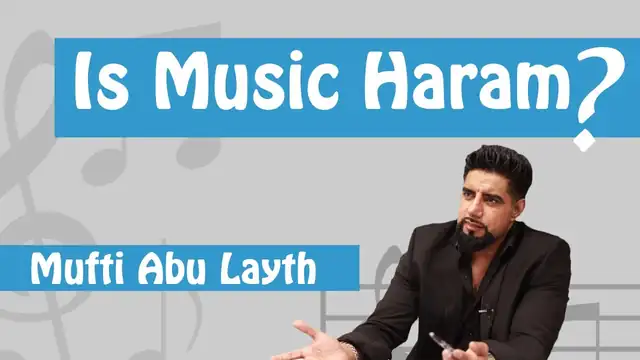 Play from 0:00
The video loads from YouTube only when you press play. Click a time in the transcript to seek.
Watch the answer
Open on YouTube at 0:00The player starts at 0:00, where the answer begins.
This segment0:00 to 2:39 · 2 min 39 sGeneral teaching
The answer in brief
machinesummary, machine-writtenNo: he says music is not haram and is arguably nourishment for the soul, pointing to its use for healing in medieval Muslim hospitals.
In more detail
The clip begins with Mufti Abu Layth saying that music is not haram and is arguably the nourishment of the soul. He reflects that if string theory is true the essence of everything is vibration, and says sound has no physical reality of its own but is the interaction between waves in the air and an organism that interprets them, which he says answers the old question of the tree falling in an empty forest. He adds that medieval Muslim hospitals (bimaristans [?]) used music therapy and that music helps some people with neurodegenerative illnesses, and asks how it could be haram.
Question as read aloud · questioner not identifiedIs music haram?
- The question was reconstructed from Mufti Abu Layth's restatement; the questioner's own words are not in the recording
- Some terms in this segment are uncertain
Position stated
Mufti Abu Layth says music is not haram and is arguably the nourishment of the soul.
“music is not Haram music is arguably it is the nourishment of the soul okay and you can see the reality to that”
Category: ruling
Kind: general teachingTranscript
machine0:00 to 2:39 · click a time to seek · dotted terms open the glossary
not people why not music is not Haram music is arguably it is the nourishment of the soul okay and you can see the reality to that it's amazing what certain sound waves can do and I feel in some ways that it's amazing that if if things like string theory be true if it hasn't been it's it's it can't be tested
yet but if string theory be true then the essence of everything is simply vibrations it's amazing that these vibrations you see because sound doesn't actually exist people sound is an interaction there's no such thing as sound it doesn't have a physical kind of reality to it sound is the interaction between waves a waves sound waves which
are simply just waves in the air and an organism that interprets those waves so that that kind of also solves the age-old question that if a tree falls in the forest and nobody's there to observe it does it make a sound no it doesn't make a sound because the sound doesn't actually have a reality to it there is no actual thing a sound in that sense it's a waves being measured by an organism being not just measured sorry
interpreted and received by an organism so and and the fact that music can actually heal people and many Muslims during the medieval times they had in the hospitals marathons they used column they had music therapy as a healing kind of mechanism and people that are sometimes you know suffering from certain neuronal degenerative illnesses you can find that music helps them it actually helps in
the brain how could this be Haram how could that be at all it makes no sense whatsoever
Paragraphs overlapping 0:00 to 2:39. Full text on the recording page.
Cite this segment
Stable id, transcript version and tier are part of the citation. Every change to a transcript is logged.Mufti Abu Layth Archive, segment 2019-08-04b-S01, auto-transcribed, may contain errors. https://muftiabulayth.org/r/k9v9am16g1k/s/1/ (accessed 1 November 2026)
- APA 7
Mufti Abu Layth. (2019, August 4). Is music haram in Islam? [Video, segment 2019-08-04b-S01, auto-transcribed, may contain errors]. Mufti Abu Layth Archive. Retrieved November 1, 2026, from https://muftiabulayth.org/r/k9v9am16g1k/s/1/
- Chicago author-date
Mufti Abu Layth. 2019. "Is music haram in Islam?" Video, segment 2019-08-04b-S01, auto-transcribed, may contain errors. Mufti Abu Layth Archive. Recorded August 4, 2019. Accessed November 1, 2026. https://muftiabulayth.org/r/k9v9am16g1k/s/1/
- BibTeX
@misc{abulayth-2019-08-04b-S01,
  author = {Mufti Abu Layth},
  title = {{Is music haram in Islam?}},
  year = {2019},
  month = {8},
  date = {2019-08-04},
  howpublished = {\url{https://muftiabulayth.org/r/k9v9am16g1k/s/1/}},
  url = {https://muftiabulayth.org/r/k9v9am16g1k/s/1/},
  organization = {Mufti Abu Layth Archive},
  urldate = {2026-11-01},
  note = {Segment 2019-08-04b-S01, auto-transcribed, may contain errors}
}
Something wrong here?
Tell us what is wrong and it will be checked against the recording. Nothing changes until a person has reviewed it.
Sending a note needs JavaScript, which is off or unavailable in this browser. Nothing has been sent.
No name, email address or account is asked for or stored, and the inbox does not store your IP address. For rate limiting it keeps an unreadable fingerprint of your connection for 48 hours, and our database provider's own logs record connections as every website's do. Only your note, its kind, the page and the moment in the recording are kept, for review.