
The Prophet & Uthman Ibn Talha Deen Of Mercy And Compassion | Mufti Abu Layth
sirah sira seera seerat prophetic biography ka'bah ka'ba kaabah 'urf muftis haraam forbidden riba ribaa sood usury ihsaan excellence jahannam jahanam jahannum makkah makka mekka madinah madina al-madinah madeenah yathrib duaa duas duaas supplication al-din ad-deen ad-din religion rahmah rahma rahmatvideo · 13:01 · 2,500 views · 31 Oct 2021 · Open on YouTube
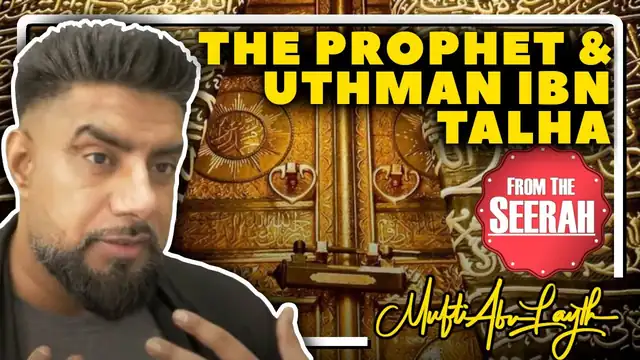 Press play to load from YouTube. Nothing loads until you do.
Transcript
machineauto-transcribed, may contain errors · source: youtube auto · click a time to seek · dotted terms open the glossaryAnd there's an incident that I I've related this before and I feel it needs to be related so often. It's a very famous incident of a companion, but obviously wasn't a companion at the time in early prophethood in Mecca. Vehemently a man that would vehemently oppose the prophet Sallallahu alaihi wasallam.
And his name was Uthman ibn Talha. And he was of wealth and he was of prestige. And he had um a status in Mecca. Not only that, they were he had a if you in modern terms, you could say the management contract. Okay?
He had that for the Haram. For the Kaaba. So, he was the de facto manager, if you like. So, the the actual keys to the Kaaba were under his control. So, what they would do is around the Haram, they used to lock They used to lock it as well. They never used to leave it open. They used to have their own kind of version of gates and So, they would open it every Monday and Thursday.
And it's interesting that as well to see Monday Thursday. And people and they know that the the prophet Sallallahu alaihi wasallam also singled out these days as special days. But this was also a custom in which the prophet grew up anyway. You see, and that's an amazing thing about embracing your custom as well, wherever you are. But so, the prophet Sallallahu alaihi wasallam he would often face a lot of slack from Uthman ibn Talha and his family, his father as well.
This uh Talha and his he had a brother as well called Uthman and they they would give a lot of slack, but especially Uthman, this son. He would give a lot of slack to the prophet. And um this one time on on an occasion, the prophet was trying to enter the Haram. And he stopped him. And he said to him, "Where do you think you're going?" he said to the prophet.
And the prophet said, "I'm just going to the Haram." And he said, "No." And the And the prophet said, "Are you really going to stop me from entering this It's a sanctuary." And he said, "Well, he picks up the keys. Says, "Who Who holds the keys?" "I do." He said, "So, hell yeah." He says, "Get out of here. I don't want you you you know, he's considering the prophet a heretic.
You you know, you've rejected the deen of your forefathers and you do this you're a disgrace and you're this and and and not just that, physically aggressive with the prophet as well. And he he pushes the prophet out. Sallallahu alaihi wasallam. And the prophet said to him and he did this on more than one occasion. And the prophet said to him you know, this one time he he stops the prophet and the prophet says to him that he he says, "Yeah, Uthman." He says, "La'allaka satara
yawman hadhal miftah bi yadi. Adha'uhu haythu shi't." He says he says, "What if perhaps one day you see that key in my hand and I do with it what I wish?" And he laughed at the prophet. And physically chucked him out.
And these are the people they clearly opposed in the battle of um it's in the early battles, I believe uh it may have been Uhud, I believe it was that his father, it's in the battle of Uhud, his father who was zealously opposing the prophet as well, his name was Talha, he is killed by Ali.
He fights Ali in the beginning and Ali radiyallahu anhu clearly just Ali wasn't radiyallahu anhu wasn't absolute one of the very famous warriors of early of that Arabian time. And Sayyidna Ali radiyallahu anhu destroys him in that mubaraza. So, so before a battle would begin, they would have this send one and we send one and they do this thing called a mubaraza, a one-on-one. And his father uh Talha is the one that is killed there.
So, you can see this from this family of proper hating against Muslims, hating against the faithful and doing all of this. Now, against and they plot and they spend they spend money, they were wealthy to hurt Muslims and the people in Medina and to to to kind of fund the projects uh of people trying to attack the faithful and loot them and do all of this and all this the prophet is aware of.
And then the tide turns. Allah. Wa tilkal ayyamu nudawiluha baynan nas. Allah says and the days they rotate amongst people, amongst mankind. With the Fatah of Mecca, the conquest of Mecca, Mecca has fallen and surrendered.
And the prophet has entered in strength, in power and might. And when the prophet was there and people were restoring a sense of calm, they were cuz there's the initial who-ha, what's going on. The prophet calls for Uthman ibn Talha.
And he turns up. And he tells him "Go bring the keys to the Kaaba." And he does. He brings it. And he hands it over to the prophet and he's expecting to be executed, by the way. You know, these people say the prophet was a warlord. The people say the prophet came to attack people, to kill people.
Wallahi, they haven't studied. And they've unfortunately just come across sayings by people who may have an agenda of their own to because it serves their interest to show a side of the prophet that favors them. Here is Uthman. He is expecting This is what he's anticipating fearing that this is it, they're going to chop off my head now, they're going to execute me, they're going to And he hands over the the keys to the Kaaba.
And the prophet says to him he says, "Yeah, Uthman. He says, "Do you recall I once said to you that ya Uthman la'allaka satara hadhal miftah, that I said to you maybe perhaps a day will come that you will see this key bi yadi in my hand.
Adha'uhu haythu shi't. I put it and I give it to where and whom I please." He says, "Do you recall that day that I said that?" And Uthman ibn Talha, he drops his head because he remembers that how time has unfolded.
So, he's in this position where he now not only does he feel humiliated, but these are perhaps to him his last moments. And he just drops his head. And the prophet calls him and he says, "Yeah, Uthman." And he looks up. Prophet says "Khudh ha." He says, "Take the keys." And he's like, "What?" And the prophet said, "I said that you see the keys that a day will come you see the keys in my hand.
I give adha'uha I give them or place them to whom I will." And he says, "Here, take them." He says, "Take them khalidatan talidah. May they be with you forever. La yanza'uha minka illa dhalim." And look at this. Not only does the prophet give them to him, he follows it by making a dua.
Like, can you imagine that? How hard hitting that is. That it the person who is not only so fearful and humiliated, he's confused that what Why is Why is he handing it back to me? The prophet says, "May they stay with you. May God always keep them with you.
Only a dhalim can snatch them from you." That meaning may God always preserve this with you. Sallallahu alaihi wasallam. Wallahi, this is the character of the prophet. So often, people I don't know why.
Makes honestly, it makes zero sense to me why people choose to I don't know, omit or just not relay this side. They speak of just wars and they just speak of I don't know what what I don't know what's going on, what whether it's subconscious, whether there's an agenda, whether what.
This is Do you know what this Uthman ibn Talha's reaction was? He immediately he embraces the prophet and he says, "Ashhadu an la ilaha illallah. Ashhadu anna Muhammadan Rasulullah." You see that ihsan in Allah yuhibbul muhsinin.
This you can never accomplish with brute force what you can accomplish with humanity and compassion and kindness. Never. It is a different wa ma arsalnaka illa rahmatan lil alamin. And this was, to be honest, it was a rightful place for anger.
The prophet had reason. He had motive. He had purpose. He had an argument. He was physically attacked by this person. You This person spent money to harm the people, not just the prophet, people the pro the pro the prophet loves. To harm them. He had him humiliated, thrown out of the Haram. He dominated him with this power. The prophet had reason.
Allah says, "What what should you do in those positions? Fafu wasfahu." Turn a new page. It's counterintuitive. You don't It's not what you would think, but it will work wonders. This You see, you taking exacting your little revenge will work for the moment.
It may help you. It may even help you at a tribe level. It may. You know, at a group level. Thinking about the bigger picture will help the cause of hume of humanity. The prophet doing this foregoing his own little goal
boosts the goals of human civilization. Because the the Do you know how passionately this person stood by the side of the prophet throughout the remaining of the prophet's life and and after for for the message. He became a key proponent of the faithful. And this is this is just one glimpse, a snapshot, a kind of clip, if you like, from the seerah of the prophet Sallallahu Alaihi Wasallam, where you can see these verses being entirely uh embodied.
This fafu wasfahu ihsan in Allah ala kulli shai'in qadir. And I thought that uh it's definitely something I wanted to share, so I hope that's uh been helpful.
Something wrong here?
Tell us what is wrong and it will be checked against the recording. Nothing changes until a person has reviewed it.
Sending a note needs JavaScript, which is off or unavailable in this browser. Nothing has been sent.
No name, email address or account is asked for or stored, and the inbox does not store your IP address. For rate limiting it keeps an unreadable fingerprint of your connection for 48 hours, and our database provider's own logs record connections as every website's do. Only your note, its kind, the page and the moment in the recording are kept, for review.
Cite this recording
Stable id, transcript version and tier are part of the citation. Every change to a transcript is logged.Mufti Abu Layth Archive, auto-transcribed, may contain errors. https://muftiabulayth.org/r/hvaxwdnu8yg/ (accessed 1 November 2026)
- APA 7
Mufti Abu Layth. (2021, October 31). The Prophet & Uthman Ibn Talha Deen Of Mercy And Compassion | Mufti Abu Layth [Video, auto-transcribed, may contain errors]. Mufti Abu Layth Archive. Retrieved November 1, 2026, from https://muftiabulayth.org/r/hvaxwdnu8yg/
- Chicago author-date
Mufti Abu Layth. 2021. "The Prophet & Uthman Ibn Talha Deen Of Mercy And Compassion | Mufti Abu Layth." Video, auto-transcribed, may contain errors. Mufti Abu Layth Archive. Recorded October 31, 2021. Accessed November 1, 2026. https://muftiabulayth.org/r/hvaxwdnu8yg/
- BibTeX
@misc{abulayth-HvAXWdnu8Yg,
  author = {Mufti Abu Layth},
  title = {{The Prophet \& Uthman Ibn Talha Deen Of Mercy And Compassion | Mufti Abu Layth}},
  year = {2021},
  month = {10},
  date = {2021-10-31},
  howpublished = {\url{https://muftiabulayth.org/r/hvaxwdnu8yg/}},
  url = {https://muftiabulayth.org/r/hvaxwdnu8yg/},
  organization = {Mufti Abu Layth Archive},
  urldate = {2026-11-01},
  note = {Auto-transcribed, may contain errors}
}