
Recordings › Al-Andalus: From Rise To Fall
Al-Andalus: From Rise to Fall Part 4
haj pilgrimage hadj aqidah aqeedah aqida creed aqeeda aqaid takbir takbeer takbirat takbeerat muftis hukm ahkam hukum hukam ahkaam kufr kaafir kufar kaafirun disbelief imaan eemaan eeman faith kalam ilm al-kalam kalaam shaitan shaytaan iblis iblees shayateen shayatin satan devil jahannam jahanam jahannum koran quraan al-quran sahabah sahaba sahabiyyah sahabiyat hijrah hijra hijrat migration khalifah khalifa khilafat khilafa khulafa ar-rashidun rightly guided caliphs rashideen khulafa-e-rashideen moorish spain umma community fitnah fitna trial in sha allah insha'allah in shaa allah insha allah inshaa allah alhamdulilah al-hamdu lillah alhumdulillah alhamdulillaah hamdulillah subhanallah subhaanallah subhanallaah as-salamu alaykum assalamu alaikum assalamualaikum salaams salam alaykum wa alaykum as-salam peace greeting dhikr zikr zikar dhikar zikir adhkar azkar du'a duaa duaas supplication deen al-din ad-deen ad-dinvideo · 1:14:22 · 3,000 views · 26 Feb 2018 · Open on YouTube
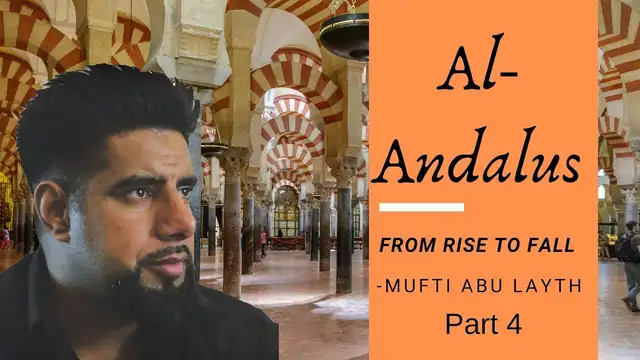 Press play to load from YouTube. Nothing loads until you do.
Transcript
machineauto-transcribed, may contain errors · source: youtube auto · click a time to seek · dotted terms open the glossaryWe're going to begin today's session, the fourth in this series of Andalus from rise to fall. What we'll be taking a look at today three I suppose three themes which will break down and I'll explain them shortly. The themes are a governance of greed.
The second, a caliphate in crisis. And the third, a need for a miracle. The objectives in more detail and what we'll be looking at is we'll go over where we left off last session about the Battle of Balat al-Shahada and the tragedy that was but a some hope which emerges after that.
This person in history known as Uqba ibn al-Hajjaj. Then we'll start to see the second part. If you remember we spoke about the governance the era of governance in al-Andalus which follows the era of conquest really has two parts to it. The first was that of of success and glory and the second is a governance of greed.
And we'll take a look at how that then leads to things like discrimination, corruption, decadence, fitan, fasad spreading through this peninsula. We'll look at also the rise of the Khawarij and who were the Khawarij and why they play a an important role in when I say important I mean albeit negative but it still remains a significant role in the downturn of of Muslim governance in al-Andalus.
Then we'll also look at a caliphate being crushed in the East. And we're speaking of the Umayyad Caliphate, the caliphate which took place after the Khulafa al-Rashidun beginning with the great and legendary Sahabi radi Allahu anhu Muawiyah ibn Abi Sufyan and from his offsprings thereon you have the Umayyad dynasty.
Or the Umayyad Caliphate. And how this it was the only caliphate to actually have central authority over the entire Muslim world. After this caliphate disappears centralized or absolute centralized authority never actually re-emerges in the Muslim world till till date.
So this loss we'll kind of speak a bit about that. We'll then speak about this this person this personality known as Abd al-Rahman ibn Muawiyah. Who was he? His struggle to survive. We'll return to al-Andalus and look at this chaotic atmosphere which is there but why this atmosphere all of us appears to be conducive or suitable for Abd al-Rahman ibn Muawiyah's own personal struggle.
We'll take a look at Abd al-Rahman's arrival on the peninsula and then a battle which follows on known as al-Musara and perhaps lessons to be learned from this entire thing. So with that in mind let us return to where we were the Battle of um uh Poitiers or Balat al-Shahada which we've kind of covered and where we're actually reminded that of the words of Allah wa tilka al-ayyam
nudawiluha bayna al-nas. And those days we shall rotate them amongst the people. We know that Abd al-Rahman al-Ghafiqi who we spoke of in the last session he was somebody with a he was a great leader somebody with passion somebody with zeal somebody with the right intentions. He takes an army of unprecedented numbers forth to meet King Charles Martel and yes although King Charles had heavily outnumbered um
the Muslim army with an army almost 400,000 strong yet numbers were not ever the the key issue in Muslim tragedies. It was always other factors and in this case once again we're reminded almost of the Battle of Uhud in the lifetime of the Prophet alayhi salaam where where the spoils of war or the treasures which the Muslims had Muslim armies had kind of accrued whilst they were going from town to town and and city to city and conquest to conquest these are endangered and the Muslim
armies turned back for their spoils of war which eventually leads to the downfall of the entire battle. Now such loss and thousands of people miss thousands of people who who suffer and meet their fate at that battle um from the Muslim armies and and then the Muslims are chased away back into the Iberian peninsula away from southern France and a huge part of southern France are reconquered.
That's where we had kind of left this. This tragedy you see we are taught never to never to despair. Allah teaches us that not to wala taqnatoo and do not despair. So what are some of the lessons or the opportunities that we see the Muslims find in these difficulties?
Well first of all the Muslims their existence was not uh it was not exterminated from the Iberian peninsula although southern France huge huge territory was lost huge losses Muslims faced but King Charles armies did not chase the Muslims down into what would be modern day Spain. They kind of left them after the Pyrenees mountain.
They kind of just let them be. This was a huge opportunity because think think about it if they had decided to continue chasing the Muslims south Allahu alam what could have become of the Muslim civilization so it was an opportunity and then we see a person arrive a person rise from this cloud of confusion who becomes the next governor and this is really still part of the first era of governance the first part.
His name was Uqba ibn al-Hajjaj al-Saluli and he's given this this chance to become a governor and he was actually given a choice by the caliph that would you like to be in charge of the whole North African terrain huge territory Muslim territory. Huge gigantic or would you like to be the governor of al-Andalus?
We think about it this recent loss recent tragedy tragedy morale is low. Would you like to go there would and he's actually given that choice and he decides to go to al-Andalus. Allahu Akbar and this is how people are. You see when they see misfortune when they see tragedy as opposed to just falling back stepping aside letting things go they rose to the challenge.
Because this is an attempt this is a possibility to do something which will count significantly. And and he does his and he does exactly that. Uqba ibn al-Hajjaj al-Saluli arrives on the on the peninsula he sets forth he tries to correct the morale he he leads he once again assembles certain armies he heads north again.
He goes into French territory once again where many of the Muslim armies had been or where there were areas of confusion. He actually stabilizes a certain amount. He goes in they say he and where he loses where he loses for example he suffers losses and loses territory he returns and returns they said up to seven times.
Almost he went back into what was seen as lost territory and secured huge parts of that for the Muslim civilization which was in al-Andalus. And he adds that and this is how we are seeing once again you know tilka al-ayyam those days being rotated so there is success there is loss there is tragedy but there is once again a sense of rejoice a sense of rejoicing a sense of success.
Now he does that and he manages to secure a certain amount of not only victory, but also restores some of the morale that the Muslims were kind of suffering from. And and he does that and he rules successfully for for for the following few years. But then unfortunately, he meets his loss at a I believe it was a a a village known or a town known as Cardona, I believe they called it.
But he's actually he himself is martyred in that particular town fighting against some of the Christian armies and I believe they were mainly kind of designated by King Charles Martel. So So this is taking place and now he falls to to his fate as well. But what follows from here is a huge turn in Muslim history.
You see, what we saw was there was a wound and people were attempting to patch up that wound. There was a gap and people were trying to fill it in. But what follows Subhan Allah. You see, after Abdullah I sorry, after Uqbah ibn Hajjaj al-Saluli, the next governor that comes in his name is Abdul Malik ibn Qatan al-Fihri.
Now this guy he doesn't really give a damn about many of the things that were going on. He rises, he sees in al-Andalus there is quite a lot of wealth that the Muslims have gathered. He starts to not only enjoy the wealth, consume the wealth. He starts to look out he was somebody that the historians write was extremely muta'assib.
Very tribalistic. Very racist and discriminating against other tribes and races. He didn't care he begins with initially as he starts to rise to power in alienating the the Berbers the Berbers who had played a significant role in the Andalusi conquest.
He starts by saying, "Well, these people ain't even Arabs. Why are we giving these people this type of He starts to do things like where there were little conquest, he starts to refuse to give them the spoils of war or their rewards or whatever it was that they were entitled to. Now this, as you can imagine, leads to huge once again uh anti-authoritarian sentiments amongst the people, huge type of um not I'm I'm like I'm not just talking about quarrels and disputes, I'm talking about civil type of strife
taking place. Huge like you can you can imagine these type of things, but he doesn't stop there. He's also looking at things like oh certain tribes within the Arabs not just like oh let's discriminate against the Berbers. He's saying, "These Arabs they've come from Sham and these Arabs they've come from Yemen and these these people are part of my tribe.
Those people ain't part of my tribe. What what are they doing in this position of power?" So he starts to turn against them. So now it's Arabs versus Arabs, tribes versus tribes. The Adnaniyin are arguing with the Qahtaniyin. Whilst all of this is happening we start to see because people you see once people begin to get upset with the status quo, especially the political status quo, some people obviously many people returned to religion.
But some people start began to turn to what was a very uh a very rare, but yet also extremely dangerous strand of Muslim society or of Islamic theology, which is the Khawarij. Now for those of us who are unaware, the Khawarij were a people that arose or a group that emerged during the time of Ali ibn Abi Talib radi Allahu anhu and Muawiyah.
And they were people who actually declared Sayyidna Ali radi Allahu anhu and Sayyidna Muawiyah radi Allahu anhu and all these companions to be kuffar to be disbelievers. They were people who would say anybody who commits a major sin is a kafir and we got nothing to do with these people. They would declare the rulers to be kuffar. They would say that you have to fight and take over and they would spread and aid this type of vigilante rule.
If you anybody who studied Islamic history is aware that when they managed to get a stronghold in Basra in Iraq and the damage they did there and the the men and women and children they massacred is well documented. To the extent that it's narrated how they would kill pregnant women and so on and and use verses of the Quran to justify and they would actually drag out the uh the fetus from within and and so on and all these stories are there, but the Khawarij were an extreme minority, but they were a very an extremely dangerous
kind of cancer that existed within the Muslim society. Now this began to emerge in al-Andalus. And the reason it started to emerge in al-Andalus is actually to do with North Africa and that's because originally some of the Khawarij had escaped to North Africa and started to take over and started to And we'll come back to that in a moment, but some of these ideas then start to filter across into al-Andalus.
Now in al-Andalus, many people had huge issues with the government and many people were victims, especially the Berbers. So the Berbers started to find some solace amongst the Khawarij type of ideology. So many of the Berber at the time began to embrace this ideology almost as a reaction against the authorities and against the government.
Meanwhile in southern France King Charles Martel drives his armies further south and crushes many of what was remaining of small Muslim settlements and civilization that was there. He kind of drives them completely out and crushes um those settlements which were to be found.
This is the type of stuff that's going on. Now the governance era part two or the governance of greed has begun. We can see that this daylight seems to be disappearing. The sun is it seems as though is beginning to set.
Now we have to kind of take a step back. We have to zoom out all of a sudden. I want us to zoom out of the Iberian Peninsula. We've got the entire globe in front of us now. And we're going to zoom back into the Middle East. The Middle East, if you remember, was where the Umayyad dynasty, the Muslim caliph would live and the caliphate was established.
It was in Damascus in Syria. That's where we've zoomed into. The caliphate is in crisis. Many people throughout the Muslim world are kind of not happy with some of the things going on. There's different movements taking place which they're trying to deal with. Unfortunately the Khawarij, which I'd spoken of many of them had kind of escaped and gone to North Africa and began to raise an army amongst themselves and and attack certain cities after cities.
And they were actually becoming successful in their military campaign. So they were taking over small towns first and villages and then attacking cities and then obviously they'd get more type of uh what is it? Artillery and military type of strength and then move on to the next city and get more people and and people obviously were unhappy. Some people are unhappy with the Umayyad rule. Some people were saying, "Oh, the Umayyads are you know, they're not taking care of us.
They're just spending on the Middle East and they're not doing this and they're not doing that." So they were happy to kind of join or to aid the Khawarij and many people were kind of just turning to the Khawarij movement. So this is the type of stuff that's going on. Now they are in What are the Umayyads doing themselves?
Now if you remember, many of them you would think that is this a time when you were trying to address these issues, but one of the largest or most successful Umayyad caliph had died. His name was Hisham. And the ones who came after him, Walid and so on, they didn't seem to be tackling these destructive elements of Muslim society.
They weren't dealing with it. They weren't going about trying to deal with this type of factionalism or with people being discontent with them or not spending money and they were just concerned and preoccupied with their own household issues, with their own family affairs, with their personal lives, with their own type of arguments and disputes that were taking place. This was the type of stuff that was going on.
Allahu Akbar. This is where if you remember we where one of the persons had addressed them, a poet of the time with that poem where he had said that I see a fire that is going on and if you remember we went over there and said that if the intelligent people of my in the geniuses or the intelligent people of of my of of of the ummah of my people do not put out this fire and he had said that I fear in that I fear that it's fuel will be corpses upon corpses.
And he said that He said that I say out of amazement that whoa that oh my god like that. And he said that are they asleep? Or are they Do they know what's actually what's slipping from their hands?
And unfortunately whether I it appears history teaches us that they seem to be more asleep than awake and more concerned about their personal affairs at that time and what what happens in this type of state of confusion is a powerful movement rises and it comes from the Far East from and so on and this is something which is very amazing and interesting but we can't go into in too much detail but perhaps another day another time that will be an interesting course in itself how the and the
kind of roles to power and so on and the type of interplay that took place between but this movement of the comes from the Far East and it sweeps the Muslim world especially the Middle East. It sweeps them and not only does it kind of have a staggering victory in taking over what they do is they begin an onslaught of any threat that they can find.
So any prince or any person who belonged to the household any man any male who was of any potential threat as in he was at least he wasn't a child so anybody that was even if he was a teenager or something like this that's it they would eliminate him. And this is what they were doing they were going from street to street from house to house they were digging out every that they could get hold of and just slaughtering him.
In fact you see the rise of one of the you can read up on him he was actually he took on the title actually which means the one who kind of sheds so much blood and they say in one day when he went to Damascus but people say up to 30,000 40,000 but thousands and thousands of people massacred in one day.
how much exaggeration there is but there was huge loss and this is what is going on. Meanwhile the movement which is taking place in North Africa they actually begin to consolidate what they have. Most of North Africa is at this stage now under control.
The person in charge goes by the name of ibn as well he's from this tribe this Yemeni tribe al-Fihri. Now North Africa is subdued by the except one simple just the town of and we did speak of once before when we spoke about the conquest and King Julian but remains unconquered by the everything else is under their control.
The Middle East and the entire Muslim part of the world in that in that in that in that region is now under control. So the thing what we find is with all this going on Andalusia has its own little problems which we're going to return to shortly.
But the reason I've brought all up is to show you that when all this confusion is going on and all this bloodshed and there's a change of a brutal change of power that is taking place and are running for their lives and they're getting hunted down and being killed one by one and the have broken away and now are ruling North Africa.
Andalusia has almost completely come off the agenda in terms of priorities. The Muslim world and the authority in the East isn't even concerned with what's going on in Andalusia. So with that in mind what we do is we're going to have to zoom out of the Middle East and come straight back to the Iberian Peninsula.
We've had governor following governor greed upon greed corruption decadence debauchery people consuming wealth for themselves giving allotments just to family members tribalism discrimination people being attacked because of their race many many rebellions taking place and and then you have one of the final governor who kind of rises his name is and once again he's from this tribe al-Fihri.
And he rules for eight years and he's the final of the governors and he absolutely does not care I mean he tries to suppress some of the rebellions for his own personal gain but one of the things he does as soon as he comes into power he realizes all what's going on in the East there's all this type of turbulence and there's all this going on and people are upset and discontent with the and he realizes there's a struggle going on in the north in North Africa and seem to be taken over.
He says right we are absolutely independent. We no longer because if you remember this was the era of governance where the governors were directly beneath the caliph. He says we no longer are beneath Umayyad. So what are we? He says we are an imarah.
We are a separate kingdom. And we don't need to be under any caliph or anything. We've just got our own rule we are a separate continent and we are a separate kingdom. So that's what he does he declares himself just an he doesn't say he's a caliph or anything like this but what he does is he called himself the and he says this is but this is an imarah.
So this is a kingdom and I am ruling it that's what I'm doing. Meanwhile the rebellions rise from from over 10 to almost 20 different rebellions going on throughout the country and I don't just mean small scale large scale on large scales King Charles Martel crushes whatever was remaining of the final Muslim settlements in France and completely eliminates almost any trace of Islam from French territory.
If you remember I spoke earlier on in one of the previous sessions about this small region in the Iberian Peninsula which is in the in the northwest and those of you that can see the PowerPoint you'll see in the northwest there was a small region known as and and I told you in Arabic it's referred to as to lie.
And it was because the king at the time his name was lie. And this was where Tariq ibn Ziyad and Musa ibn Ziyad had conquered almost all everything except this one small tiny territory and they were called back. Now from that kingdom this king lie during his time what happens is he now dies and he is succeeded by his son I believe his name was that's what they call him in Arabic.
And what what he does is he rules for about two years or so and he manages to once again establish a bit more of his kingdom just a bit more nothing too much there's a bit of some Christian conquest which take place and so on but then he dies and doesn't leave an heir. And this is something and he like he doesn't have any like a direct child or anything.
But then another person is appointed. Referred to an Arabic as Ad Finge and we'll come back to this in a moment. Okay? But that's just something to tell us what was going on. Meanwhile, we have to kind of step away from there, come back to the mainland Iberian Peninsula. Al-Andalus and we see the Qahtaniyin are still fighting with the Adnaniyin who are all fighting with the Berber whilst there are Fahriyin who are fighting against with the Qaysiyin.
And all of this is going on. Yusuf ibn Abdurrahman who is the Amir he tries to crush and control whatever he can, but at the same time always giving preference to the Fahriyin. What happens at this one particular point, there is this one friend of his who gets killed. And Yusuf ibn Abdurrahman believes it was the doing of Bani Qays, a particular tribe.
Now, he this leads to some type of altercations which take place, some arguments and disputes between him and some of the ruler some of Bani Qays, but it's kind of just left there. In the following weeks, what happens is Abdur Yusuf ibn Abdurrahman is presented with a case, like a particular case, some type of dispute, something nothing to do with uh uh the previous incident, just something that takes place.
But one of the people involved happens to be a Qaysi from Bani Qays. So, what happens is Yusuf ibn Abdurrahman thinks this is a great opportunity to take some revenge from Bani Qays. So, he has this person beaten. Now, what happens is Bani Qays feel they've been oppressed and they go to the one of the popular rulers at the time.
I'm I'm not rulers, but like leaders amongst them, like a chieftain amongst them. And he a person, a man by the name of Sumayl ibn Hatim. And this person emerges to play a key role in the chaos of Al-Andalus. Because what he does is he was a very charismatic leader.
A very charismatic chief. And he starts to see their point and thinks you're right that this this this ruler, this Amir seems to have this thing only for his tribe. So, he starts to kind of incite the masses, especially the Qaysiyin who were in huge numbers, by the way. Against uh Yusuf ibn Abdurrahman.
And he's quite successful. And then he starts to draw in certain other people, certain other rebellions that were taking place and and they start to rebel against against the Caliph or sorry, against the Amir. And they're doing that and and the Amir Yusuf ibn Abdurrahman is trying to fight back. At the same time he's trying to fight back with different kingdoms and all this is taking place.
Now, meanwhile, what happens is Sumayl ibn Hatim at one point, he what he'll do is he'll kind of incite certain people, certain governors, he's trying to make alliances with them and say, "Look, why don't we team up with you and we fight against Yusuf ibn Abdurrahman?" And and then some people are kind of agreeing with him and they're having some fights and some are unsuccessful. Then he's kind of making alliances with other rebel groups and they're going against but this person, he kind of travels certain parts of Andalusia making alliances at different times with different rebel groups and and actually holds
a very strong fort, if you like, against the Amir Yusuf ibn Abdurrahman who if I remind us at this time, is still continues with his extreme tribalism. He does what he seems to be doing is any people who he finds at fault that are especially from the other tribes, he would have them whipped in the streets.
Would have them whipped very bad and have certain like you know, like a mockery made out of them and so on. And at the same time the Khawarij thing is going on. People are being declared Kuffar. They're being declared Kafir. Many of the Berbers feel completely alienated. All this is going on. It is a time when Muslims had said Muslim historians had said things were so bad the kingdom of Balay which I spoke of, which was then taken over and uh by um
which was then taken over by his son Balbun and then followed by uh Ad Finge who we'll speak of uh slowly uh speak of in a moment. That kingdom seemed to be growing from strength to strength and they could see what was going on in the Muslim um peninsula.
They could see what was going on in Al-Andalus. Meanwhile, in the East, nobody cares about Al-Andalus because it's gone completely from the agenda because they've got so many things on their own plate that Al-Andalus is in a complete different continent as far as they're concerned.
So, with that in mind, this is where Muslim historians had said truly the Iberian Peninsula was in need of a miracle. That's what it was in need of. The situation was so bad, the fitan and fasad. This is where the we are reminded of that ritha where the person says with all this innocent bloodshed and poverty and poverty had risen drastically, starvation.
That limithli hadha yadhubul qalbumin kamadin. In kana fil qalbi Islamun wa Imanun. That is due to things like this that the heart melts from anguish if it was to have in it an ounce or an atom even of Islam or Iman.
The time in the entire when we zoom out of the entire Muslim world was looking so bad. Ya salam. Chaos in every corner. Bloodshed, corruption, tribalism, racism. Fitan, fasad.
Allahu Akbar. We are reminded there's of the words of a poet. There's an Urdu poet who went by the name Hali. And he speaks of his own time, but which is reminiscent of such a time where he says Eh khase khasan e rusul waqte duae.
Ummat pe teri aake ajab waqt pada hai. That he kind of addresses the messenger of Allah alaihi wasallam saying it is that this is such a strange He says this this time is a time of duae. That indeed like your ummah has has been afflicted by a very shocking time and era.
So, with that in mind, this is where Muslim historians had said that Al-Andalus was completely gone and Islam within the following few years would have perhaps disappeared, but also if anything, we were in need for an absolute miracle. This is where we are almost reminded that Allahu Akbar that at times perhaps miracles are exactly what we find.
I'd like us to kind of once again zoom out from where we were and go to Baghdad. But we're going to fast forward. We're going to skip a few scenes. We are sitting in the court of a palace of Baghdad. Stability has now pretty much come through come throughout certain parts of the Muslim globe at this point.
I'm We're not saying how, but we're just saying it has been reasonably stabilized. There is the ruler Abu Ja'far al-Mansur, one of the Abbasid Caliphs. A very popular one, somebody who um has several famous encounters with the likes of Abu Hanifa and so on and the stories are well known. But he's having a discussion with many of his wuzara, his wazirs.
And he says to them he says, "I'd like to ask you a question." He says, "Who is the falcon of Quraish?" Falcon of Quraish. And they say uh trying to suck up to him in a way that oh, it's you, of course.
And he says, "Look, don't be stupid, all right? You know, you don't need to do that. Who is the falcon of Quraysh? And then they say, "Was it Abu Bakr? Was it Umar?" And they go through these names. "Was it Muawiyah? Was it Uthman?" They mention all these great names, and he say he says, "No. No." And they say, "Well, you know," and then they go through some other names, and then they eventually they say, "Well, well, we don't know. I mean, who was then the falcon of Quraysh?" And he says, "It was Abdurrahman ibn Muawiyah."
And here there's a question mark. Abdurrahman ibn Muawiyah? Who's that? Stop. We've got to stop that scene from there. And we've got to reverse. We've got to rewind this We've got to rewind history a little and go back in time.
Back to what was taking place at the when the caliphate of Bani Umayyah was crumbling. I mentioned that North Africa had kind of separated itself. It was under Khawarij rule. That Abdurrahman ibn Habib was in charge of North Africa. I had mentioned that um the Umayyad were being kind of murdered and so on.
And everything was in a sense of decay and downfall. All of that is going on. There is bloodshed on almost every corner of the main cities of the Muslim empire in the Middle East. That's what's going on. Umayyad are being hunted down.
Now, during that time, there is a person by the name of Abdurrahman ibn Muawiyah, ibn Hisham ibn Abdul Malik. Now, if you recall, I had said that Hisham ibn Abdul Malik was one of the last stable caliphs of the Umayyad kingdom, of the Umayyad dynasty. And once he died, everything kind of went pear-shaped.
Now, this is the grandson of that great caliph. And he had many grandsons, and this is one of them. He's just a prince, if you like, or of many amongst many Umayyad princes. And he's just living his normal life. He's chilling out. He was living in luxury until the Abbasids had ransacked Damascus.
And he kind of moves out of what is um steps away from where the hype of things are, and he's in a quiet location. And one day he's trying to kind of In fact, it's said that he's trying to calm his child down. He has a son. He's only 19 years old. And he's trying to make his his his his child, who's who's an absolute baby at the time, and he's trying to make him stop crying. And so, he's kind of carrying him and walking about, and he walks out of the house, only to realize, "Wait a minute.
He can see black flags have been kind of have been raised on different corners of the street. And this means and the black flags represented the Abbasids. This meant that the Abbasids were here, and the area was on lockdown. And Umayyad were being hunted.
So, he puts his child down. He goes inside, gives him to to the mother, leaves the womenfolk. He has a younger brother by the name of Walid, who they who was approximately 13 years old at the time. He grabs him. He gets some money that he had, puts it together in a bag, and they run. And they begin to run. Whilst they are running, they are seen and spotted by some Abba by some Abbasi soldiers.
So, now these Abbasids are on the chase. They're in pursuit. They're chasing Abdurrahman and his brother Walid down these streets, and they're running after them. And they've got their swords in the air and everything. And these guys are running, and they reach the Euphrates River, the Alfurat. And what they do is they throw themselves into the river, but the river is a mighty river, and it's got a strong type of current to it.
And they're swimming against the current, and they're swimming, and they're kind of struggling. So, the Abbasids that were chasing them, the soldiers, they they they didn't know how to swim, so they kind of stood there at the riverbank, and they said to these guys, they said, "Listen, come back. Don't worry about it. Don't worry about it." Said one of those. Said, "So, you know what?" They said, "Come back.
And you know what? As long as you're not fighting, you're cool. All we're going to do is take you in, but when you know, no harm shall befall you." So, Abdurrahman's younger brother, Walid, says, "I'm going back." Abdurrahman tells him, "No. Do not Like, don't don't listen to them. Keep on swimming." And he says, "No, no, I'm going back." And he's And he's not too far from the from the riverbank, and he climbs back on the riverbank.
And they hold him and execute him brutally right there, almost immediately. And Abdurrahman witnesses that. He climbs out at the other end, and he runs. He runs for his life. Abdurrahman says that that day, he says, "I was so frightened that I ran and I ran." He says, "I felt I was going to take flight at any moment.
That I would actually take off into the air. That's how fast I ran." Allahu Akbar. And such situations make people experience such things. And what he does is he says, "I headed westwards, but I headed towards North Africa." And why North Africa? Because Abdurrahman, he was from obviously Bani Umayyah in term from his father's side, but his mother was actually a Berber.
And the Berber tribes were uh mainly settled in North Africa, and he had several relatives and family uh which were kind of scattered in different parts of North Africa. So, he heads towards North Africa, and he wants to go towards the capital, more or less of the time, which was like Ifriqiya or Qairawan. And but when he gets there, he begins to hear And this is whole story of how he cuts through the Hijaz and how he goes through Egypt and parts of Libya, and then he gets to what would be modern-day Tunisia, only to realize
the status quo of North Africa. That Abdurrahman ibn Habib, the the Khawarij, the Khawarij ruler, had kind of taken complete control. And he, because you have to remember, his struggle, the Khawarij struggle, was originally against who? It was against the Umayyad.
In fact, theologically, right from the very beginning, it was against Muawiyah, radiyallahu anhu. And then secondarily against Ali, radiyallahu anhu, as well. But So, right from the very onset, the Khawarij have always hated Bani Umayyah. So, when he comes to hear that, "Oh, Abdurrahman ibn Muawiyah has set foot in my kingdom," he says, "Allahu Akbar.
Get hold of him. Hunt him down." And here is Muawiyah, this 19-year-old Abdurrahman ibn Muawiyah, sorry, who's who's now got multiple death warrants upon his head. So, what he does is he heads back into what would be parts of Libya, a town called Barca, and he goes into hiding.
He has a few relatives there. He has what Along his journeys, he gets uh he has a servant with him, who people say was a Greek uh servant by the name of Badr, a very loyal servant that remains with him throughout his his journeys. Now, he lies low in Barca. That's what he does, Abdurrahman. He is totally disheveled.
He's in a state of confusion. He doesn't know what to do. For several months, he just lies low. He's in distress. The Muslim world around him is collapsing. He himself is just fearful of his life. He doesn't know what's happened back in Damascus. Now, after months begin to pass, he thinks, "Well, what should I actually do?" We What should I be actually doing?
Now, months start to look like years now passing by. So, he thinks, "Look, I either A, I can always remain in hiding and spend the rest of my life like this. Or B, I become proactive, and I do something." So, what he starts to do is he starts to think, "Okay, if I'm to be proactive, where can I go?
Because I can't stay in this town in Libya for the rest of my life." So, he looks to the Muslim world. He looks to North Africa and he thinks, "No. Going there is suicide." He looks to the Middle East and he thinks, "No. Going there is utter suicide." So, during this time of thought, his attention is brought to Al-Andalus.
People tell him that, "Do you know what's going on in Al-Andalus? Al-Andalus has got its own chaos and confusion. In fact, there's so much there's Berbers versus Arabs and Arabs versus Arabs and Fihriyeen versus Qaysiyeen and Adnaniyeen and Qahtaniyeen and there's all this tribalism and the Christian kingdoms in the north attacking further south and and they've declared independence from the entire Muslim world and there's Khawarij type of insurgencies and rebellions taking place everywhere and there's poverty and there's all this." So, he thinks
that maybe that chaos may actually be conducive to my situation. So, he doesn't just think, "Okay, let's What he does is he he thinks, "Okay, who can I reach out to in Al-Andalus? Do I have any allies?" So, what he does is he sends his servant. He sends Badr to be his eyes and ears in Al-Andalus.
So, he does, he goes there and he comes back and a lot of this going back and forth is taking place by his by Badr. Now, Badr assesses the situation and they tell him, "Do you know who you have an ally in? You have an ally in the Berber. Because these people are a people who have no representation.
So, he reaches out to the Berber from where he is in Libya, sends his servant to negotiate to write with to certain Berbers and to communicate with them and say, "Look, listen. Do you know that a prince of the Umayyad dynasty is alive today and would like to come to Andalusia? Would you Would he have your support?" And they like, "Hell, yeah." They absolutely hate Yusuf ibn Abdurrahman, the emir.
They like, "We'll support him." But, the thing is the Berber are not in a position of power. So, he's got certain a certain amount of support in terms of manpower, but he doesn't have power. Because these weren't people in positions of power. If you remember, the last governor had put mainly only had only put Arabs in positions of power and not only any Arab, certain tribes in positions of power.
So, then he decides to reach out to many of the Yemeni people. Now, the Yemeni people, they did not used to get on with Bani Umayya. Because they had that tribal difference cuz they were not part of uh what is it? The Umayyads. The Bani Umayya are from originally I mean are from Quraysh and are from Mudar.
Now, the a lot of the Yemeni tribes were not from Mudar. So, they had this distance and they don't like Bani Umayya necessarily. But, having said that, they didn't like the current ruler either. So, Abdurrahman plays on this and he says to them, "Look, listen." He says, "What are you saying? Would you support me if I was to come to" He has this communicated to them.
So, many of them, they say, "Okay, fair enough. We'll do that." So, now he has a set some allies within the Iberian Peninsula. What does he do next? Allahu Akbar. But, he prepares and he plans. So, Allah says, "Wa a'iddu and prepare." He reaches out to He does research. Are there any other Umayyads remaining in the Muslim world scattered anywhere?
And he reaches out to them and he finds dribs and drabs and there's certain almost some Umayyad type of person, some far distant relative living in this place in Yemen and living in that place in Hijaz and living in Egypt one year and he starts communicating to all of them. He writes letters. He announces his plans. He gains their support.
They also agree that yes, if you do manage to go to Al-Andalus, we will come along and also support you. Now, he seems to see some s- infrastructure almost being at least theoretically being mapped out. So, what he does now, he thinks the time is right. Four years have elapsed.
Allahu Akbar. Four years in his preparation had elapsed. It is now 138 Hijri. Abdurrahman ibn Muawiyah alone travels through North Africa and crosses the sea into Al-Andalus.
Just on his own. Carrying no real weapons, nothing, just his own sword, just which most people would carry, just and his own uh garments and so on, but that's it. Just single-handedly lands in a place known as Almunecar, which is in southern Spain and there is actually a statue which has been uh erected in that place in remembrance of Abdurrahman the First.
Now, he lands there and he has a s- a mass amount of support because you have to remember, Hisham, his grandfather, was a legendary caliph of the entire Muslim world. One of the most powerful caliphs of the Umayyad dynasty ever was Hisham. And this is his grandson who has come and he hasn't just come.
He's come with a claim to the dynasty that this land was under the rule of my forefathers and I have that right to rule it. He's come with that claim. The people around him, they support him. The Yemeni tribes arrive. He uh the Berbers are there to support him.
He then writes to Yusuf ibn Abdurrahman al-Fihri, the emir at the time, who was an absolute oppressive and an absolute oppressor. He writes to him and says, "Look, this is who I am. I have come here." And he writes to him saying to kind of to rule as it was as it was meant to be rightfully done.
And he says to him, "And I extend to you a hand of friendship." He says, "If you will surrender to me," he says, "I will make you in charge of certain things and give you a position of power." Obviously, Yusuf ibn Abdurrahman says to him that, you know, "Have you lost the Like looks at him as Has he lost the plot? Who is this person to come in my imarah and tell me?" So, he says, "Okay." And Yusuf ibn Abdurrahman, what he does is he gets an army together and he says, "Despite all the rebellions going on," he says, "let's head south.
Let's crush this Umayyad that has landed on this peninsula." Allahu Akbar. Yusuf ibn Abdurrahman ibn Muawiyah gets the people around him and they advance north. And they are heading towards a place known as Al Musara. Allahu Akbar.
At this time, Yusuf ibn Abdurrahman uh sorry, Abdurrahman ibn Muawiyah is only 25 years of age. You know, as they approach the battlefield and they know that this is where showdown will take place, the other armies are kind of descending and they can see them. He becomes aware that some of the Yemeni people around him are s- spreading rumors.
They are saying that, "Oh, have you noticed this guy, Abdurrahman, this young guy who's turned up? Right, have you noticed the horse that he has? Because many of them weren't well equipped. So, they had like mules and they didn't have decent horses and he's They said, "Look at his horse. It's it's a rapid horse." Meaning, it's like saying he's driving a sports car.
It's like this guy's got a Porsche. What they were trying to get at is that if the battle steams up, he could easily leave us standing. I mean, he's not from here anyway. All he has to do is turn that horse around and he's off, nowhere to be seen. All we'll see is dust." So, they start to spread these rumors that how can we actually be relying upon this guy when look at him and look at us?
Now, he b- he he becomes aware of this of these type of rumors. So, what he does is he approaches one of the leaders of the of the of the Yemeni tribes was a man by the name of Abu Sabah Yasubi. He approaches him and he actually with wisdom he says to Abu Sabah, he says he says hey, he says that you know this horse I've got he says it's too frisky and too swift and fast and it doesn't let me become stable.
He says what do you say if I swap you for your mule? And that guy's like what? Uh yeah, okay. That's like somebody saying I'll swap you, you know, my Porsche for that Volkswagen Passat. So this is what's going on. So this guy is he's like yeah, absolutely. So they swap.
Now the Yemeni people, the tribesmen, they notice this and they think they see this guy riding a mule. I think whoa. This does not seem like a person trying to run away from the battlefield. This seems like a person with determination. And that is exactly Allahu Akbar. That is exactly what Abdurrahman ibn Muawiyah had.
He could see that this whole peninsula was engulfed by such darkness by such corruption that what he brought with him was a determination of light and hope. If if this meant that Abdurrahman ibn Muawiyah would meet his fate on the battlefield, then let it be so.
But he would not turn back. Allahu Akbar. This craze this obsession Allah, I mean when you see it in people mountains can be moved. We are reminded of a poem which was actually used in there's a poem which was actually used in the Indian Independence quite a bit by it's actually written by a person by the name of Bismil Azimabadi, but it's very popular.
And this and he says Sarfaroshi ki tamanna ab hamare dil mein dekhna hai zor kitna bazu-e-qatil mein. He says that this obsession now has kind of taken over our hearts. That now is the time to see how much strength the murderer actually has.
There is an amazing line to it that he does say. He says that haath jinme ho junoon katte nahin talwar se sar jo uth jaate hain woh jhukte nahin lalkaar se.
He says that the hands which once get a passion or an obsession within them, they are not simply cut by swords. Meaning you cannot destroy a force by destroying people. He says heads which are finally raised they don't just bow to anybody that summons them. This this is the type of passion and determination that you see not only in people, but especially in Abdurrahman ibn Muawiyah.
And this event this battle that takes place at Al Musara Abdurrahman displays immense courage and success is what he is met with. He has a staggering success. And what they do is in fact and when he finishes, Allahu Akbar, and Yusuf ibn Abdurrahman kind of runs away with whatever is remaining of his army Abu Sabah, the Yemeni leader, actually turns to many of the people with him and says he kind of like they make a plot that
let's now kill Abdurrahman ibn Muawiyah. But when he says that many of the people many of the Yemeni people, the tribesmen and so on, they disagree with him and they say no that this is a man of integrity. That did you see that this person has come here and he's given us a sense of hope. He's given us a direction.
He's given us objectives. And what they do from there is they head to Qurtuba which used to be the capital. And when Abdurrahman heads there and before he heads there you know, many of his army they actually say that oh, let's chase Yusuf ibn Abdurrahman's armies and let's kill them and let's kill him and let's destroy them and and he actually stops them.
And look at the wisdom. And he says to them that la tatabi'uhum do not follow them. He says wala tastaslu sha'fata a'da'in he says do not try to completely exterminate such a people tarjuna sadaqatahum he says a people which you may be actually hopeful for their friendship.
Wastabquhum li ashaddi adawatihim minhum he says let them be that they may help you against an enemy who is more who is more vigorous and almost like determined against you and hateful against you. And he was referring to the kingdoms, the Christian kingdoms in the north that were kind of that were kind of sweeping south gradually.
He was referring to them. Now with that in mind, what he says to the people around him is let's head towards Qurtuba and when they get to Qurtuba, he tells the people in Qurtuba, he sends in a letter and he says to them that look, anybody regardless of tribe, regardless of Bani Fahar or Bani Qays or Bani he says anybody who wishes to leave this town may do so with all his possessions.
And he says and anybody who decides to stay may do so. He says I have come here and he says I've come here to rule as my grandfather ruled the Muslim world. Part of the Umayyad dynasty and the Umayyad Khilafah. And he says I've come here and not to rob your wealth or kill your people.
And he reassures them that none of that will take place. And they open the doors of Qurtuba to him. And when they do, that is exactly how he behaves. Now then what he begins to do is expand from town to town to city to province. And Allahu Akbar, he is met with great success.
And he begins to stabilize. And amidst all of this this remember there were at least 20 to 30 rebellions that were taking place and Abdurrahman ibn Muawiyah begins to extinguish them one after the other. And there was a person by the name of Ala ibn Mughith al-Hadrami who was in Seville and this person he had made communicated with the Abbasiyin and Abu Ja'far al-Mansur and he had said to him that look, listen, would you want me to assassinate Abdurrahman ibn Muawiyah and he had said
absolutely yes and we'll give you so and so and such and such money and so on. So he attempts he gets such an army Ala does and he tries and he attacks Abdurrahman ibn Muawiyah, but only to be met with utter failure. And Allah helps the armies and the army of Abdurrahman ibn Muawiyah and they actually and not only do they defeat Ala's Ala ibn Mughith's army, but what they do is they actually send a very kind of shocking um message back to uh Abu Ja'far al-Mansur.
What he sends back is actually the head of Ala ibn Mughith. And what is said is that Abu Ja'far al-Mansur had actually gone to Hajj. It was the days of Hajj and it was just the days following after. So Hajj had been complete and his camps were set up in a special place. So they had a very um almost uh like a a a very type of low-key secret operation in which a person went and leaves the head of Ala ibn Mughith unnoticed right outside the tents of oh, the tent of Abu Ja'far al-Mansur.
And when he comes outside, he kind of sees this box and he opens it and he finds the head of Ala and he finds with it a message from Abdurrahman ibn Muawiyah. And he actually it is transmitted that he says he says that arrab ma hazal fata. He says that we, you know, this Ala ibn Mughith, we had kind of encouraged him and to kind of do this.
And then he kind of he's shocked by the whole incident and he says that he says that this is only the doing of only a shaytan. And when some of the people kind of look to him meaning should we kind of try to deal with Abdurrahman ibn Muawiyah? And he says fatamin matma. He says we don't want anything to do with this young man, this young guy.
And he says alhamdulillah ja'ala bainana wa bainahu al bahr. He says Allah be praised who placed a sea between him and us. Meaning let him be, we've got our own worries to worry about. Now, that is and that is the story of how Abdurrahman ibn Muawiyah enters al-Andalus.
And we will in the following sessions see what he goes on to establish. And how he's kind of cements stability into how he cements stability into the Iberian Peninsula. We will see how what his kingdom goes on to set the trajectory for a to be set up in al-Andalus, but that's to come.
But what I'd like us to do for the moment is once again stop where we are. And we're going to fast forward back to that scene where we were with Abu Ja'far al-Mansur you know, many months later perhaps even years later sitting in his palace and he asks the people who is the falcon of Quraysh?
And they said who and then he responds with Abdurrahman ibn Muawiyah. They ask him why? And he says he says bi nafsi. He's somebody He says he's somebody who just went out on his own. He says just completely on his own from Damascus.
He says he been he says he been He says only accompanying his opinions and only been with him. And only supported by his determination. He said he crossed a desert. He says he crossed a sea.
And he traversed a sea. He says he crossed a sea. He says until he entered a non-Arab land the Iberian Peninsula. He says he says he set up armies. Then he set up armies. He says he set up cities.
And he erected cities. He says he set up cities and he reestablished a dynasty, the Umayyad dynasty, after it had disappeared from the face of the earth. He says only by his good planning.
He says and only due to his determined passion. They say that when Abdurrahman ibn Muawiyah he entered the Iberian Peninsula he came single-handed he stepped off that boat. And the day he died he had beneath him an army a hundred thousand strong.
He says a day will come again. And those days Allah says we will rotate amongst the people. With that in mind we'll we'll we've arrived at the end of really today's session and to be to look into what comes after Abdurrahman ibn Muawiyah has actually had a stronghold in the Iberian Peninsula and the events which follow.
For that inshallah I'll see you all next session. And jazakum Allahu khairan for listening attentively. Just do remember me in your humble duas. Once again jazakum Allahu khairan for listening. Was salaam alaykum wa rahmatullahi ta'ala wa barakatuh.
Something wrong here?
Tell us what is wrong and it will be checked against the recording. Nothing changes until a person has reviewed it.
Sending a note needs JavaScript, which is off or unavailable in this browser. Nothing has been sent.
No name, email address or account is asked for or stored, and the inbox does not store your IP address. For rate limiting it keeps an unreadable fingerprint of your connection for 48 hours, and our database provider's own logs record connections as every website's do. Only your note, its kind, the page and the moment in the recording are kept, for review.
Cite this recording
Stable id, transcript version and tier are part of the citation. Every change to a transcript is logged.Mufti Abu Layth Archive, auto-transcribed, may contain errors. https://muftiabulayth.org/r/hlwxuobkbxi/ (accessed 1 November 2026)
- APA 7
Mufti Abu Layth. (2018, February 26). Al-Andalus: From Rise to Fall Part 4 [Video, auto-transcribed, may contain errors]. Mufti Abu Layth Archive. Retrieved November 1, 2026, from https://muftiabulayth.org/r/hlwxuobkbxi/
- Chicago author-date
Mufti Abu Layth. 2018. "Al-Andalus: From Rise to Fall Part 4." Video, auto-transcribed, may contain errors. Mufti Abu Layth Archive. Recorded February 26, 2018. Accessed November 1, 2026. https://muftiabulayth.org/r/hlwxuobkbxi/
- BibTeX
@misc{abulayth-HLwxUoBkbXI,
  author = {Mufti Abu Layth},
  title = {{Al-Andalus: From Rise to Fall Part 4}},
  year = {2018},
  month = {2},
  date = {2018-02-26},
  howpublished = {\url{https://muftiabulayth.org/r/hlwxuobkbxi/}},
  url = {https://muftiabulayth.org/r/hlwxuobkbxi/},
  organization = {Mufti Abu Layth Archive},
  urldate = {2026-11-01},
  note = {Auto-transcribed, may contain errors}
}