
Recordings › Who is Uzair in the Quran? Ezra or Osiris? | Mufti Abu Layth · 29 Dec 2019 › Segment 4 of 4
Why did Moses carry a staff?
muftis koran quraan al-quran sura soorah surat suwar soora chapter ayah aya ayat ayaat aayah aayat walee awliya awliyah guardianMoses' staff in Surah Taha and the culture of the Pharaohs
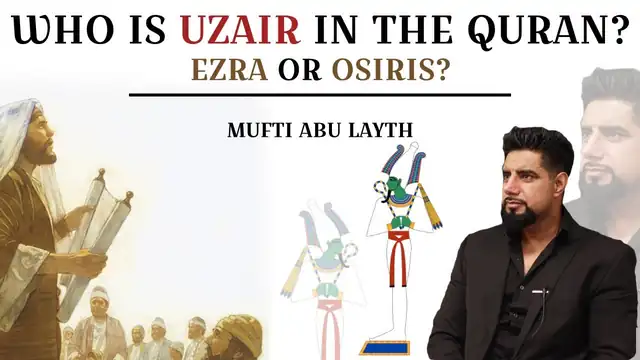 Play from 14:29
The video loads from YouTube only when you press play. Click a time in the transcript to seek.
Watch this part
Open on YouTube at 14:29The player starts at 14:29, the beginning of this part.
This segment14:29 to 19:24 · 4 min 55 sGeneral teaching
What this part covers
machinesummary, machine-writtenMufti Abu Layth says Moses' staff partly reflects the Pharaonic culture he grew up in, and that keeping cultural practices is fine without affiliating with paganism.
In more detail
Mufti Abu Layth, saying many may disagree with this interpretation, reads Surah Taha 20:17-18, where Allah asks Moses what is in his right hand and Moses replies that it is his staff, on which he leans, with which he tends his sheep, and for which he has other uses. Mufti says the usual explanation is that Moses was a shepherd, but he thinks the staff partly reflects the Pharaonic culture Moses grew up in, where the pine-cone staff symbolised Osiris. Mufti feels Moses recognised this and so justified having the staff instead of simply naming it. Mufti says this shows there is no harm in keeping aspects of a culture, even pagan ones, as long as one does not affiliate with the paganism. Mufti concludes that Uzair in 9:30 being Osiris makes far more sense to him than the forced fit of Ezra.
Position stated
Mufti Abu Layth says he thinks part of Moses' staff was the culture of the Pharaohs he grew up in, where the pine-cone staff symbolised Osiris.
“I actually think part of this stick thing was the culture in which Moses grew up with the Pharaohs see the Pharaohs this stick and especially the pine cone staff was symbolic of Osiris”
Category: historical claim
Kind: general teachingTranscript
machine14:29 to 19:24 · click a time to seek · dotted terms open the glossary
the time in their language so hence were are literally a hoot or zero nip number so the early Jews had said that about Osiris and speaking on how much this culture of Osiris was embedded in Egyptian surroundings and Egyptian understanding is I speaking of the staff thing this the stick I want to take our attention to I know many people may disagree with me on this interpretation yeah but I want to take our attention to
surah taha yeah so you've got verse 17 yeah Allah addresses Moses and he says what man till capya me Makia what is that that you hold in your right hand [Laughter] you see now this verse is incredibly interesting why because what does moosa aleihsalaam respond with you see he says all I hear are sunny aasaiya he said that this is my staff my stick that a
Tabaco i Lee had that I you know I lean on it and what a host should be allowed under me and I use it when I'm you know seeing to my attending to my flock of sheep I will kind of use this stick and wall efe have Mahara and he says and I have other needs with this sticker so why do you think that you see the general understanding is that Moses why did he have this staff oh because he was a shepherd fair enough
I actually think part of this stick thing was the culture in which Moses grew up with the Pharaohs see the Pharaohs this stick and especially the pine cone staff was symbolic of Osiris that Osiris this thing this is nice that this is what he had and hence the Pharaohs all had it this kind of staff and Moses Elise and I'm grew up in that culture that this was the the power thing this was the slick thing this was the awesome thing to do to have a kind
of a stick like that and in some ways I feel that that's what Allah kind of just highlights not to criticize but to show that look that kind of connection and in these verses I feel Moses recognizes that and hence he doesn't answer it like that he says because Allah says it warmer tilaka be a meaning I am Muslim and what is that by the way in your right hand Carla here are saya he says it's my stick he could just stop thee he goes on
to justify why he has he to what Co Ali you know I mean on it how should be how I live under me I tend to my flock with it wali Fe inaudible ha you know and I've got other needs in his collar LT I am you know crappie and and then it appears to move now you see to me this verse demonstrates one the the kind of culture of the of the Pharaohs in which Moses grew
and he also shows on other coming back to a question we're looking at earlier on that there is no harm in having certain aspects of a culture so long as you don't really see that even if they were pagan istic but you don't see or affiliate to that paganism there's nothing wrong with that and to me this verse about Musa Allison is speaking about that so that you see with this in mind it makes perfect sense that yahood is the early Israelites and you can see when they leave Egypt in the Quran them
saying to Moses halana ila and Kamala Omaha you know they see these people worshiping statue they still have that sentiment it's still very fresh and Osiris would have been a very powerful figure so for the early Jews to think that he was a kind of he had an element of divinity to him just in the way that some if a Hindu was to convert to Islam but would still maybe hold that kind of position for arm it that makes a lot more sense to me that in this verse of
the Quran Jose is Osiris so I wanted to share that with you guys because a few people had asked me and although I had initially mentioned the Israel thing I was not too content with it myself I felt they didn't really fit nicely that it was kind of like a forced fit and this actually seems to make a lot of sense so I hope that's of some help people cool let's move on to some other questions
Paragraphs overlapping 14:29 to 19:24. Full text on the recording page.
Cite this segment
Stable id, transcript version and tier are part of the citation. Every change to a transcript is logged.Mufti Abu Layth Archive, segment 2019-12-29-S04, auto-transcribed, may contain errors. https://muftiabulayth.org/r/gdlcbtkyhgm/s/4/ (accessed 1 November 2026)
- APA 7
Mufti Abu Layth. (2019, December 29). Why did Moses carry a staff? [Video, segment 2019-12-29-S04, auto-transcribed, may contain errors]. Mufti Abu Layth Archive. Retrieved November 1, 2026, from https://muftiabulayth.org/r/gdlcbtkyhgm/s/4/
- Chicago author-date
Mufti Abu Layth. 2019. "Why did Moses carry a staff?" Video, segment 2019-12-29-S04, auto-transcribed, may contain errors. Mufti Abu Layth Archive. Recorded December 29, 2019. Accessed November 1, 2026. https://muftiabulayth.org/r/gdlcbtkyhgm/s/4/
- BibTeX
@misc{abulayth-2019-12-29-S04,
  author = {Mufti Abu Layth},
  title = {{Why did Moses carry a staff?}},
  year = {2019},
  month = {12},
  date = {2019-12-29},
  howpublished = {\url{https://muftiabulayth.org/r/gdlcbtkyhgm/s/4/}},
  url = {https://muftiabulayth.org/r/gdlcbtkyhgm/s/4/},
  organization = {Mufti Abu Layth Archive},
  urldate = {2026-11-01},
  note = {Segment 2019-12-29-S04, auto-transcribed, may contain errors}
}
Something wrong here?
Tell us what is wrong and it will be checked against the recording. Nothing changes until a person has reviewed it.
Sending a note needs JavaScript, which is off or unavailable in this browser. Nothing has been sent.
No name, email address or account is asked for or stored, and the inbox does not store your IP address. For rate limiting it keeps an unreadable fingerprint of your connection for 48 hours, and our database provider's own logs record connections as every website's do. Only your note, its kind, the page and the moment in the recording are kept, for review.