
Preservation of The Quran & The Farahi School | Mufti Abu Layth
hadeeth ahadith ahaadeeth hadis hadees ahaadith muftis sanad isnaad asanid chain of narration koran quraan al-quran tilawah tilawat tilaawah sahaba sahabi sahabiyyah sahabiyat ulama ulema ulamaa ummah umma ummatvideo · 7:58 · 7,900 views · 28 Dec 2020 · Open on YouTube
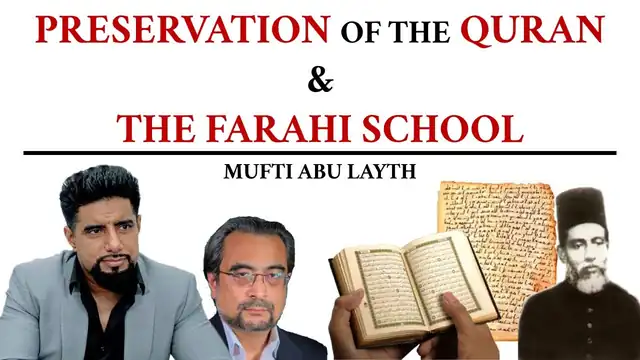 Press play to load from YouTube. Nothing loads until you do.
Transcript
machineauto-transcribed, may contain errors · source: youtube auto · click a time to seek · dotted terms open the glossarysome of the uh the questions now you have a holistic perspective uh which is I I if I'm if I can say this also RB's perspective I believe if I'm correct in that I don't want to misattribute something to him basically he's my my supervisor and teacher uh especially so my I would I can say that my work in fact if I go a little more broad I would say my work is actually an explanation of hamidin Farah's thesis on the collection of the Quran and of course the transmission which he put forth about 100 years ago and R sa is a student of one of his of his students of
fari students so it's like uh presenting The Works of far isah Andi and then elaborating some more details and incorporating some more contemporary details in the works of these three Scholars that's that's amazingly pooped so there is this Legacy uh of coming right down from uh you know right down through isah and then right now in a in a paragraph before we begin expanding uh what is the view that you espouse about the Quran so as opposed to the objections and the
counter theories just your theory or's Theory what is this when you say the Quran is preserved how would you put yours just to be clear on it and then we'll expand on the other problems and objections that people may have so the Quran was primarily preserved verbatum through the oral lore I would say and orally through memorization the Quran was committed to memory and uh thousands of the sahabah they committed it to memory uh the S were secondary because you see uh uh in those times the diacritical marks and the vowel marks although they were
present but they were sparingly used uh and uh everything that was written followed that oral recitation so the primary mode of recitation if we uh uh if you talk about it in very secular terms is that a very large number of people memorized various parts of the Quran some of them whole part some of them partially and then they transmitted uh that oral uh recitation to the Next Generation so it's it was like a generation to generation transfer it was not like a few people transmitting to a few people and precisely this is what we call Tat in in our in our in our I would say a religious term although the term
the is not just religious it's historical which means that such a vast number of people transmit something that their collusion on falsehood is virtually rendered illogical and impossible so it was like saying that thousands of sahabah committed the Quran to memory and passed it on to the next generation and to the Next Generation and this is like a pyramid uh which is continuously coming down and expanding its base and the topmost pyramid the topmost section of the P pyramid itself consisted of such a large number of people as uh you can say that it was safely and securely transped to the Next Generation and since then this process
has been continuing on and on and this is something very unique to the Quran because you'll not find any other book being committed to memory in such a large number and then being transmitted and the written recitation was actually which followed the oral recitation so whatever you were was speaking or whatever you were reciting was put to the pen and the paper or uh of and various various instruments of those times and it always needed the testification or the testimony of a half is to say that whatever has been written is correctly written so you see it was basically a novel way of transmitting something the Quran I would say uh which
was of course not very novel in the culture in which the Quran originated you would be knowing that the Arabs basically they were people in whom orality was a very very common thing so they would have these gen Genies learned by heart Abu Bakr himself was a was a genealogist who had all these genealogies in his head and they used to rely on on this memory on this prodigious memory this is how you know even some people today like I was listening to Professor Keith small who's also somebody uh very uh involved in Quran kind of manuscripts and he was saying as well that it's very clear from
how the early manuscripts are that it's very clear and evident self-evident that there was a very strong oral tradition and this was simply like a kind of code to help people to nudge them along it wasn't actually something like people trying to I mean I just thought that's a very it just goes in with what you're saying so okay so the oral tradition was there this part okay I think very few people would doubt that um the prophet sallallah alaihi wasallam in his lifetime thean is complete and it's being taught to the uh
companions he passes away uh sallallahu alaihi wasallam what in your belief happens then in in as part of this paragraph before we expand on the some of the maybe the difficult objections or problems so you see a very unique method was adopted in the transmission of the Quran so if you ask me what happened at the death of the Prophet or what was the status of the Quran at the death of the Prophet I will say that it was with the living tradition of the Muslims it was being written it was being taught it was being read it was being memorized it was being done uh like a comparative text as
well so all kinds of things which are uh which which living tradition of any religious community was would have was possessed by the Quran so at the time of the prophet's death there were students of the Prophet who had WR written it down but the prophet never left an officially compiled written Quran that he never did and I think that was very wise thing as well because protecting something written is not easy uh all things can creep in in in a society where we have so many things and the custody of that mus would have been become would have been very difficult and over a period of time it would have just rotten away so this was this was just partly adopted that written culture
was there but it was never relied upon and the prophet never gave a written sort of a Quran to his companions the companions themselves wrote it wrote it down for them so it was basically like students taking notes and then uh all of them comparing those notes to each other and coming up with the same result and the the way the prophet himself received the Quran was oral he never wrote it down for himself we know that he was not conversent with reading and writing so I mean not writing he would he he could understand so he just got it from Gabriel and the way he got it from Gabriel was that oral tradition and he transferred it exactly in the manner that he received it from Gabriel and this is how the Quran was transferred so
the story that what the Cals did after the prophet's demise like for example did Abu Bakr write a mup or did Usman made copies I think they are grossly inflated and misrepresented and misinterpreted all that they did was they just spread the Quran which was already there be being responsible Cals of their uh of their Kingdom they wanted it to expand and for new Muslim converts and there was there were Wars going on there were people coming into the Falls of Islam and they wanted more copies of the Quran so what they did was just they spread far and wide these copies of the Quran but the stories which are mentioned in bukari and in in some of
the other Hadith books regarding how the Quran came to be compiled I've shown in my research that they lack uh not only in their isnad a lot of problems but in the content as well yeah there's a lot of conflicting narration as well and you show that so so well in the book right
Something wrong here?
Tell us what is wrong and it will be checked against the recording. Nothing changes until a person has reviewed it.
Sending a note needs JavaScript, which is off or unavailable in this browser. Nothing has been sent.
No name, email address or account is asked for or stored, and the inbox does not store your IP address. For rate limiting it keeps an unreadable fingerprint of your connection for 48 hours, and our database provider's own logs record connections as every website's do. Only your note, its kind, the page and the moment in the recording are kept, for review.
Cite this recording
Stable id, transcript version and tier are part of the citation. Every change to a transcript is logged.Mufti Abu Layth Archive, auto-transcribed, may contain errors. https://muftiabulayth.org/r/bwmh6zln9xw/ (accessed 1 November 2026)
- APA 7
Mufti Abu Layth. (2020, December 28). Preservation of The Quran & The Farahi School | Mufti Abu Layth [Video, auto-transcribed, may contain errors]. Mufti Abu Layth Archive. Retrieved November 1, 2026, from https://muftiabulayth.org/r/bwmh6zln9xw/
- Chicago author-date
Mufti Abu Layth. 2020. "Preservation of The Quran & The Farahi School | Mufti Abu Layth." Video, auto-transcribed, may contain errors. Mufti Abu Layth Archive. Recorded December 28, 2020. Accessed November 1, 2026. https://muftiabulayth.org/r/bwmh6zln9xw/
- BibTeX
@misc{abulayth-BWmH6ZlN9Xw,
  author = {Mufti Abu Layth},
  title = {{Preservation of The Quran \& The Farahi School | Mufti Abu Layth}},
  year = {2020},
  month = {12},
  date = {2020-12-28},
  howpublished = {\url{https://muftiabulayth.org/r/bwmh6zln9xw/}},
  url = {https://muftiabulayth.org/r/bwmh6zln9xw/},
  organization = {Mufti Abu Layth Archive},
  urldate = {2026-11-01},
  note = {Auto-transcribed, may contain errors}
}