
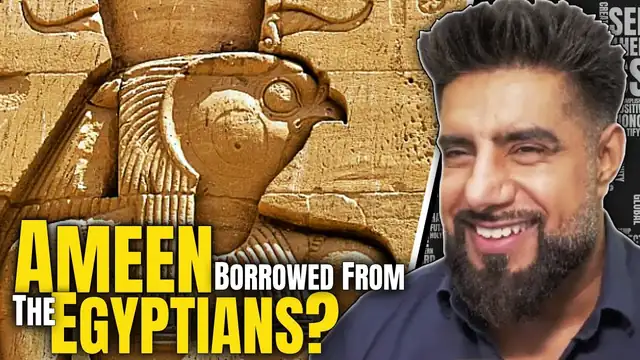
Was The Word "Ameen" Borrowed From The Egyptians? | Symbols Of Devotion | Mufti Abu Layth
tafseer exegesis tafaseer commentary qiblah kiblah kibla direction of prayer ka'bah ka'ba kaabah muftis dalil daleel adillah adilla evidence shirq mushrik mushrikin polytheism imaan eemaan eeman koran quraan al-quran aya ayat ayaat aayah aayat sahabah sahabi sahabiyyah sahabiyat companions madinah madina al-madinah madeenah yathrib aalim scholar deen ad-deen ad-din religion ibadah ibada ibaadah ibadatvideo · 12:17 · 3,000 views · 12 Apr 2022 · Open on YouTube
 Press play to load from YouTube. Nothing loads until you do.
Transcript
machineauto-transcribed, may contain errors · source: youtube auto · click a time to seek · dotted terms open the glossarypeople were wondering, does the term So, there were this term amen that was um the person's name that just questioned. But, this is Amin. Is Your name is Amin. But, as we write like Amin, amen, um this term that is used across the Abrahamic faiths.
So, from the Judeo-Christian tradition right down into Islam. So, but Hebrews, Christians, Muslims, they all use this Amin. And there was some this discussion. I'm sure if you go on YouTube, you'll find lots of it. That people have have tried to have have attempted to argue that purportedly this is Amun, the Egyptian sun god, Amun-Ra.
And because his name without the vowels could be Amin, Amun, Aman, it could be because they don't write the vowels. And that the Hebrew people, the Israelites, picked this up when they were in Egypt as part of their generational development.
And people have argued that this then took on a meaning with them. And then it was passed from them to the Christians. And it was passed right through the Middle East. And And it became this word, which means People generally say that So, in Arabic, the linguists say it means it's a It's a ism fi'l. Okay, they call it an ism fi'l, which is a noun that um an imperative noun.
So, a noun that has a command to it. Or a We say command or an imperative in grammar. So, what that means is istajib. Reply, please. So, Allahumma, you know, Allahumma amin. Ya Allah, please accept. So, people have attempted to cast doubt and and I I would say, "Look, these things firstly the it's not categorical that they they that this must mean Amun-Ra.
Uh but even if it did, even if, let's say, 3,000 years ago from 4,000, sorry, 3 and 1/2 thousand years ago from today, when the Israelites were in Egypt, that they did adopt this word, let's say, if that was the case even. And there isn't compelling right now, I mean, from where we stand yet, from what we have of Egyptology, there isn't compelling proof that this is from that.
This is an argument that people have put forward, and there are quite a few videos about it on YouTube. And some people seeing it as a tragedy and a betrayal to the faith and shirk and all these kind of things. And and others saying this is propaganda and all this. But the point is that even if this is of that origin, it doesn't matter because words are a social construct.
See, words evolve over time. So, it doesn't mean that today we may use a word and it may have a similar So, it may have meant something slightly different in the past. It may today mean something bad. It may today mean something good. You know, today not just today, a lot of terms that were So, for example, people use the term wicked, bad, you know, uh as like as positive terms.
You know, that's wicked. You backtrack a few generations and that was a negative term. So, words are they exist. Language is a social phenomenon. It is a social construct. There's no such thing as Wittgenstein had argued that as a private language. It doesn't exist.
Language exists only publicly as a social phenomenon, an epi-phenomenon. So, the So, words over time may adopt different meanings and they may come to be used in different ways. Okay, so, it doesn't matter. The point is what it means in this context, not what did this word mean?
So, if you take many English words today and you go back just 400 years, 500 years, you'll see that oh, this word is taken from French and this word is taken from Latin and it meant something different there and it meant something different here and it means something different there and it does But, that's irrelevant. That what does it mean today? So, that's what's important.
Okay, so, I I thought it's I was just reminded by um by the name, I mean, that it doesn't So, I thought I'd just shed some words that these things, what is relevant is you today and your devotion. That your devotion to God.
You see, and and a beautiful reminder for that, seriously, I think it's it's so overwhelmingly wow. It's in the Quran where Allah says, "They ask you about Safa and Marwah." That And Allah says, Inna Safa wal Marwata min Sha'a'irillah. You see? And if you read the tafsir like Kurtubi and different tafasir, if you read Fakh al-Din al-Razi, I believe, and Ibn Ashur as well.
But, Kurtubi I believe highlights the discussion as well. The reason they were asking is because many pagan Arabs used to worship certain gods on Safa wal Marwah. And especially um What was it? Isaf wa Na'ila. The two estranged lovers that were on each of these mountain tops or mounts, not mountains, but mounts, uh hills. And they were distanced by the wrath of God.
So, there was this Jahili kind of myth that existed. And You see, so several there were several. I don't know, it's difficult to say whether they were majority or minority, but uh mufassirin like Kurtubi and other people will say that people some people from the Ansar from Medina, from the Sahaba of the Prophet Sallallahu Alaihi Wasallam, they um clearly understood this Safa wal Marwah had mythological beliefs associated with it.
It had these, you know, these kind of false gods. So, this verse I think this verse is so beautiful as an axiom in life. Take it wherever you want. But, just look at how Allah answers this. Because some people may believe that look, at wal Marwah, it goes back to Ibrahim Islam and Hajar.
Going through so that's one um narrative associated with it. The other narrative is no, it goes back to these two figures who were kind of uh blasphem- profane and they were lovers and they were distanced by the wrath of God and then the pagans used to go between them. So, now the question is they asked the prophet and Allah reveals in the Quran Inna Safa wal Marwah ta'min Sha'a'irillah.
Allah. You see, people when they are saying these things, when they are going towards cuz which people? Obviously, the Muslims now because it is the Muslims that were going there. When they are going between these mounts, when Muslims today are using the word "Ameen", when Muslims today do certain Let's say we point towards the Qibla, when we do certain acts, these are Sha'a'ir, these are symbols.
It's symbols, ain't they? They These are symbols that reflect back or symbolize our devotion to God. They in and of themselves, nobody worships a mount. Nobody worships the Kaaba. We don't worship the Qibla. We don't worship these things.
We don't worship a mushaf, the Quran. We worship Allah through these means, by reciting, by praying, by pointing, but these are symbols. Sha'a'irallah. Faman tatawwa'a bihima. Whosoever saw these and here the tawwa doesn't mean whoever does it voluntarily. In Arabic the tawwa can mean voluntarily.
This means whosoever treated this as a tawwa. See, if you considered a devotion here. Take this as seriously a an axiom, a qanun for life.
In this verse that Allah has given you. That whosoever is devoted to God. By this by these symbols. Symbols don't Symbols are just symbols. You know what? You've got Somebody could say, "Well, this is a book and this is the Quran." To somebody they're just both books. Somebody that doesn't come comes across the Quran for the first time it's a book to them.
Somebody sees the Kaaba for the first time they see a building. They don't know they just Let's say they've never understood Islam, don't know what it is. They just see a building, a cube-shaped building. It's not the thing, it's the devotion. It's your iman that that sparks that life. Allah Now, look at this.
Allah is grateful. I mean, does it get any better than that? Allah is grateful to you. Allah doesn't need to be grateful to you to anyone. Allah is grateful. Wa Alim. Why Why Alim? Why end it with Alim? Because you might have some question You might have some But what am I doing or what has this person said, but you know, what if yeah, I'm devoted, but this person is saying, you know, I don't Allah knows.
Relax. You know, Kalimate. Don't worry, Allah knows. So, you just concern yourself with the devotion. The rest, leave it to God. So, that's I think it's a, you know, a beautiful lesson from the Quran, which extends far beyond the ayah in itself and it's it's a it's a canon.
It's a canon for life that we take with us.
Something wrong here?
Tell us what is wrong and it will be checked against the recording. Nothing changes until a person has reviewed it.
Sending a note needs JavaScript, which is off or unavailable in this browser. Nothing has been sent.
No name, email address or account is asked for or stored, and the inbox does not store your IP address. For rate limiting it keeps an unreadable fingerprint of your connection for 48 hours, and our database provider's own logs record connections as every website's do. Only your note, its kind, the page and the moment in the recording are kept, for review.
Cite this recording
Stable id, transcript version and tier are part of the citation. Every change to a transcript is logged.Mufti Abu Layth Archive, auto-transcribed, may contain errors. https://muftiabulayth.org/r/ayximckvlh4/ (accessed 1 November 2026)
- APA 7
Mufti Abu Layth. (2022, April 12). Was The Word "Ameen" Borrowed From The Egyptians? | Symbols Of Devotion | Mufti Abu Layth [Video, auto-transcribed, may contain errors]. Mufti Abu Layth Archive. Retrieved November 1, 2026, from https://muftiabulayth.org/r/ayximckvlh4/
- Chicago author-date
Mufti Abu Layth. 2022. "Was The Word "Ameen" Borrowed From The Egyptians? | Symbols Of Devotion | Mufti Abu Layth." Video, auto-transcribed, may contain errors. Mufti Abu Layth Archive. Recorded April 12, 2022. Accessed November 1, 2026. https://muftiabulayth.org/r/ayximckvlh4/
- BibTeX
@misc{abulayth-aYXiMcKvlH4,
  author = {Mufti Abu Layth},
  title = {{Was The Word "Ameen" Borrowed From The Egyptians? | Symbols Of Devotion  | Mufti Abu Layth}},
  year = {2022},
  month = {4},
  date = {2022-04-12},
  howpublished = {\url{https://muftiabulayth.org/r/ayximckvlh4/}},
  url = {https://muftiabulayth.org/r/ayximckvlh4/},
  organization = {Mufti Abu Layth Archive},
  urldate = {2026-11-01},
  note = {Auto-transcribed, may contain errors}
}