
Urdu Poetry & Paradox Of Profanity Fani Badayuni, Mir Taqi, Abdulhamid Adam | Mufti Abu Layth
ka'bah ka'ba kaabah muftis jahannam jahanam jahannum taqwa taqwaa muttaqi god-consciousness ibadah ibada ibaadah ibadatvideo · 9:58 · 2,100 views · 20 Dec 2021 · Open on YouTube
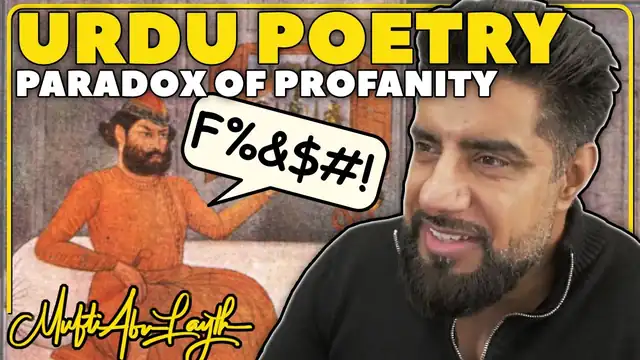 Press play to load from YouTube. Nothing loads until you do.
Transcript
machineauto-transcribed, may contain errors · source: youtube auto · click a time to seek · dotted terms open the glossarythere was a poem i had here somewhere i did think you know what i saw this poem ah shall we uh i don't know if we should this is one of anybody uni arabic means perishing from the word fana okay so as i would tell you usi
no see to advise you to self to annihilate the ego and the love of god before you perish by his command but he says i suppose i'll read that another day because i think we've kind of moved on from that point otherwise he'll just keep going back but he's an epic poet i i tell you who i have been
going through recently as well that's uh abdul hamid adam i absolutely love abdulhamid he's amazing honestly oh his poetry he really let me think of some that he um that he says he really uh he likes to provoke as well you see he's one of those provocative but that's the poets do that you see the poets do that because it's it's power it's a paradox it's the motif of paradox that is adopted in poetry so what they do is they they
it's they tease easily they tease with this motif of power of of the paradox of taboo that they push the boundaries of taboo to unsettle but then to reconnect you with the divine because especially when they're speaking about divine stuff you'll get um people like abdul hamid adam he says many all of them me and all these people they have this
constant trope of uh of the taboo and they they intertwine that into the paradox so they will so for example me saying um uh what is uh says
you see that after there is it's actually in a classical arabic word as well meaning a kind of temple of but he's using it to differentiate it from muslims [Music] you see all of a sudden he says after leaving the day that temple meed has come to the kaaba and and that's you see it's taking this avenue and then what he does is he
he applies the paradox pushing the table he says whosoever god wants he corrupts and you're like what you see it's the the volta it's the turn that you think you're not expecting it but in that taboo what he's doing it's the it's the the paradox of profanity but he's pushing your your kind of safety zone your comfort to make you question once again that you're not just falling into meaningless superstitious worship are you
that ultimately it is still god you see because he's affirming god it's it's a huge it's an immensely you know when you go into the the the kind of the algorithm of what the poets are doing it's very deep it's not just like some people they oh my god that sounds profane on some levels of course it's superficially profane but that's how they you see that's how they get in to make you question once again existentially and not just to simply blindly
submit but to holistically submit to the will of god it's amazing and you see abdul hamid adam has loads like that as well and he says that in what environment with what truthfulness what wow what did we remember
hamko [Laughter] that he says it was at the doorstep of the place of idolatry
is a place where idols are killed one could also say it's it's a term the poets used for you know for beautiful people for women that were had of astounding uh beauty they used to call them but as well in urdu and also which also means an idol because they were kind of it's the same it's the reason goddesses are called that but that's what you do but he's saying that at the doorsteps of this place of idolatry of idols i remembered god allah
you see once again like just tampering on the profane bringing in the paradox but thereby reminding you of the divine it's it's incredible and they do that and they do it so effectively and they don't want you to get lost in in these symbols they want you to understand that there is a greater like don't get lo don't lose yourself in the symbols try to aspire to something higher the divine so this is why the the kaaba is often a common motif a common trope
used in urdu poetry so abdul hamid adam in that same poem i believe he goes on to say um he says um there see the dear and the kaaba is often one there's this juxtaposing of the two as a motif amongst many urdu legendary poets like all of these often me
you know so all these kind of people mom and khan mummy and all these great people will use this adam so so he says that he says that amongst the temple i found god you see that even if i was surrounded by idols he's saying that i saw my connection with god it it
i found it in a place where you'd least expect it you see you've you're lost in the world you're in all these things you're submer you know you've submerged you're drowning you all these things are happening this is not the place you'll find god but he found god he said never give up on hope and then he juxtaposes it with the paradox of the prophet
he says and what is the in the cabbage is a stone the black stone you see showing that don't take your piety for granted you don't want to become somebody that is ultimately no different because of your arrogance it's as though you're just worshiping a stone that whatever and whenever we remembered it was always
on point and with great accuracy see oh it's amazing honestly i could just get lost in poetry for for so long i i get into like in you know when i hear it i guess i get proper excited it like brings me to life it animates me i love listening to this kind of poetry and listening to people talking about it
Something wrong here?
Tell us what is wrong and it will be checked against the recording. Nothing changes until a person has reviewed it.
Sending a note needs JavaScript, which is off or unavailable in this browser. Nothing has been sent.
No name, email address or account is asked for or stored, and the inbox does not store your IP address. For rate limiting it keeps an unreadable fingerprint of your connection for 48 hours, and our database provider's own logs record connections as every website's do. Only your note, its kind, the page and the moment in the recording are kept, for review.
Cite this recording
Stable id, transcript version and tier are part of the citation. Every change to a transcript is logged.Mufti Abu Layth Archive, auto-transcribed, may contain errors. https://muftiabulayth.org/r/8rdaj0a1zvc/ (accessed 1 November 2026)
- APA 7
Mufti Abu Layth. (2021, December 20). Urdu Poetry & Paradox Of Profanity Fani Badayuni, Mir Taqi, Abdulhamid Adam | Mufti Abu Layth [Video, auto-transcribed, may contain errors]. Mufti Abu Layth Archive. Retrieved November 1, 2026, from https://muftiabulayth.org/r/8rdaj0a1zvc/
- Chicago author-date
Mufti Abu Layth. 2021. "Urdu Poetry & Paradox Of Profanity Fani Badayuni, Mir Taqi, Abdulhamid Adam | Mufti Abu Layth." Video, auto-transcribed, may contain errors. Mufti Abu Layth Archive. Recorded December 20, 2021. Accessed November 1, 2026. https://muftiabulayth.org/r/8rdaj0a1zvc/
- BibTeX
@misc{abulayth-8rDaJ0a1zvc,
  author = {Mufti Abu Layth},
  title = {{Urdu Poetry \& Paradox Of Profanity  Fani Badayuni, Mir Taqi, Abdulhamid Adam | Mufti Abu Layth}},
  year = {2021},
  month = {12},
  date = {2021-12-20},
  howpublished = {\url{https://muftiabulayth.org/r/8rdaj0a1zvc/}},
  url = {https://muftiabulayth.org/r/8rdaj0a1zvc/},
  organization = {Mufti Abu Layth Archive},
  urldate = {2026-11-01},
  note = {Auto-transcribed, may contain errors}
}