
Recordings › From the Mind of a Mufti
Are the previous scriptures corrupted? | Mufti Abu Layth
muftis koran quraan al-quran wahy wahi wahee salam as-salamu alaykum assalamu alaikum assalamualaikum salaams salam alaykum wa alaykum as-salam peace greetingvideo · 4:53 · 4,500 views · 13 Aug 2019 · Open on YouTube
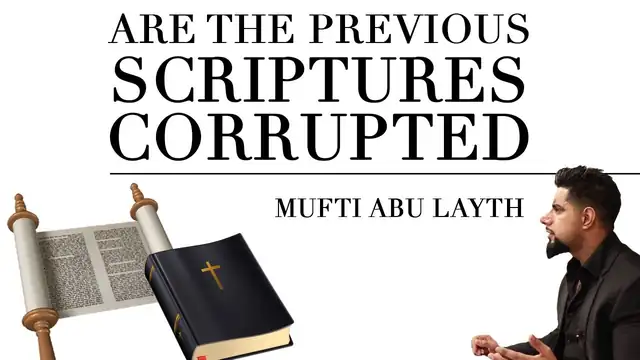 Press play to load from YouTube. Nothing loads until you do.
Transcript
machineauto-transcribed, may contain errors · source: youtube auto · click a time to seek · dotted terms open the glossaryYeah. Mhm, in the Quran, why does Allah tell the prophet to tell the people the scripture to refer to their What? To refer to their if they have been corrupted. Right, so this ties into a question which I've answered previously on do we believe that the Torah uh the previous scriptures, Jewish scriptures or the Israelites scriptures and and the Bible.
Oh, yes salaam, is that me? Right, so Right, do we feel that the Bible and the Torah and these things have been corrupted? Now, first of all, just to clarify many people may be surprised that this is a little footnote, if you like.
The Torah is not the scripture that was revealed to Moses, Musa Alayhis Salaam. Uh the Torah is a combination, it's of scriptures. Okay, so it's it's it's perhaps like saying the Jewish Bible. Okay, not all of those books were revealed to Moses.
So in the Quran, to be specific, Allah never says in the Quran that we gave Moses the Torah. And but rather that we gave him the book or we gave him revelation or we gave him the Furqan or we gave him the criterion. But it he never says we gave him the Torah.
So the Torah was to Bani Isra'il, so it includes the message of Moses and many others that come after him. So Allah does speak about the Torah and Bani Isra'il, but he doesn't say it was Musa Alayhis Salaam who received the Torah. Now So I'm not saying that the message of Moses was not a part of the Torah, it was a part, but it's not the Torah, okay, just to be specific.
So you understand that in the Torah uh you will see the the rulings like God mentioning that and we told the uh and we mentioned in uh that wa katabna fiha and in it in the Torah it was written that an nafsu bin nafsi wal ainu bil aini that a soul for a soul and an eye for an eye and a tooth for a tooth.
Um you I'm sure you're familiar with these laws. These laws were revealed much after Moses. Because these are the laws that the Israelites became acquainted with once they were in captivity and the generations that ensued under the rule or in in Babylon.
So whilst they lived in Babylon uh the century that they spent there in captivity and then maybe some of them that weren't captives, but they lived there. So the law of Hammurabi uh it mentions this. In fact, it's the actual wording of the law of Hammurabi which predates Moses. So you'll see that the the text um not text, but the kind of um um the clay tablets that have been found uh with the law of Hammurabi and these things and the Epic of Gilgamesh and these that date to almost 4,000 years
ago. Um these had w- these very laws coded with that specificity. So it mentioned that a a life for a life and an eye for an eye and a tooth for a tooth. Word for word it is exactly what is then the scripture of the Torah and then the Quran quotes that. So it couldn't have been from the time of Moses because at that time the Israelites hadn't crossed over and established the kingdom of Israel and they hadn't then later on been taken into captivity and spent several
hundreds of years in Babylon uh where they did. So just to clarify, okay, so so you guys have a a better under
Something wrong here?
Tell us what is wrong and it will be checked against the recording. Nothing changes until a person has reviewed it.
Sending a note needs JavaScript, which is off or unavailable in this browser. Nothing has been sent.
No name, email address or account is asked for or stored, and the inbox does not store your IP address. For rate limiting it keeps an unreadable fingerprint of your connection for 48 hours, and our database provider's own logs record connections as every website's do. Only your note, its kind, the page and the moment in the recording are kept, for review.
Cite this recording
Stable id, transcript version and tier are part of the citation. Every change to a transcript is logged.Mufti Abu Layth Archive, auto-transcribed, may contain errors. https://muftiabulayth.org/r/3uyzfkzg6ty/ (accessed 1 November 2026)
- APA 7
Mufti Abu Layth. (2019, August 13). Are the previous scriptures corrupted? | Mufti Abu Layth [Video, auto-transcribed, may contain errors]. Mufti Abu Layth Archive. Retrieved November 1, 2026, from https://muftiabulayth.org/r/3uyzfkzg6ty/
- Chicago author-date
Mufti Abu Layth. 2019. "Are the previous scriptures corrupted? | Mufti Abu Layth." Video, auto-transcribed, may contain errors. Mufti Abu Layth Archive. Recorded August 13, 2019. Accessed November 1, 2026. https://muftiabulayth.org/r/3uyzfkzg6ty/
- BibTeX
@misc{abulayth-3uyzFKzg6tY,
  author = {Mufti Abu Layth},
  title = {{Are the previous scriptures corrupted? | Mufti Abu Layth}},
  year = {2019},
  month = {8},
  date = {2019-08-13},
  howpublished = {\url{https://muftiabulayth.org/r/3uyzfkzg6ty/}},
  url = {https://muftiabulayth.org/r/3uyzfkzg6ty/},
  organization = {Mufti Abu Layth Archive},
  urldate = {2026-11-01},
  note = {Auto-transcribed, may contain errors}
}